Free Tax Expense Spreadsheet That Finds Your Missed Write-Offs
A free tax expense spreadsheet that maps every cost to its Schedule C line, totals your deduction, and flags the write-offs most businesses never record. No email required.


This free tax expense spreadsheet maps every cost to its line on your Schedule C, totals your deduction, and flags the write-offs you'd otherwise forget. You don't trade your email to get it. Copy it, type one row per receipt, and your deduction totals fill themselves in.
I built it because I learned this the expensive way. I spent my whole career on a W-2 paycheck, then bought Shoeboxed in late 2025. My first year as a business owner taught me that every untracked expense made my tax bill bigger.
Our own data says most owners make the same mistake. Since January 2024, 12,412 businesses have sent us 2.5 million receipts, and the write-offs they miss follow a clear pattern. The clearest example:
"Across the 4,842 businesses that sent Shoeboxed fuel receipts since January 2024, 93.5% never logged a single business mile."
Shoeboxed customer data, June 2026
They lost that deduction completely. So this spreadsheet includes a Deduction Finder tab that hunts down the write-offs you forgot.
Get the free tax spreadsheet
Copy the spreadsheet to your Google Drive →
Tap that link, sign in to Google, choose the "Make a copy" button, and you get your own private copy that only you can see. Prefer Excel? Download the Excel version instead, or print the PDF and fill it in by hand.
You get five sheets in one workbook:
- Tax Write-Off Tracker. One row per receipt. Pick a category from the dropdown and the sheet fills in the Schedule C line and the deductible amount, and cuts business meals to the 50% the IRS allows.
- Schedule C Summary. Your totals, organized by tax line. This is the one page you hand your accountant in April.
- Deduction Finder. Every Schedule C write-off as a checklist that asks one question: got records for it? The seven write-offs businesses miss most come flagged.
- Home Office Log. Both ways to figure the home office deduction, side by side.
- Mileage Log. Four fields per trip, and the sheet multiplies by the 2026 mileage rate for you.
Plus a bonus tab holding a 25%-off Shoeboxed code, good on any plan, in case you'd like us to do the typing.
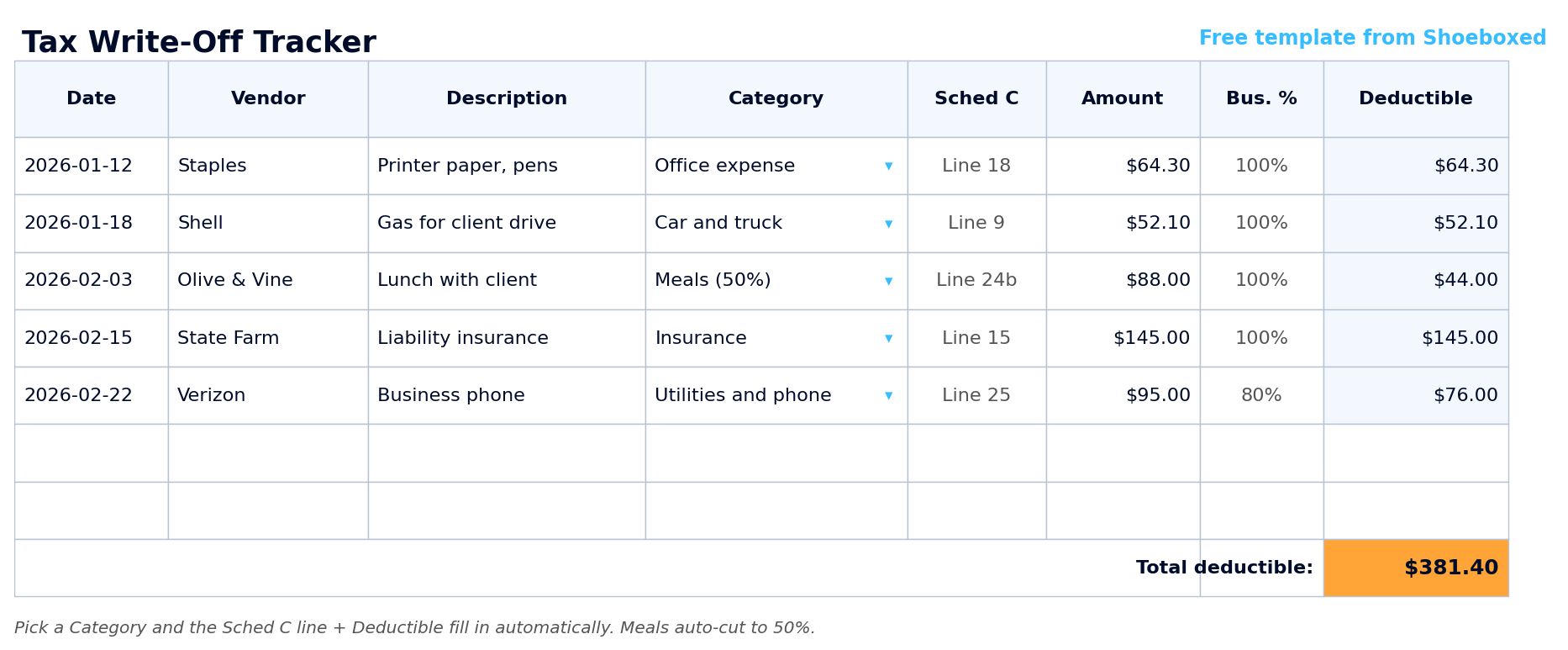 You type the date, vendor, description, and amount. The Schedule C line and the deductible amount fill themselves in: the $88 client lunch drops to $44, and the phone at 80% business use deducts $76 of the $95 bill.
If you only do one thing on this page, grab the spreadsheet.
The rest of this page covers the tax rules built into it, starting with the write-offs our data says you're probably missing right now.
What belongs on a tax expense spreadsheet
Eight columns do the work, and you only type half of them:
- Date, vendor, description, and amount. You copy these four off the receipt.
- Category. You pick it from a dropdown.
- Schedule C line. Fills in by itself, based on the category.
- Business %. Starts at 100%, and you lower it for costs you split with your personal life.
- Deductible amount. The sheet does the math.
Why does the template fill those in for you? Because our data shows what happens when people do it by hand.
Our app lets you tag a receipt with one tap. Even then, 28.7% of the 2.5 million receipts we processed never got a category. A blank spreadsheet is worse, because you type every label yourself. Here's what that looks like: people typed the same expense four different ways. "Cost of Goods Sold," "COGS," "Cost of Goods," and "Purchases Cost of Goods" all showed up in our data at the same time. Each spelling looked like a small expense nobody would bother claiming. Added together, they were real money.
That's why the category column in this template is a locked dropdown instead of a blank box. Pick "Insurance" and it lands on Line 15, the insurance line, every time. The spelling stays the same every time, so everything adds up into one number your accountant can defend.
To get every document ready for your accountant, our printable tax prep checklist walks you through what to gather.
The Business % column handles costs you split between work and home. Put 80% next to a phone you use for both, and the sheet deducts 80% of the bill. The same column works for your home internet, a shared vehicle, or anything else you use for both.
One note: this spreadsheet tracks what you spend and what you can deduct. If you also want income tracking and a profit-and-loss, grab the small business expense spreadsheet instead, and keep this one for getting your write-offs tax-ready.
Where each write-off goes on Schedule C
Schedule C is the tax form where self-employed people list their business expenses. Every cost you track belongs on one of its lines. If you've never matched an expense to a line on that form, April turns into a guessing game between you and your accountant. The dropdown answers the question for you, and the table below shows where your money lands.
| What you spent money on | Examples | Schedule C line |
|---|---|---|
| Advertising | Ads, your website, signage, business cards | Line 8 |
| Car and truck | Business miles (logged on the Mileage Log tab) | Line 9 |
| Commissions and fees | Sales commissions, referral fees you pay out | Line 10 |
| Contract labor | A 1099 freelancer, an installer, a subcontractor | Line 11 |
| Depreciation and Section 179 | Computers, machinery, big gear (often deductible in full the first year) | Line 13 |
| Insurance | Liability, property, workers comp | Line 15 |
| Interest | Interest on a business loan or line of credit | Line 16 |
| Legal and professional | Your accountant, a lawyer, a bookkeeper | Line 17 |
| Office expense | Printing, postage, software, small office costs | Line 18 |
| Rent or lease | Your shop, warehouse, storage unit, rented equipment | Line 20 |
| Repairs and maintenance | Fixing the gear and the space you work in | Line 21 |
| Supplies | Materials you use up doing the work | Line 22 |
| Taxes and licenses | Business license, permits, payroll taxes | Line 23 |
| Travel | Flights, hotels, out-of-town work trips | Line 24a |
| Meals | Business meals, deductible at 50% | Line 24b |
| Utilities and phone | Power, water, business phone and internet | Line 25 |
| Wages | What you pay W-2 employees | Line 26 |
| Other expenses | Bank and card fees, dues, anything that fits nowhere else | Line 27b |
| Home office | The space you run the business from (logged on the Home Office Log tab) | Line 30 |
| The template uses these exact lines from the 2025 Schedule C, the version you'll file in 2026. The IRS renumbers a line now and then ("other expenses" moved to 27b this year), so check yours against the form for your filing year. |
Meals get cut in half. The IRS only lets you deduct half of a business meal, and in Publication 463 they put it plainly:
"you can generally deduct only 50% of the unreimbursed cost of your meals."
The template does that cut for you the moment you pick Meals from the dropdown, so a $40 client lunch lands as a $20 deduction without you doing the math.
Big-ticket gear can be deducted in full. Buy a computer or a machine for the business and you can usually deduct the whole cost the year you bought it instead of spreading it over several years. That choice is called Section 179. Pick "Depreciation / Section 179" from the dropdown and it lands on Line 13, then have your accountant confirm it fits the year you make a big purchase.
The write-offs that never reach your spreadsheet
When we pulled the numbers for this article, I expected to find messy categories. I found something worse: whole types of deductible spending that never get recorded at all.
Across the 12,412 businesses in our data, in the two-plus years since January 2024, 90.6% have never logged an insurance payment and 88.3% have never logged a phone or internet bill. Another 77.7% have never logged a fee paid to a lawyer, accountant, or bookkeeper. Meanwhile, 45% of those same businesses faithfully track their meals.
The small stuff gets tracked, and the big write-offs walk away.
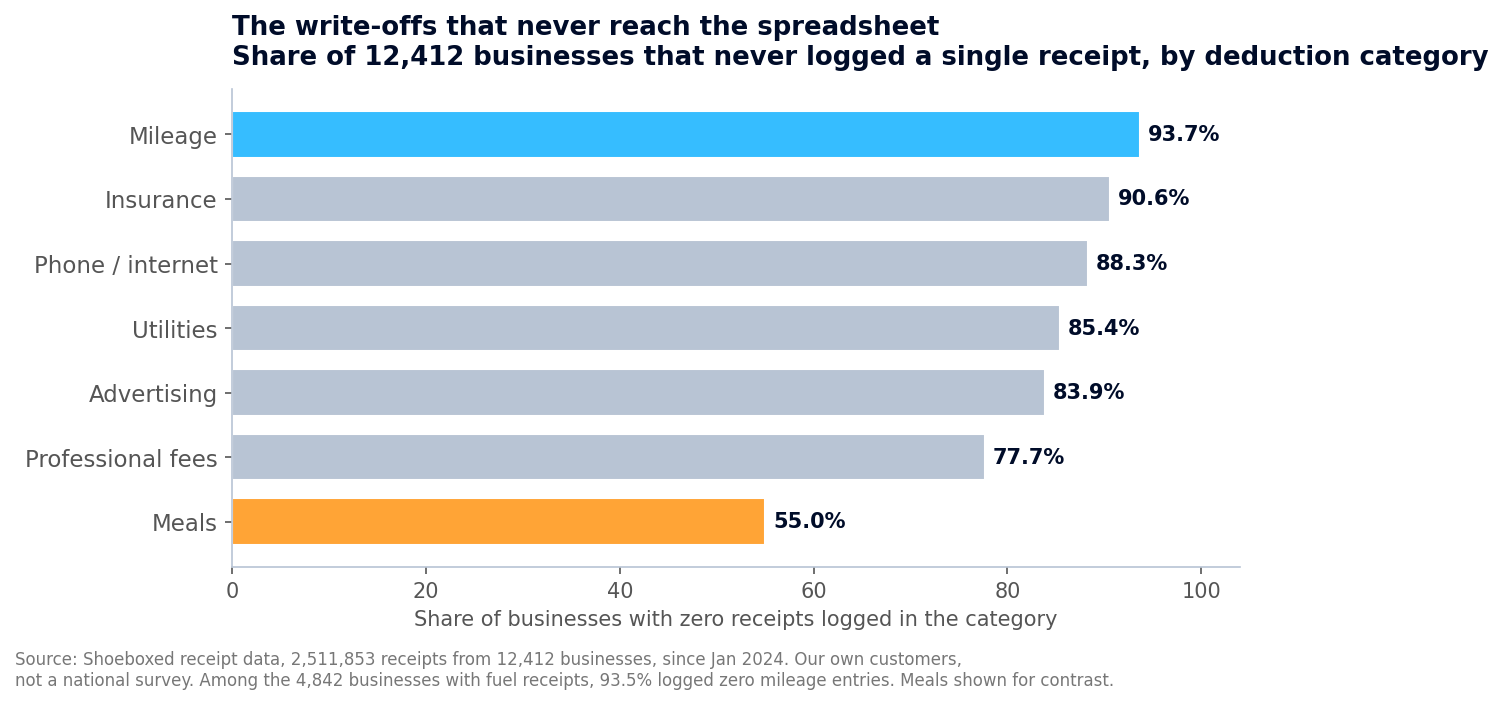 The share of businesses that never logged a single receipt in each category, across 2.5 million receipts from 12,412 businesses since January 2024. Meals sits at the bottom because the small stuff does get tracked.
These are our own customers, not a national survey. But 2.5 million receipts is a lot of data, and I'd bet the same pattern holds for your business too.
It makes sense when you look at how these costs get paid. Insurance auto-drafts. The phone bill auto-pays, and your accountant's invoice arrives in an email you read once and archive. None of them produce a paper receipt, so none of them ever make it into your spreadsheet.
That's the gap the Deduction Finder tab closes. It lists every Schedule C write-off once, asks whether you've got records for it, and flags the ones our data says businesses miss most. Mark "Not yet" next to Insurance and the tab tells you what to do next: pull your policy statements. Walk the whole checklist once before tax season and you'll know exactly which write-offs you've been leaving behind.
Home office and mileage: the two biggest deductions you can't see
Two of the biggest deductions a business owner can take never arrive as a receipt. Nobody mails you a bill for your business miles, and nobody sends an invoice for your home office. So neither one shows up in the pile of receipts you sort at tax time.
Here's the stat that gets me: of the 4,842 businesses in our data with fuel receipts, 93.5% never logged a single business mile in their records. They buy gas for work, so we know they drive for work. And the IRS lets you deduct 72.5 cents for every business mile in 2026. Drive 8,000 business miles in a year and you can take $5,800 off your taxable income.
The Mileage Log tab asks for the four things the IRS wants on every trip: the date, where you went, why, and the miles. It multiplies by the rate for you. How you lose the deduction: trying to rebuild your miles from memory next April. The IRS wants a log kept as you go, so start filling in the Mileage Log tab this week, even mid-year. And if you'd rather not type trips at all, our mileage log template guide covers the easier ways, including an app that logs your drives for you.
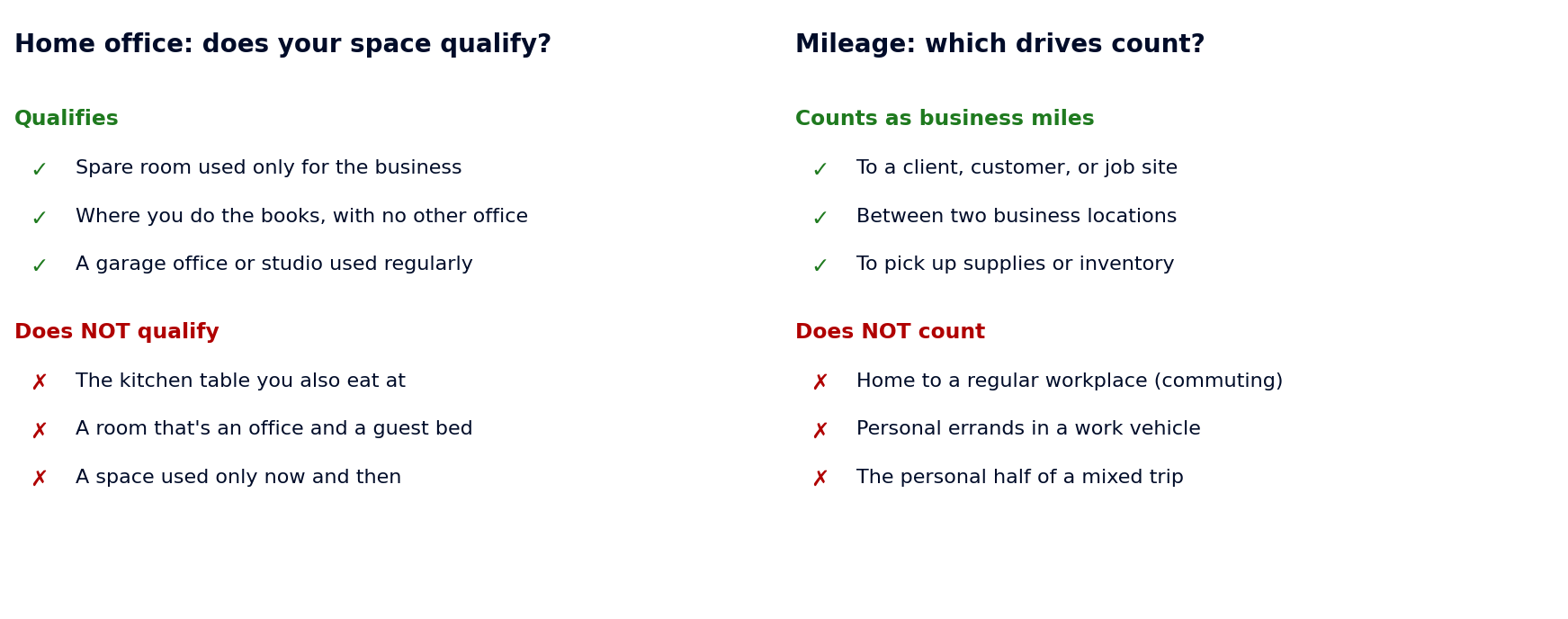 The Home Office and Mileage tabs each open with this quick check, so you know what qualifies before you log anything.
The home office is the other invisible one. Plenty of owners skip it on purpose because they've heard it's an audit magnet, but that fear is outdated. The IRS builds a simplified method into the form now, and the test you have to meet is one sentence long:
"Deduction for home office use of a portion of a residence allowed only if that portion is exclusively used on a regular basis for business purposes"
Exclusively means the space is used for business and nothing else. The spare room you turned into an office counts, and the kitchen table where the family eats does not. Pass that test and the simplified method pays $5 per square foot, up to 300 square feet. A 200-square-foot office is a $1,000 deduction.
You can take the simplified number, but it stops at $1,500 no matter how big the office. Run the actual method on the Home Office Log tab and you'll likely save more if you rent or carry a mortgage. That method deducts the business share of your rent or mortgage interest, plus utilities, insurance, and repairs, with no cap. In our data, 85.4% of businesses never logged a utility bill. Those bills are exactly what the actual method needs, which is why so much of this deduction goes unclaimed. To see your number fast, type your address into our home office calculator and it pulls your home's square footage and runs the math at your tax bracket.
How you lose the deduction: letting the office double as a guest room. One personal use of the space and it fails the exclusive-use test, so keep it business-only.
Four ways people lose a write-off they earned
I've watched good owners hand money back to the IRS over small recordkeeping mistakes, and the same four show up again and again.
Waiting until April to tag things. A receipt means nothing if you can't remember what it was for, and you forget faster than you think. How you lose the deduction: a charge you can't explain is the first thing an auditor disallows. Tag the receipt the day it happens, while you still remember which client that lunch was for.
Running the business out of your personal account. When business charges and grocery runs sit on the same card statement, tax time turns into a treasure hunt. How you lose the deduction: you can't prove the charge was business, so you skip claiming it and overpay. A separate business card turns every statement into a record.
Trusting thermal paper. Most receipts print on thermal paper, and the ink fades toward blank within a year. How you lose the deduction: the receipt fades to blank before your return is even due. Snap a photo the day the receipt prints, because the IRS accepts a digital copy that shows the same details.
Saving the amount but losing the why. The IRS spells out what a record has to show:
"Your supporting documents should identify the payee, the amount paid, proof of payment, the date incurred, and include a description of the item purchased or service received that shows the amount was for a business expense."
That last part trips people up. A $312 charge at an office supply store proves you spent the money, but says nothing about what the purchase did for your business. How you lose the deduction: no description, no deduction. The tracker's Description column exists for exactly this, and one short phrase like "trade show banner" does the job.
The easy way: skip the typing
The template is free and it works, and I stand behind it. But I'll be honest about the catch: someone still has to type every receipt into it, and our own numbers show what happens when that someone is a busy owner. Receipts pile up untagged, and whole categories never get logged, so the books quietly fall behind.
That's the whole reason Shoeboxed exists. We're a 20-year-old receipt scanning and mileage tracking service. Snap a receipt with the app, forward an email, or mail us the whole shoebox in our Magic Envelope. Our team in Durham scans the paper while the software pulls out the date, total, vendor, and category. Every cost lands already sorted, spelled the same way every time.
The mileage tracker fixes the biggest gap we found in our data. The app tracks your drives by GPS, texts you the list at the end of the day, and you reply with which ones were business. The log the IRS wants builds itself while you drive.
When I switched from a W-2 paycheck to owning this company, I found out fast how much tracking tax expenses matters, and a template only helps if you keep up with it. So the spreadsheet is yours, free, no strings. And if the typing ever becomes the chore our data says it becomes, Shoeboxed Pro runs $29 a month with a 30-day money-back guarantee. Scan a year of receipts, and if it isn't for you, we refund the money.


Frequently asked questions
How do I make a tax spreadsheet? Give yourself eight columns: the date, the vendor, a short description, the amount, the category, the Schedule C line, the business-use share, and the deductible amount. Add one row per expense as the year goes, and total by category at tax time. Or skip the build entirely, because the free template above ships those columns with the math already wired in.
How do I create a fillable spreadsheet? Fillable means the sheet does the work: a dropdown picks the category and a formula computes the deductible amount, so you type a few things and the sheet fills in the rest. In Google Sheets the menu path is Insert, then Dropdown. In Excel it lives under the Data tab, then Data Validation, then List. The template on this page arrives with the dropdowns and formulas already working in either app.
Where can I find tax worksheets? The spreadsheet on this page handles expense and write-off tracking. For the official worksheets the IRS publishes, like the estimated tax worksheet, go to the forms and instructions section of irs.gov, where each form's instructions include its worksheets.
How do I prepare an Excel sheet for an income tax return? Track your expenses all year, then roll the totals up by Schedule C line when you file. The Schedule C Summary tab does that roll-up automatically, and it's the one page your accountant needs. And if Excel is where you live all day, our excel expense spreadsheet guide goes deeper on the format side.
How long do I keep the receipts behind the spreadsheet? Three years in the normal case, counted from the date you filed, and longer in a few special situations. Keep a photo of each receipt and you can toss the fading paper.
About the author
I'm Doug. I spent my whole career collecting W-2 paychecks until late 2025, when I bought Shoeboxed with an SBA loan and 5% down. My first year as an owner taught me most of what's in this article the expensive way, which is why the template exists. Before this I ran Earth Class Mail, and I write these guides because the surest way to grow Shoeboxed is to help business owners keep more of what they earn.
30 Seconds Could Save You Thousands on Taxes
Self-employed? Get an instant, personalized tax-savings estimate.




 4.4 / 5 on