Google Sheets Expense Tracker Template: Free for 2026
Discover the free Google Sheets expense tracker template (plus Excel, PDF, and CSV), and learn how to use it. Built from 2.4M real receipts.

Google Sheets Expense Tracker Template: Free for 2026
By Doug
Last updated: May 2026
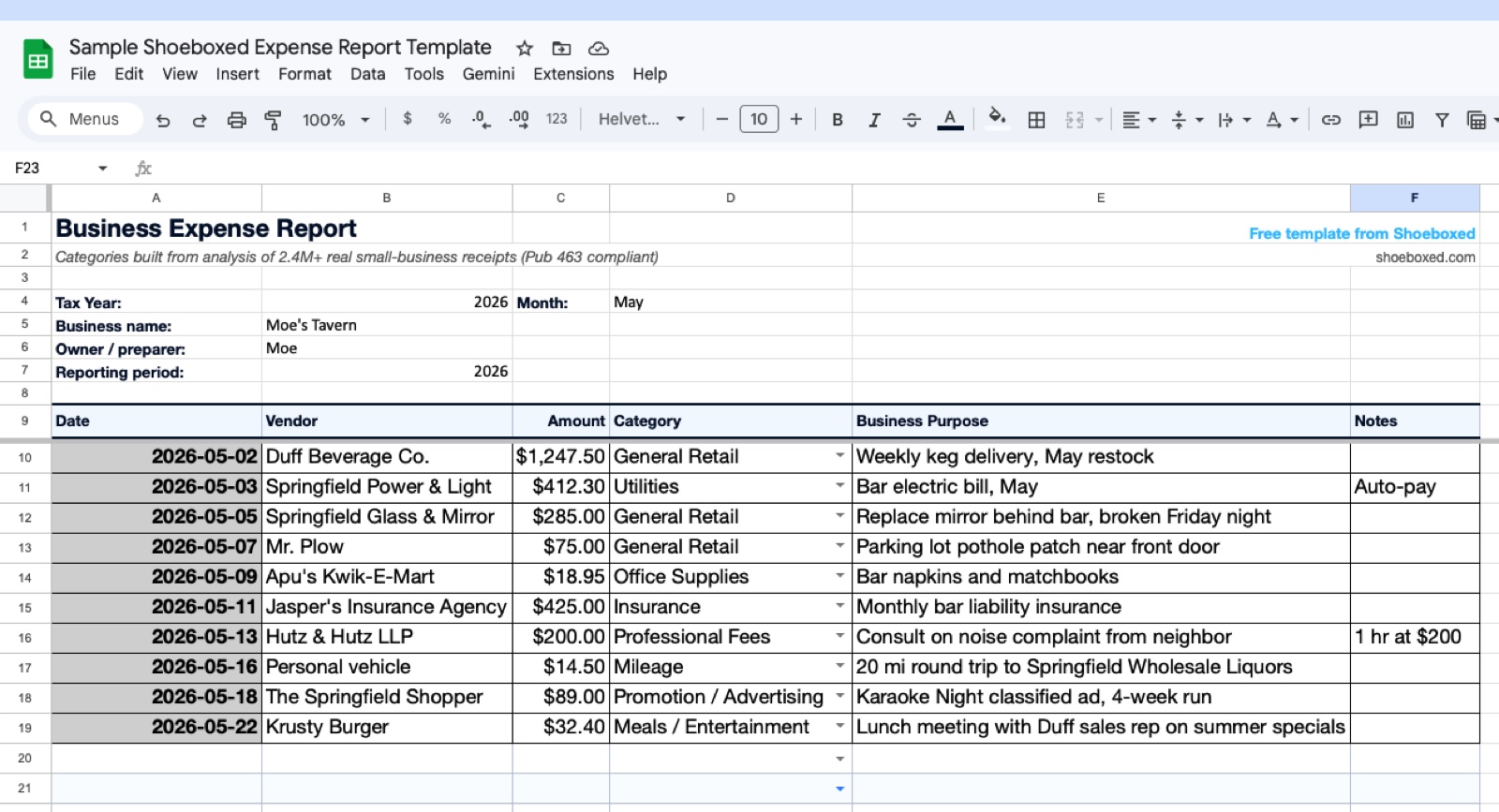
The free Shoeboxed expense tracker template, open in Google Sheets. Drop your business name in cell B5, fill rows below, the totals come along for free.
And if you're paid every two weeks, the bi-weekly budget template gives each paycheck its own column and works in Sheets too. Prefer to total things up once a week instead of waiting for month-end? The weekly expense tracker runs this same template on a 10-minute weekly review.
Prefer paper over a screen? Grab the free printable expense tracker with the same Schedule C categories printed right on the page.
I pulled 2.4 million receipts from over 12,000 small businesses on Shoeboxed and looked at what categories real Schedule C filers use. Then I built a free Google Sheets expense tracker template around what the data showed.
Click the link below, hit Make a copy , and the template lives in your own Drive three seconds later. We don't ask for your email. We don't run a free trial in the background. You just get the template. Excel, PDF, and CSV versions sit in the same block if one of those fits you better.
Working in Excel instead of Sheets? Here is the Excel version of this tracker. Run a trade with its own costs? The lawn care business expenses spreadsheet is built for landscaping crews, down to the dump fees and the mower repairs.
TL;DR, the four steps:
- Copy the Google Sheets template into your own Drive.
- Enter receipts row by row. Pick a category from the dropdown.
- Total at month-end. The auto-sum row at the bottom does the math for you.
- Save the original receipt (photo or paper). Keep records for at least 3 years from the filing date.
Get the free Google Sheets expense tracker template
The Google Sheets version sits at the top because that's what you came for. The other three formats use the exact same structure, so switching between them takes no learning curve.
- Google Sheets (one-click copy). Hit the link, click Make a copy , and your own copy lands in your Drive. Auto-totals as you type. Share with your accountant in two clicks.
- Excel (.xlsx). Same dropdowns, same formulas. Opens in Excel 2010 and later.
- PDF. Print-ready, fill in by hand or in Acrobat.
- CSV. Raw data for accountants, QuickBooks imports, or your own spreadsheet.
The template belongs to you the moment you click. We didn't build it as a lead magnet. We built it because every other free expense template we looked at shipped with the wrong category list. We had the data to know better.
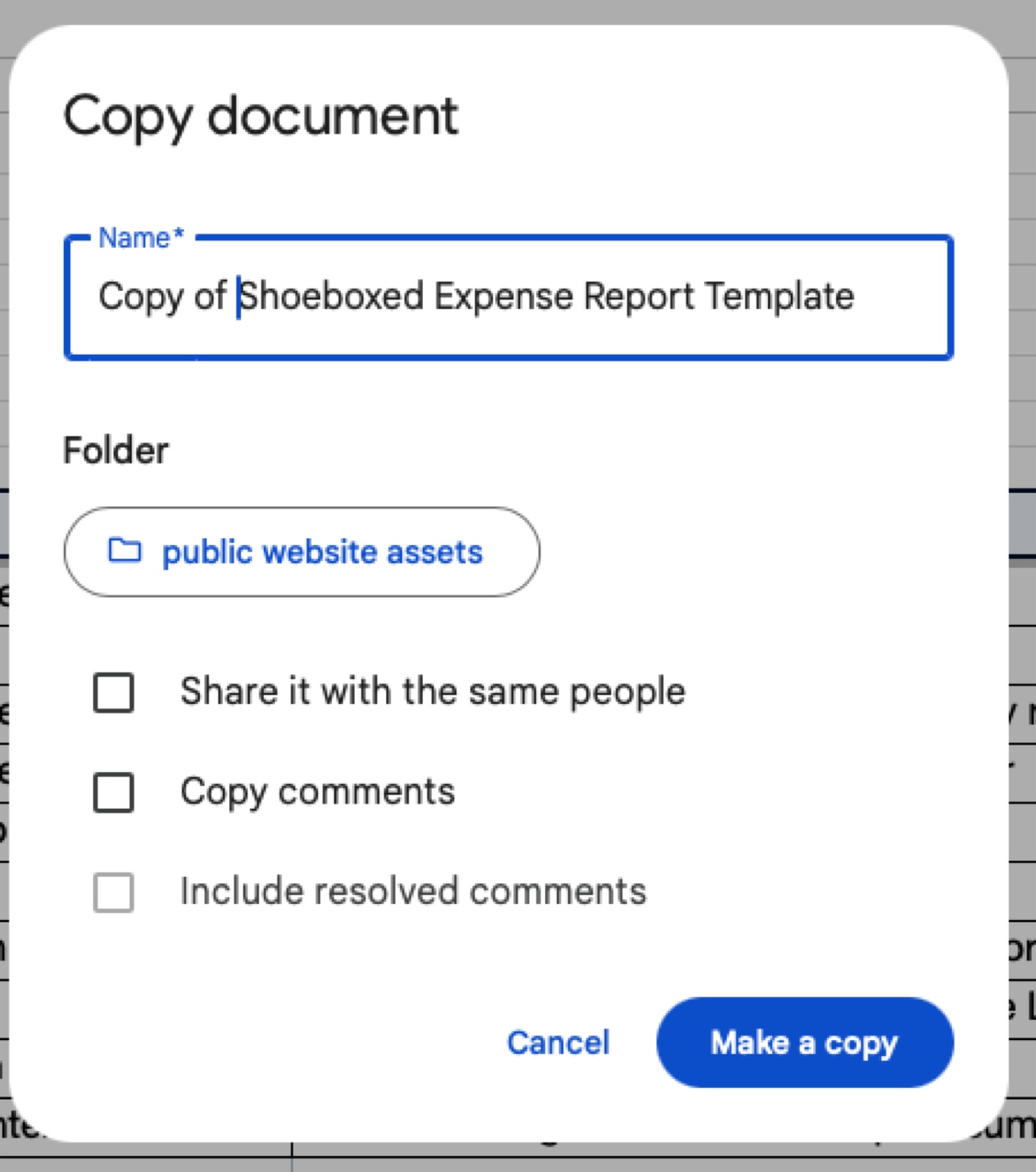 This is the entire signup flow. One click, one Make a copy, the template lives in your Drive.
The 15 expense categories real small businesses use
Here's the part most expense templates get wrong. They ship with 6 to 8 categories. That isn't enough for a real small business.
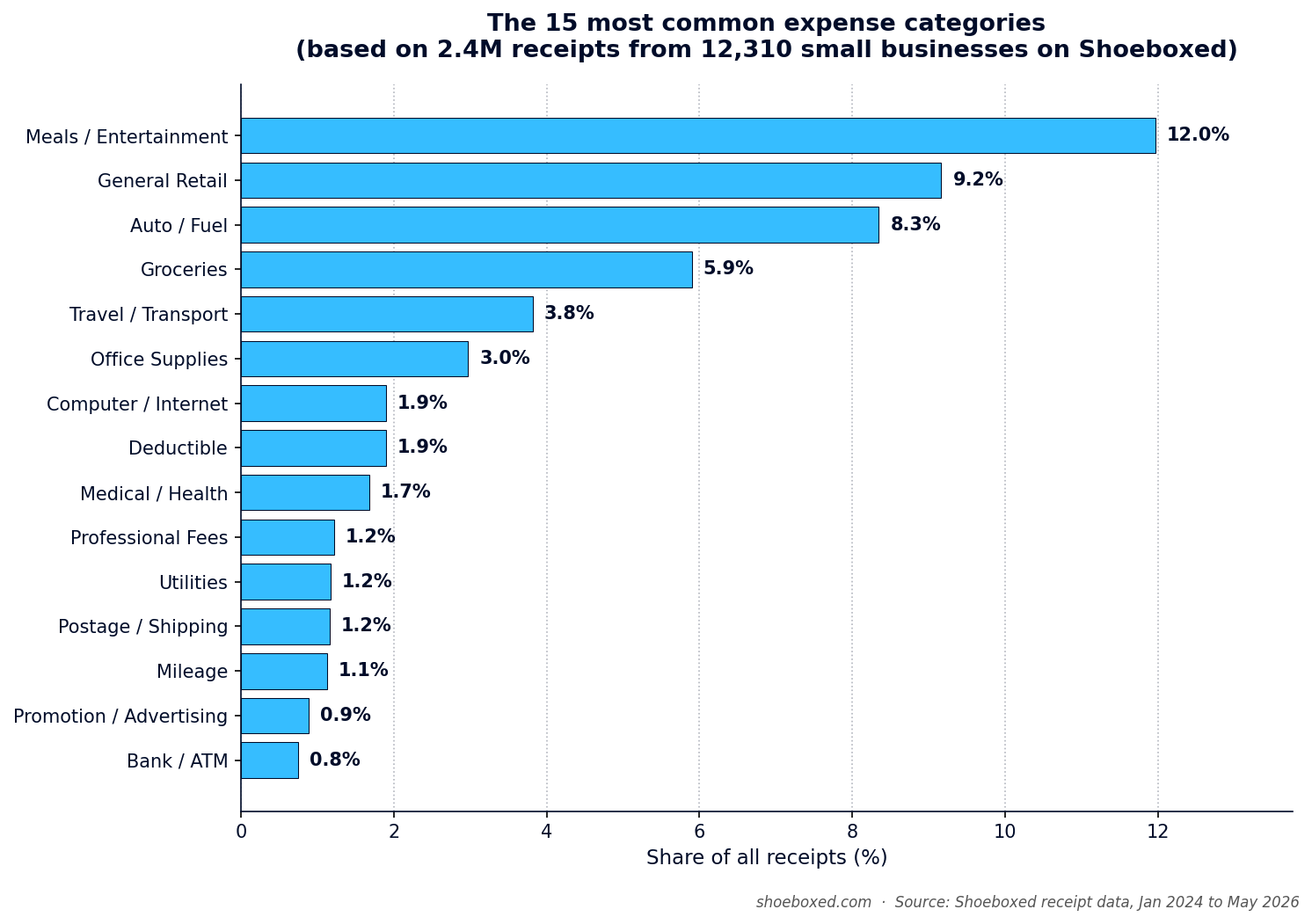
I went and looked. Across 2,429,865 receipts from 12,310 small businesses on Shoeboxed since January 2024, here are the categories that show up most often:
| Rank | Category | Share of receipts |
|---|---|---|
| 1 | Meals / Entertainment | 12.0% |
| 2 | General Retail | 9.2% |
| 3 | Auto / Fuel | 8.3% |
| 4 | Groceries (personal, usually not deductible) | 5.9% |
| 5 | Travel / Transport | 3.8% |
| 6 | Office Supplies | 3.0% |
| 7 | Computer / Internet | 1.9% |
| 8 | Medical / Health | 1.7% |
| 9 | Professional Fees | 1.2% |
| 10 | Utilities | 1.2% |
| 11 | Postage / Shipping | 1.2% |
| 12 | Mileage | 1.1% |
| 13 | Promotion / Advertising | 0.9% |
| 14 | Bank / ATM fees | 0.8% |
| 15 | Insurance | 0.4% |
The top three (Meals, General Retail, Auto/Fuel) cover almost a third of every receipt small businesses file. Each one earns a dedicated category, not a buried sub-line.
A quick note on Groceries at #4: lots of self-employed folks track grocery runs out of habit. Most of those don't qualify on Schedule C. The template includes the column so you can see the receipt, and the label flags it.
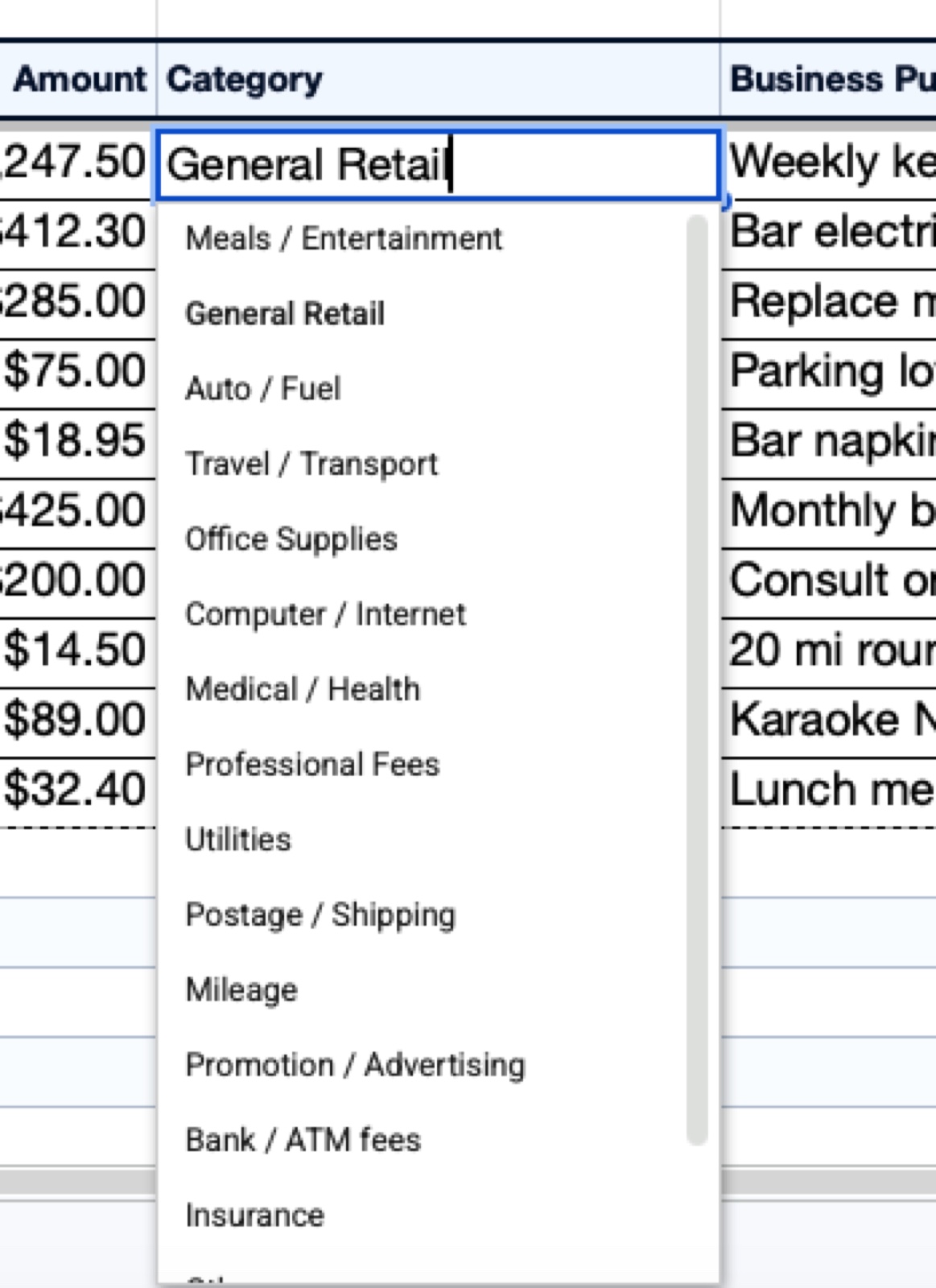 Same 15 categories, baked into the Sheets template as a single-click dropdown. No free-typing, no spelling drift.
Here's what surprised me most when I ran the numbers. 28.5% of those 2.4 million receipts have no category attached at all. Almost a third get filed without a tag. The people filing them use a one-tap app where picking a category takes one tap. On a paper pile or a free-text spreadsheet, the blank rate runs even worse.
That matters at tax time because every uncategorized receipt becomes a guess. Guesses don't survive an audit.
The fix runs through pre-defined dropdown categories, not free-text fields. We see COGS spelled four ways in our own data: COGS, Cost of Goods, Cost of Goods Sold, and Purchases Cost of Goods. Real data runs messy. Your template can stay clean.
The Google Sheets template above ships with these 15 as a Data Validation dropdown on the Category column. Pre-defined categories beat free text every time.
Why a Google Sheet beats Excel for most one-person businesses
We built the same template for Excel, PDF, and CSV. If Sheets works for you, it has three concrete advantages over Excel for a Schedule C filer:
- Free with any Google account. No Microsoft 365 license, no $99 a year, no version mismatch when your accountant opens it.
- Real-time sharing with your accountant. Click Share , paste their email, set view-only access. They watch your records build all year and ask questions in March instead of April.
- Same file on phone, laptop, anything with a browser. Snap a Sheet on the phone in the parking lot, edit on the laptop in your home office that night. Auto-saves on every keystroke.
If your accountant insists on Excel or you live on a plane with no Wi-Fi, grab the .xlsx above. The structure matches.
How to use the template
Here's the workflow most of our customers settle into.
Step 1: Copy the Sheet into your Drive
Click the Google Sheets link above. Google opens a Copy document prompt. Click Make a copy.
Rename the file with a year that sorts: Expenses 2026, not Expenses. You'll thank yourself in three years.
Step 2: Gather your receipts
Pull everything together. The paper receipts on the kitchen counter. The email confirmations from Uber and Amazon. The phone photos in your camera roll. Even the parking-garage stub still folded in your jacket pocket from that February meeting.
Don't sort yet. Just gather.
Step 3: One row per receipt
Fill six fields per row: date, vendor, amount including tax, category, business purpose, notes. Don't overthink it. The template runs from left to right; type what you see on the receipt.
Step 4: Pick the category from the dropdown
Click the Category cell, pick from the 15 options. Don't free-type. The dropdown protects you from the COGS-spelled-four-ways trap. Each receipt type belongs in its own category. Consistency makes the totals usable in April.
Step 5: Save the original receipt
Keep the original as a photo, scan, or filed paper. The Sheet works as the index. The receipt itself proves the expense to an auditor.
If you lost a receipt, write a contemporaneous note covering the date, vendor, amount, and reason. That beats nothing.
Step 6: Total at month-end and share
The Sheet auto-totals at the bottom of every month. Click Share in the top right, paste your accountant's email, set them to Viewer. Now your accountant has live access without being able to break your formulas.
The whole loop runs in less than 10 minutes a month for most one-person businesses.
The 4 things every expense entry needs (per the IRS)
The IRS spells out what counts as adequate records. Every expense entry needs four elements.
" You should be able to prove the elements of an expense or use of property… Generally, you must have documentary evidence, such as receipts, canceled checks, or bills, to support your expenses."
Source: IRS Publication 463.
The four required elements per entry:
- Date. Record the day you paid.
- Amount. Record what you paid, including sales tax.
- Vendor or payee. Record who you paid.
- Business purpose. Record why this expense counts as business.
That fourth one trips most people up, and it's the one auditors care about most. " Lunch with prospect to discuss Q3 contract" beats a blank notes field every time.
The template ships with a column for each of the four. An entry without business purpose runs as half a record.
For the official line on which expenses qualify in the first place, see Schedule C and its instructions.
Real deduction math: what tracking is worth in 2026
Walk through the actual numbers with me.
Say you're a Schedule C filer with 100 business receipts a year averaging $50 each. That's $5,000 in business expenses. At a 24% federal bracket (typical for self-employed earning $80K to $160K), that $5,000 cuts your tax bill by $1,200.
Apply the 28.5% blank-tag rate from our data. If 28.5% of your receipts get filed without a category, $1,425 of that $5,000 sits in a what was this? pile at tax time. At your accountant's desk those entries become "Other" or get dropped. You just paid $342 in unnecessary tax on receipts you already have.
Scale that to 500 receipts a year and the unnecessary tax runs roughly $1,710. The fix takes two minutes per receipt at point of purchase instead of eight hours of forensics in April.
According to IRS Statistics of Income data on sole proprietorships, Schedule C filers across the country claim $104.2 billion in vehicle and mileage deductions every year and $11.15 billion in home office deductions. Those two buckets carry the most upside from clean records. If you drive for work and run a dedicated home workspace, you leave real money on the table without them.
Don't forget mileage. It's the biggest gap I see.
The same data pull surfaced a gap that costs Schedule C filers more than any other line. Auto/Fuel ranks #3 at 8.3% of receipts. Mileage ranks #12 at 1.1%.
People log fuel receipts and forget to log the miles those receipts represent. The IRS lets you claim either actual auto expenses (fuel plus maintenance plus depreciation) or the standard mileage rate. For most small business drivers, the mileage rate wins by a wide margin.
The 2026 IRS rate sits at 72.5 cents per business mile. The average self-employed driver covers 12,000 business miles a year. That works out to an $8,700 deduction , or roughly $2,088 back at a 24% bracket.
We built a free IRS mileage log template using the same approach as this expense template. Excel, Sheets, and PDF, all free, none ask for your email. Use both together for a complete Schedule C kit. Our iOS and Android apps also track mileage automatically by GPS in the background, so you never forget to log a trip.
Tracking income too? Our newer free Income and Expense Worksheet ships with the same 15-category expense dropdown plus a second tab for income — same shape, both sides of the ledger.
If you drive a commercial truck rather than a passenger car, the standard mileage rate doesn't apply to your rig (Pub 463 §4 — heavy trucks use actual expense method). We built a trucker-shaped expense template with built-in per-diem tracker for that case.
What 20 years of receipts looks like
Shoeboxed launched in 2007. We've processed receipts for almost twenty years and we see what real small-business expenses look like at scale every day.
The photo at the top of this post: one shipment, one customer, forty-two pounds of paper. That pile became digital records before any of those expenses could survive an IRS review.
That customer does it the hard way, saving every paper receipt for months and mailing the whole pile in one go. The lesson scales to every business. Real operations generate more receipts than you remember, and any pile grows faster than your willingness to sort it.
Here's what happens after a customer mails receipts to us. The one-tap OCR experience runs on more human hands than people realize.
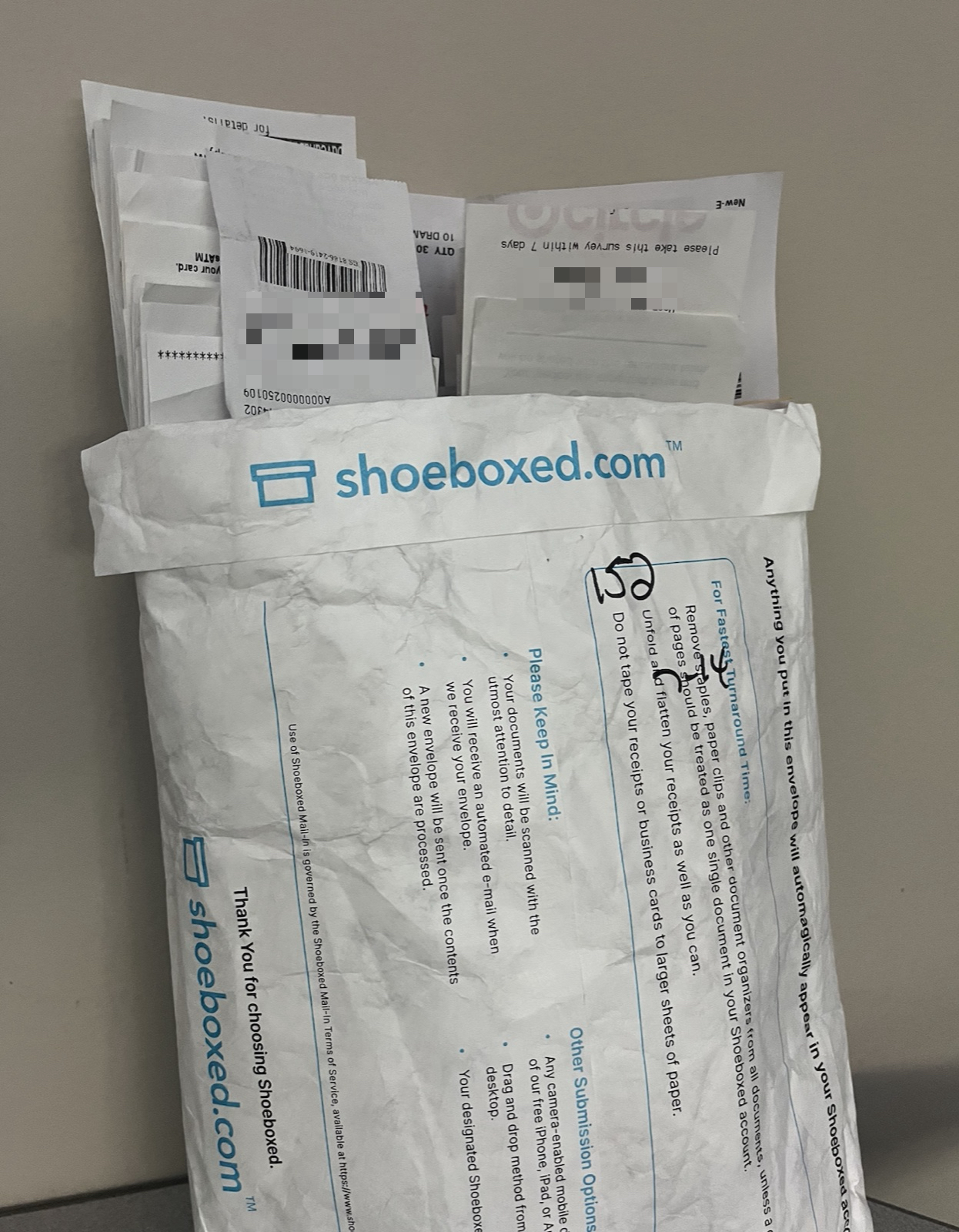 A Magic Envelope arrives. This one held 152 receipts. The customer wrote the count on the outside, which we appreciate.
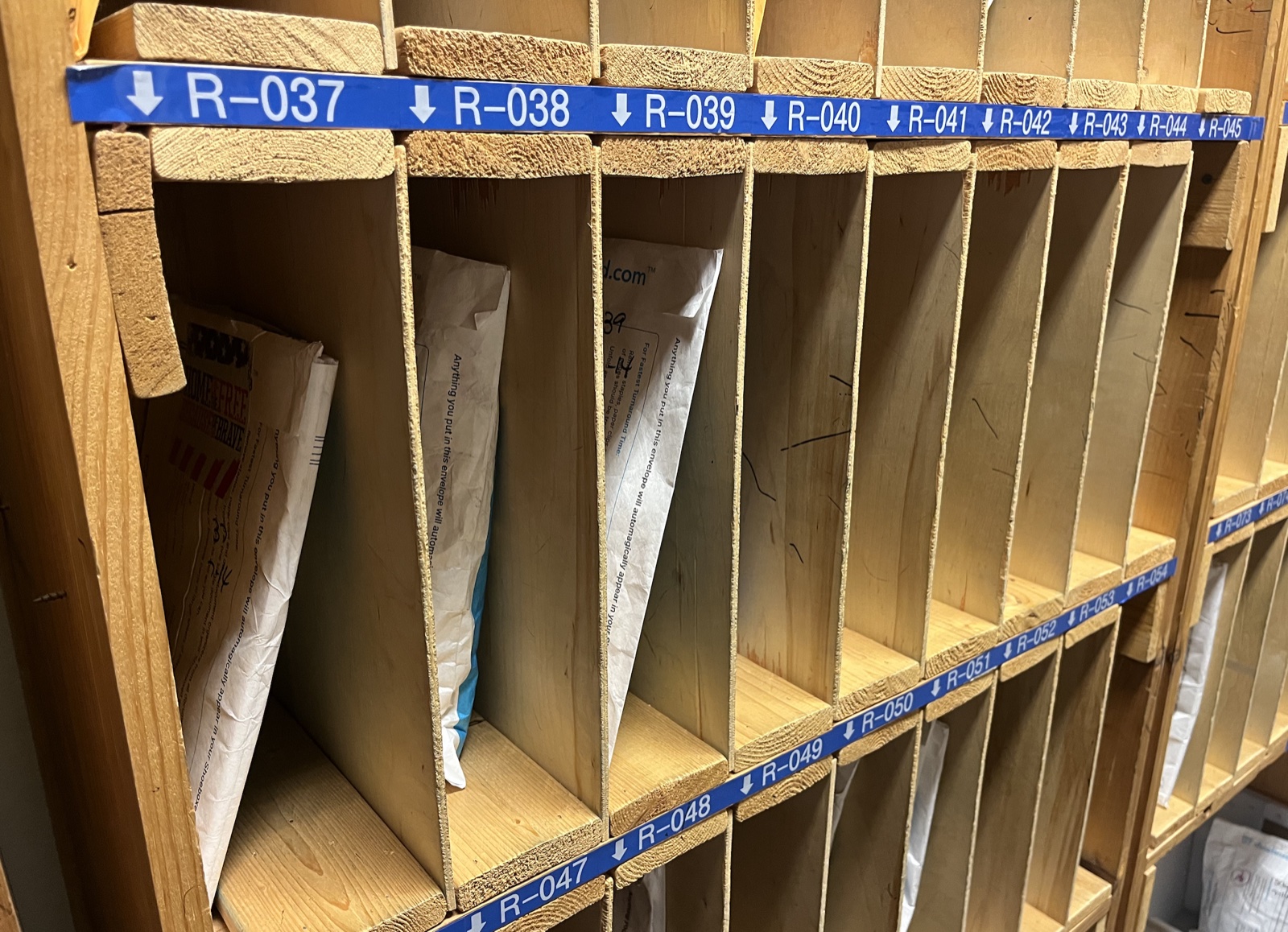 Each customer 's envelope goes into a sorted slot. We process them one at a time so receipts never get mixed across accounts.
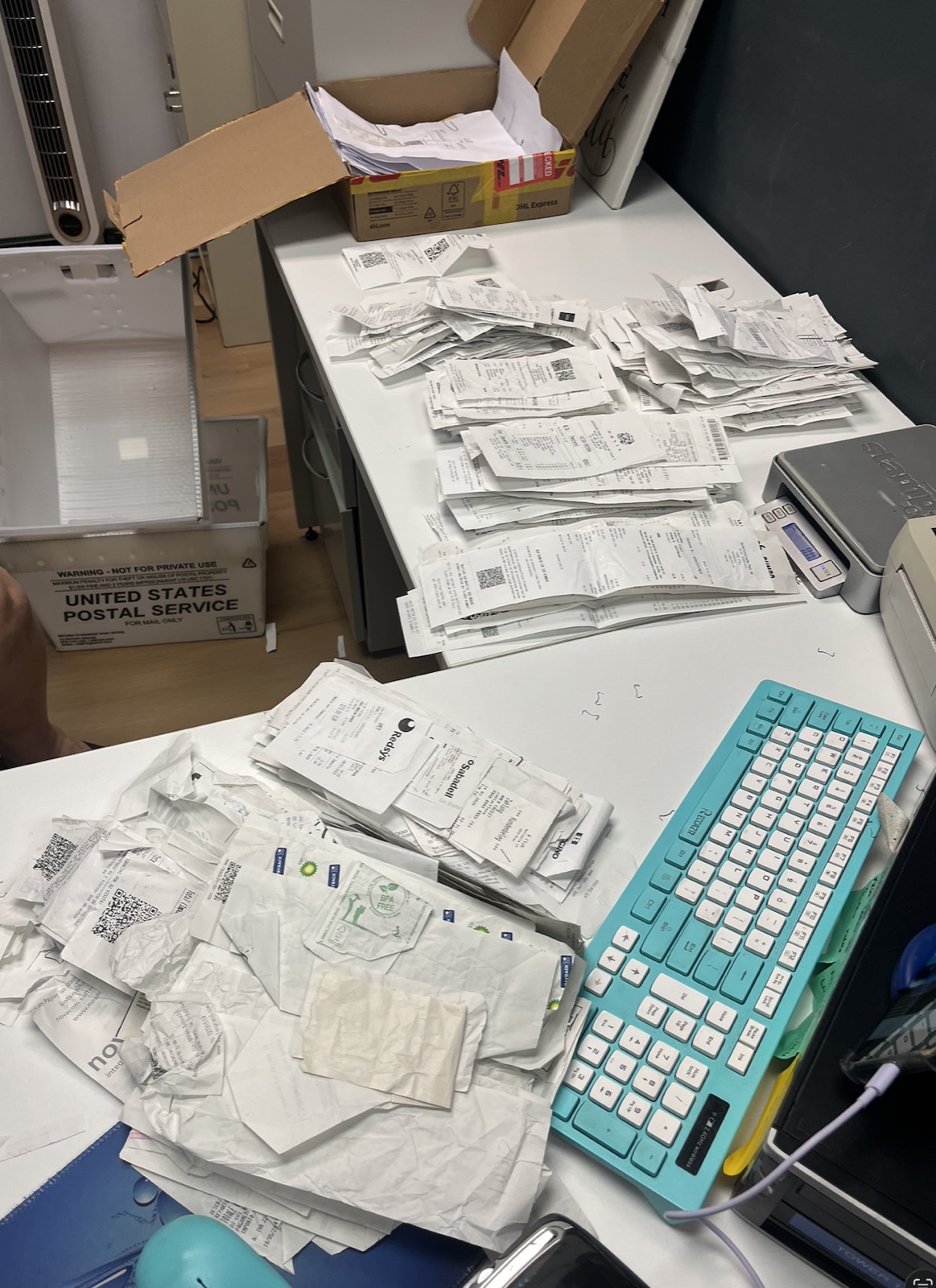 A customer 's envelope, opened. Every receipt gets sorted, prepped, and scanned by hand by someone in our office before it touches the OCR.
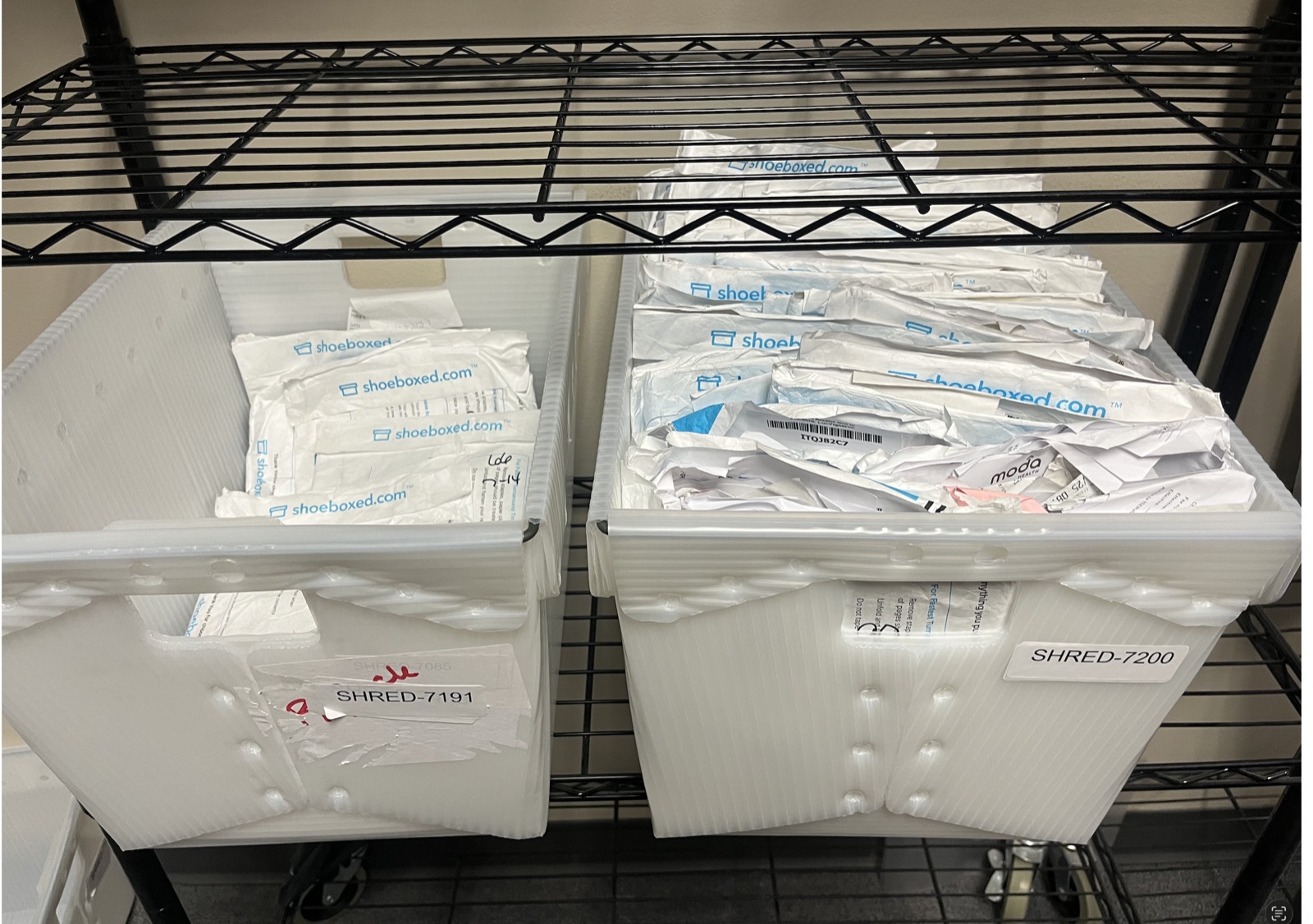 After scanning, the originals go to secure shredding. The customer 's digital records live forever in their account.
Paper isn't dead. A big chunk of what our customers send us still arrives by mail. Phone photos make up another big chunk, and email forwards round out the rest. That input mix drove the four-format design of this template. Each input has its own workflow.
Audit-proofing: 3 small habits that hold up under review
The IRS doesn't audit randomly. They flag returns where the records look thin. Three habits cover most of what holds up under review.
Habit 1: Photograph thermal receipts the day you get them
The thin paper receipts from CVS, gas stations, and restaurants fade in 6 to 12 months. By tax time the next year, half of them read as blank slips. Snap a photo the same day, before the ink walks off.
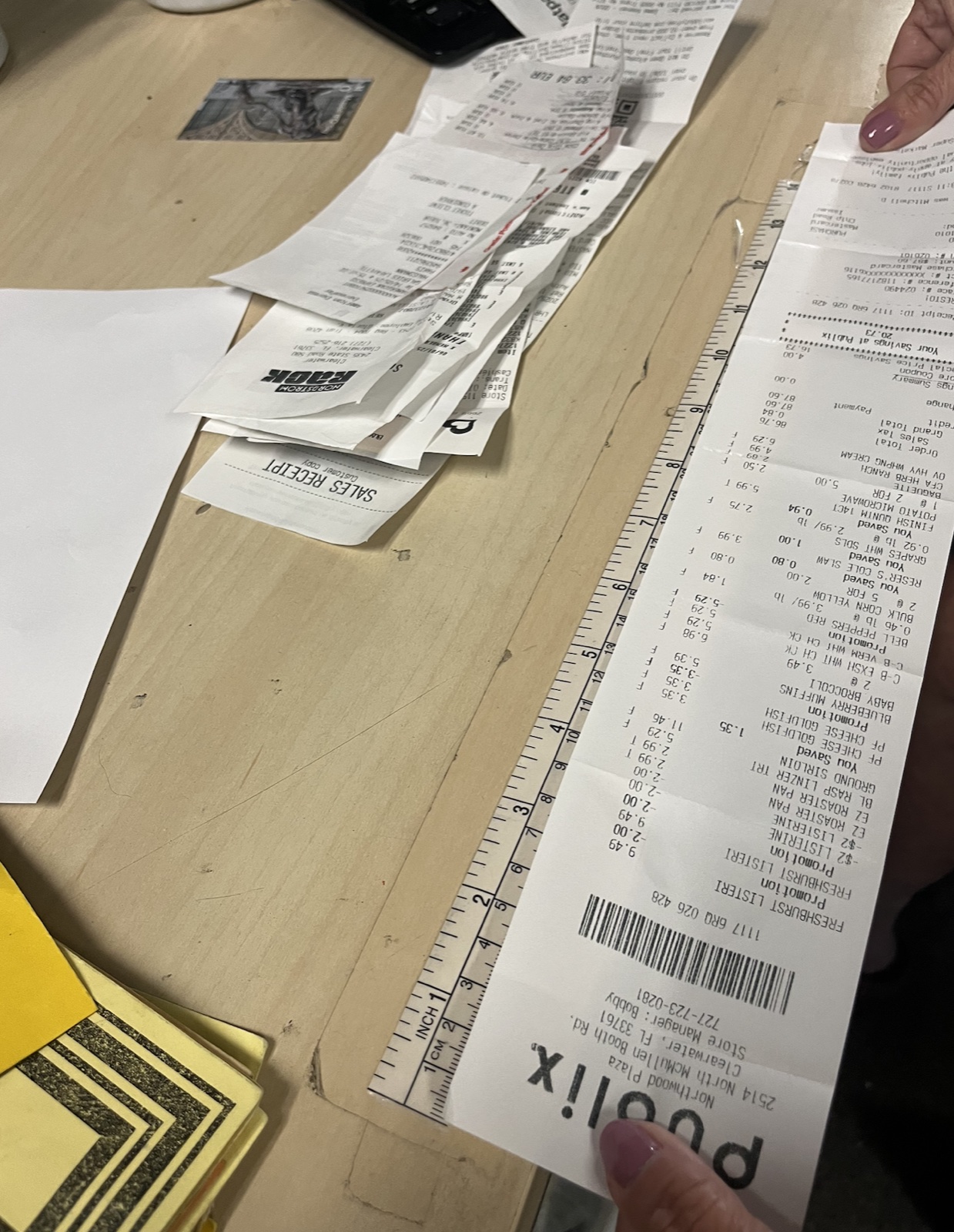 A real customer sent us this receipt, photographed against a 12-inch ruler. The whole thing prints on thermal paper from one store run. A phone photo saves you when the ink fades 12 months later.
Habit 2: Categorize as you go, not at year-end
Remember the 28.5% blank-tag stat from our data? Almost all of those are last-minute filers trying to remember in March what a $42 charge in July covered. Two minutes at point of purchase beats two hours in April.
Habit 3: Write the business purpose in one sentence per receipt
Write something specific: " Lunch with prospect to discuss Q3 contract." " Office supplies for client mailing." " Gas for site visit at 4400 W Pine." Specific notes beat generic ones every time, and specific is what an auditor wants to see when they ask why this expense belongs on your Schedule C.
Small habits at purchase pay off big at tax time.
If you run a home office, our free home office calculator can help. It walks through what a defensible home office claim looks like in about two minutes.
Is there an expense tracker in Google Sheets?
Yes. Google Sheets ships with a Monthly Budget template in its Template gallery. The template above gives you a Schedule C–shaped expense tracker with a one-click copy.
The built-in Google template ships with 6 to 8 categories. The one we built ships with 15 categories drawn from real small business spending, plus pre-built dropdowns and auto-totaling formulas.
For most Schedule C filers, the missing categories in the built-in version force real expenses into "Other," and "Other" doesn't survive an audit.
Is there a Google Sheets template for budgeting?
Yes. Google Sheets has a Monthly Budget template and an Annual Budget template built into the Template gallery. Those plan what you'll spend. The expense tracker template above records what you spent. Most small businesses need both: the budget tells you the plan, the expense tracker tells you the truth.
The expense tracker doubles as a budget check. Put your monthly target at the top. Compare it against the auto-totals at the bottom each month.
Is there a free expenses tracker?
Yes. The Google Sheets template above is free. The Excel, PDF, and CSV versions are free. None of them ask for your email. None of them run a free trial in the background.
We built these because a free template that ships with the wrong categories does more harm than good. We had the data to know what real small business spending looks like.
If you want capture and storage in addition to the template, our app has a 7-day free trial in the App Store and Play Store, and the web version comes with a 30-day risk-free trial. You can run both side by side.
Does Google have an expense tracker app?
Not as a standalone app. Google Sheets handles the closest thing, and the Sheets app on iPhone and Android works on the same file you build on your laptop. Google Wallet tracks purchases made through Google Pay, but it doesn't see cash, paper receipts, Venmo, or the half of small-business spending that happens off Google Pay.
For full automatic capture across every spending channel (cards, cash, paper, email, app subscriptions), you need a dedicated tool.
If you don't want to type at all
 Our Durham headquarters. We 've processed receipts since 2007.
I'll be straight with you. Typing receipts into a spreadsheet runs as the slowest way to do this. Some people like the control. Most people skip the typing when they can.
Here's what we built at Shoeboxed for the second camp:
- Magic Envelope. Stuff your receipts in the postage-paid envelope, mail it to us, and our team in Durham scans and categorizes each one into your account. A bookkeeper in your mailbox.
- Mobile app. Snap a photo of any receipt. Our AI reads vendor, amount, date, and category and writes them into your account in seconds. You never type a number.
- Automatic mileage tracking. The app logs your business trips by GPS in the background, then texts you a daily summary. Tap the trips that count as business.
- Real US support. When you have a question, you reach a real US support team in our same Durham office. More about the team.
A recent App Store review puts it better than I can:
" Every time I have an issue and send an email to the Shoebox support team they respond quickly and clearly. Every time they have exceeded my expectations."
Miket99, App Store review, April 2026
I bought Shoeboxed in late 2025 after fifteen years of running other people's companies as CEO. I'd used Shoeboxed myself back in 2010 at a previous gig and called it magical even then. I use it daily now. Small business owners deserve every dollar they're legally entitled to keep, which is why I bought Shoeboxed and work hard to make it better. More on why I bought it.
If the spreadsheet is enough, keep the spreadsheet. If you ever want to stop typing, here are a few starting points:
- Free home office calculator. No signup. If you run a home office, please use it. Most home-based filers leave four figures on the table every spring.
- Try the Shoeboxed app. Seven-day free trial on iPhone and Android.
- 30-day risk-free trial on the web. If you prefer starting at a laptop.
Either way, the template above belongs to you.
Wrap
The template comes in four formats. It ships with the 15 categories built from real receipts. It bakes the four IRS-required fields into every row. The audit habits up above cost you 30 seconds each and pay off the first time you get a notice.
Grab whichever format fits how you work. It's yours the moment you click. We'll be here either way, almost twenty years into this.
Traveling for work? Our Google Sheets travel expense template layers in the IRS per-diem method most self-employed people skip.
Ready for full books instead of just expenses? The Shoeboxed accounting spreadsheet template tracks income and expenses and maps every category to its Schedule C line.
Once you graduate to an S-corp, the Augusta Rule is one of the bigger tax wins that opens up — up to 14 days of tax-free home rental income to your business.
Farmers and ranchers have their own tax form. Our farm expense spreadsheet mirrors this one but maps to Schedule F instead of Schedule C.
Work From Home? You Could Be Missing $500–$3,000/Year
Self-employed, 1099, or freelancer? Enter your address and we'll pull your real property data to estimate your home office deduction.
Free · 30 seconds · No signup required




 4.4 / 5 on