Types of Receipts, Sorted: How They Arrive and What They Prove
Every type of receipt, sorted into three plain groups: how it arrives, what it proves, and the accounting kinds. With data from 57.5 million scanned receipts.

Updated June 2026
A receipt is written proof that a payment happened: the slip, email, or PDF you get when money changes hands. Every type sorts into one of three groups: its format (how it arrives), its job (what it proves), and its accounting meaning (money received, not paper).
My company has scanned 57.5 million receipts since 2007, and people still ask me the same two questions: what counts as a receipt, and which kinds do I need to keep?
Here are all the types of receipts, sorted the simple way. The groups below match how the pile on your desk really works, and each entry tells you what to do with that kind, not just what it's called.
"Of the 3.5 million receipts Shoeboxed customers sent in since January 2024, 37% arrived as paper in the mail, more than came through our app (36%) or by email (27%). Paper is still the most common way a receipt reaches us."
Shoeboxed customer data, June 2026
The types of receipts, in 30 seconds
By format, meaning how the receipt arrives:
- Paper receipts: register slips and printed tickets. Available on the spot, but the ink fades within a year or two.
- Handwritten receipts: filled out from a receipt book, usually with a carbon copy underneath. Still legal, still common in the trades.
- E-receipts and email receipts: the confirmation an online store or register sends to your inbox. Searchable, and they never fade.
- PDF receipts: the downloadable kind from software vendors and billing portals. Same proof, different wrapper.
- QR and barcode receipts: a code on a slip or screen that links to the full record. The code is for the store's system; the details behind it are your proof.
- Credit card statements: a backup, not a receipt. A statement shows the date, vendor, and amount, but it misses the line items the IRS wants for a full record.
By job, meaning what transaction it proves:
- Sales, retail, and transaction receipts: proof of a purchase at checkout, with items, prices, and tax. The itemized list is the part worth keeping. From the buyer's side, that same slip is a purchase receipt.
- Service receipts: proof you paid for work, like a repair or a consult. For a deduction, the description of the work matters more than the total.
- Cash receipts: proof for payments with no card or bank trail. The only record that exists, so guard it.
- Credit card slips: proof a card payment went through, with the approval code on it. Keep the itemized receipt too; the slip proves payment, not what you bought.
- Bank transaction records: proof money moved between accounts, like a transfer or deposit confirmation. Enough for the bank, but not enough on its own to back a deduction.
- Business-to-business receipts: proof of a wholesale or corporate purchase, usually with purchase-order numbers and terms. Match it to the invoice it pays.
- Reimbursement receipts: the proof an employee hands in to get paid back.
- Donation receipts: proof of a charitable gift, with its own IRS paperwork rules past $250.
- Gift receipts: proof of purchase with the price hidden, for returns and exchanges.
In accounting, where "receipts" means money received, not paper:
- Revenue receipts: money from normal operations, like sales and rent collected.
- Capital receipts: one-time money, like selling equipment or taking a loan.
- Gross receipts: your total business income before expenses. When a tax form asks for gross receipts, it wants a number, not your shoebox.
The shortcut: sort your pile by the job, keep anything that proves a business expense, and don't sweat the format. A faded slip and an email confirmation of the same purchase carry the same weight with the IRS, as long as the details survive. (How long to keep each kind gets its own section below.)
The four facts the IRS reads on every receipt
The word trips people up because it carries two meanings. In everyday life, a receipt is the proof you get when you pay for something. In accounting, "receipts" means the money your business took in, which is why a tax form can ask for your gross receipts and expect a dollar figure. This article is about the first kind, the proof. (For the money side, our guide to the types of bookkeeping covers how income gets recorded.)
For business purposes, the IRS reads four things on any receipt: the amount, the date, where the purchase happened, and what the purchase was. A receipt that shows those four facts does its job whether it's a register slip, an email, or a photo of either one.
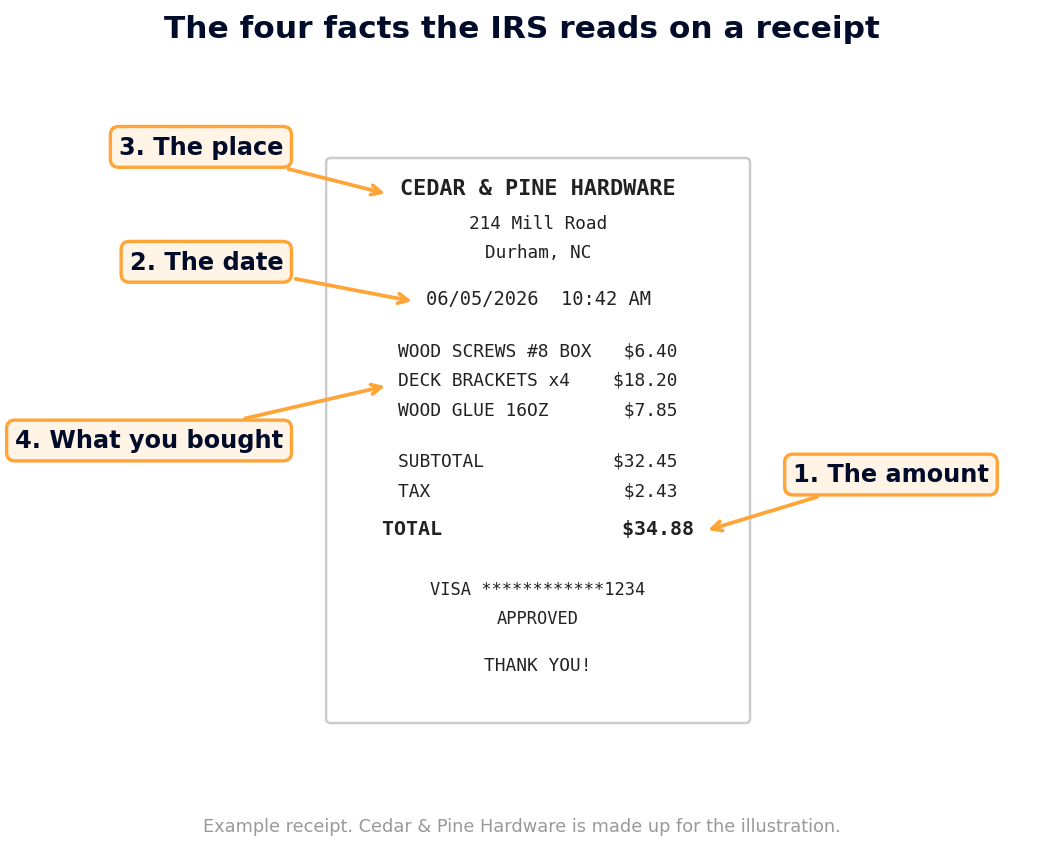 The four facts on a real receipt layout. (Cedar & Pine Hardware is made up for the example.)
Our guide to the IRS receipt requirements and the $75 rule covers exactly when you need that paper and when a log entry covers you.
Two everyday papers fail that test, and they cause most of the confusion: the invoice and the packing slip. Both get their own section below, because mixing them up is how a purchase ends up undocumented at tax time.
Receipt types by format: how each one arrives
People ask me about format more than anything else, so let's settle it first. Every format below carries the same legal weight once the four facts are readable. The differences are practical.
| Format | What it looks like | The catch |
|---|---|---|
| Paper (thermal) receipt | The shiny register slip | Scan it within weeks; the ink won't wait for tax season |
| Handwritten receipt | A filled-in page from a receipt book, often with a carbon copy | Legibility is on the writer. Make sure the four facts are readable |
| E-receipt or email receipt | The order confirmation in your inbox | Easy to lose in a crowded inbox. Forward it somewhere permanent |
| PDF receipt | The download from a billing portal | Lives wherever you saved it, which is the problem. Pick one home for them |
| QR or barcode receipt | A code that links to the full record | The code can stop working if the store changes systems, so save the details behind it |
| Credit card statement | The monthly list from your bank | Acceptable backup when the receipt is gone; pair it with a note of what you bought |
| Every receipt format, with the one practical catch each carries. The four facts matter; the wrapper doesn't. |
One more format comes off our own scanning floor. Our mobile app turns business drives into PDF mileage receipts, map attached, so a trip can produce a receipt the same way a purchase does. The mileage log template guide covers that system.
Receipt types by job: what each one proves
This second axis is the one that matters. When your bookkeeper or accountant says "send me the receipts," this table is the list they mean, sorted by what each kind proves and what to do with it.
The most common kind on that list is the everyday sales receipt, which gets its own guide with a labeled example and a free printable template.
| Receipt type | What it proves | What to do with it |
|---|---|---|
| Sales or retail receipt | A purchase, with items, prices, and tax | Keep it if the purchase was for the business. The itemized lines back up the deduction |
| Transaction receipt | One specific payment, with a transaction number | The number is what you quote to settle a dispute or chase a refund. Our transaction receipt guide shows where to find it |
| Service receipt | Paid work: repairs, consults, professional fees | Check that the work description survived. That line carries the deduction |
| Cash receipt | A payment that left no card or bank trail | Scan it the day you get it. There is no backup anywhere |
| Credit card slip | A card payment went through | Staple it (or scan it) with the itemized receipt from the same purchase |
| Bank transaction record | Money moved between accounts | Good supporting evidence; pair it with a receipt that shows what the money bought |
| Business-to-business receipt | A wholesale or corporate purchase, with purchase-order numbers and terms | This is the proof the invoice got paid, so file it with the invoice |
| Reimbursement receipt | An expense an employee covered out of pocket | The business keeps it after paying the employee back; it becomes the company's receipt |
| Donation receipt | A charitable gift | Past $250, the IRS wants a written acknowledgment from the charity, so ask for one on the spot |
| Gift receipt | A purchase, with the price hidden | Fine for returns and exchanges. Our gift receipt guide covers when the price still matters |
| The receipt types by job. The third column is the part the flat lists never give you. |
If you shop at the big chains, we keep store-specific walkthroughs for finding and reading their receipts, including Amazon, Walmart, Costco, and Home Depot.
The impostors: three documents people file as receipts
Our scanning team in Durham sees these three show up in customer envelopes all the time, filed as receipts. None of them are receipts, and each one has a real job of its own.
| Document | What it really is | The mix-up |
|---|---|---|
| Invoice | A request for payment, sent before money moves | It looks like a receipt but proves nothing was paid. Once it's paid and marked so, the paid invoice works as your receipt |
| Packing slip | A list of what shipped in the box | It shows items but no prices and no payment, so it can't back up a deduction |
| "Gross receipts" | Your total business income before expenses, a number on a tax form | The same word with a different meaning. When Schedule C asks for gross receipts, it wants a dollar figure, not a pile of paper |
| Three documents that get filed as receipts, and what each one really is. |
The invoice one matters most. If you pay a vendor's invoice and keep only the unpaid version, your file shows a request, and a request doesn't document the expense. Keep the proof the payment happened: the marked-paid invoice, the card slip, or the bank record alongside it.
How long to keep each kind
The rule is simpler than the seven-years advice that gets passed around. The IRS says to keep records for three years from the date you filed, for most filers.
- Three years: the normal case, counted from the date you filed.
- Six years: if you left more than 25% of your income off the return.
- No limit: if you never filed, or filed a fraudulent return.
The job axis adds two wrinkles worth knowing. Donation receipts carry their own paperwork: at $250 and up, the IRS wants a written acknowledgment from the charity, and bigger noncash gifts can add IRS forms on top. And receipts for big purchases that you depreciate, like equipment, need to outlive the asset, because they prove what you paid for it.
Whatever the window, the paper is the weak link. A thermal slip can fade to nothing within a year or two, well inside even the three-year window, so the scan is the copy that survives to the audit. (Our IRS receipt requirements guide covers what the scan needs to show.)
We get into why thermal slips do that, and what to do when one already has, in our guide on why receipts fade and how to stop it.
The full system, from the capture habit to the IRS retention windows, is in our guide on how to store receipts.
What 3.5 million receipts say about the types small businesses send
Most lists of receipt types come from imagination, but ours comes from a scanning queue. Since January 2024, customers have sent us 3,507,696 receipts, and 1,298,936 of them came in actual envelopes.
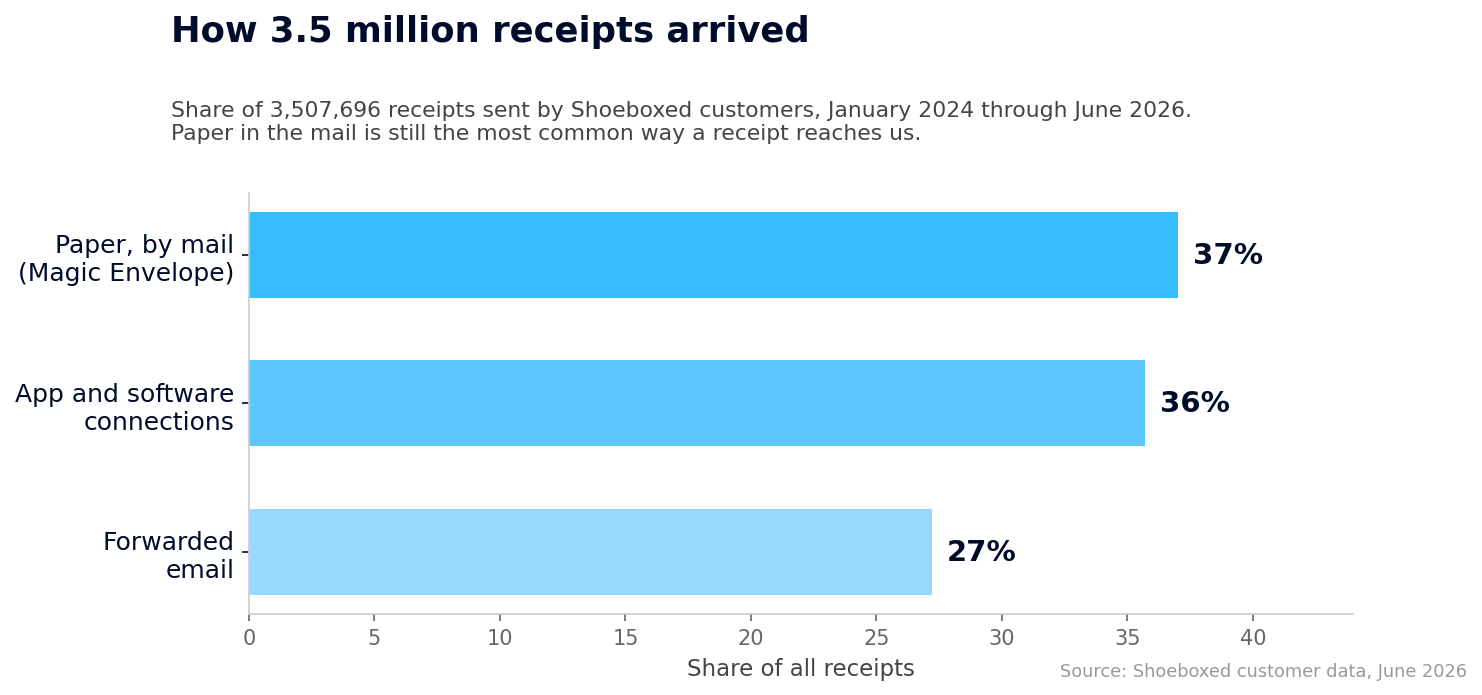 How 3.5 million customer receipts arrived since January 2024. Paper in the mail is still the most common channel.
Paper came first. 37% of everything arrived as physical receipts mailed in through our Magic Envelope. The app and software connections came second at 36%, and forwarded email receipts third at 27%. So for all the talk about paper dying, more receipts still reach us by mail than any other way.
That mix is why the format axis of this article exists. A real business doesn't run on one receipt type. It runs on a glovebox of thermal slips, an inbox of confirmations, and a folder of PDFs, all at once. The filing system has to swallow all three.
Keep every type of receipt without the shoebox
Whatever mix of types your business runs on, the habit that works is one home for all of them. Snap the paper ones with the app, forward the email ones to your account's email-in address, or mail the whole pile in a postage-paid Magic Envelope. Our team in Durham scans the paper, and our software pulls out the date, vendor, total, and category, whatever the type and whatever the format.
Two ways to start. On the web, Shoeboxed starts at $9 a month with a 30-day money-back guarantee: try it for a month, and if it isn't for you, we refund the money. Start a Shoeboxed account → Rather start from your phone? The mobile app comes with a 7-day free trial, no payment required up front:


And if a receipt already got away from you, our lost receipt guide covers how to reconstruct the proof.
Helping you keep more of your hard-earned money is the whole point.
Saving gas receipts for tax time? Learn when gas receipts count on your taxes before you keep another one.
Frequently asked questions about types of receipts
What is a receipt?
A receipt is written proof that a payment happened. It can be a register slip, an email, or a PDF, and it should show the amount, the date, where the purchase happened, and what was bought. Show those four facts and the format doesn't matter.
What are the 4 types of financial transactions a receipt can prove?
Most receipts prove one of four things: a sale (you bought something), a payment (money settled a bill), a transfer (money moved between accounts), or a refund and reimbursement (money came back). Sorting your pile by those four jobs beats sorting by paper versus email every time.
What are common receipt alternatives if I lost the original?
A credit card or bank statement paired with a note of what the purchase was for covers most gaps, and many stores will reprint a receipt if you give them the date and your card's last four digits. Our lost receipt guide walks through the rescue options in order.
What are the 3 copies of a receipt?
That question refers to receipt books: the white original goes to the customer, and the yellow and pink carbon copies stay with the business as its record and backup. Our receipt book guide shows how the three-part system works.
Is an invoice a type of receipt?
No. An invoice asks for payment, and a receipt proves payment happened. The one exception is a paid invoice that's clearly marked paid, which then works as proof.
About the author
I'm Doug. I bought Shoeboxed in late 2025 with an SBA loan and 5% down, so I run a small business and sweat the same tax bill you do. The receipt counts in this article come straight from our own scanning operation in Durham. I write these guides because the surest way to grow Shoeboxed is to help people keep more of what they earn.
Sources
- IRS: How long should I keep records?
- IRS Publication 463 (documentary evidence rules)
- IRS: Charitable Contributions, Written Acknowledgments




 4.4 / 5 on