Sales Receipt: A Labeled Example and a Free Template
What a sales receipt is, shown on a labeled example: the four facts the IRS reads, a free printable template, and what 3.5 million scanned receipts reveal.


Updated June 2026
A sales receipt is the written proof of purchase a seller gives a buyer the moment a sale happens. It shows the amount paid, the date, where the sale took place, and what was sold. Those are the same four facts the IRS calls adequate evidence of an expense. An invoice asks for money; a sales receipt proves the money arrived.
Imagine you're selling quilts at the Saturday craft fair and a customer pays $308.16 in cash, then asks for a receipt. Or maybe you're on the other side of the table, holding a crumpled sales receipt in February and wondering if it counts as proof. Will that piece of paper hold up for the return and for the tax deduction? The answer comes down to four facts the IRS looks for, whether a register printed the receipt or you wrote it by hand.
Keep reading for a labeled example and a free printable template. In a hurry? Jump straight to the template.
What is a sales receipt? A labeled example
Registers print sales receipts, online stores email them, and plenty of small businesses still write them by hand. The format doesn't change the job. Here's one filled out, with five parts labeled: the four facts the IRS reads, plus how the customer paid.
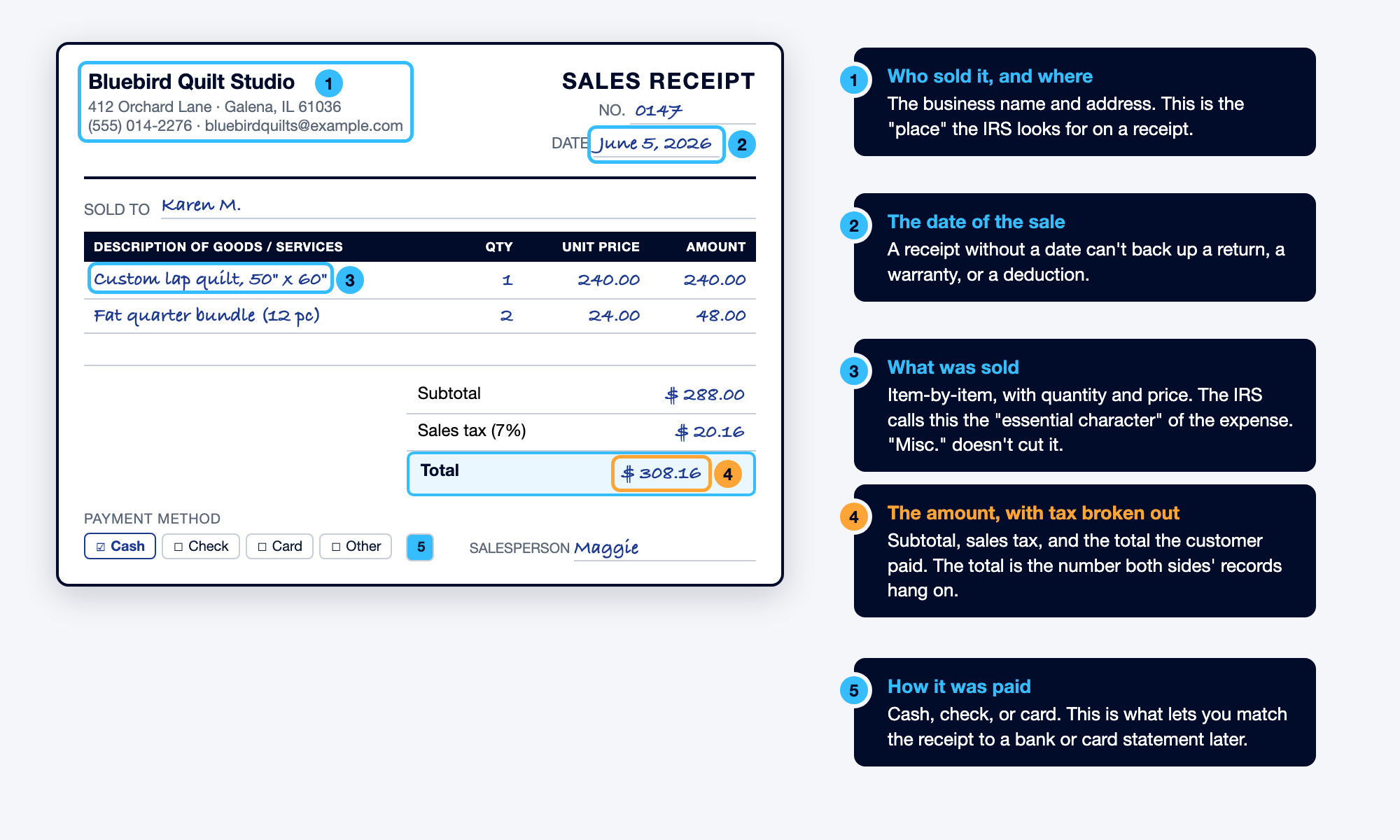 A filled-out sales receipt with the five parts labeled. (Bluebird Quilt Studio is made up for the example.)
Four of those parts come straight from the tax man, and the fifth, the payment method, is for your own books. IRS Publication 463 says the IRS will ordinarily accept a receipt as adequate evidence when it shows the amount, the date, the place, and what was bought. Compare your receipt to the example, and if you can read those four facts on yours, the IRS will accept it as proof of the expense. (Our guide to the types of receipts sorts every other kind the same way.)
Download our free sales receipt template (PDF, no email required)
If you're the one writing the receipt, start here: download our free sales receipt template (PDF). Print it and you get two receipts per page, a top copy for your customer and a duplicate for your records.
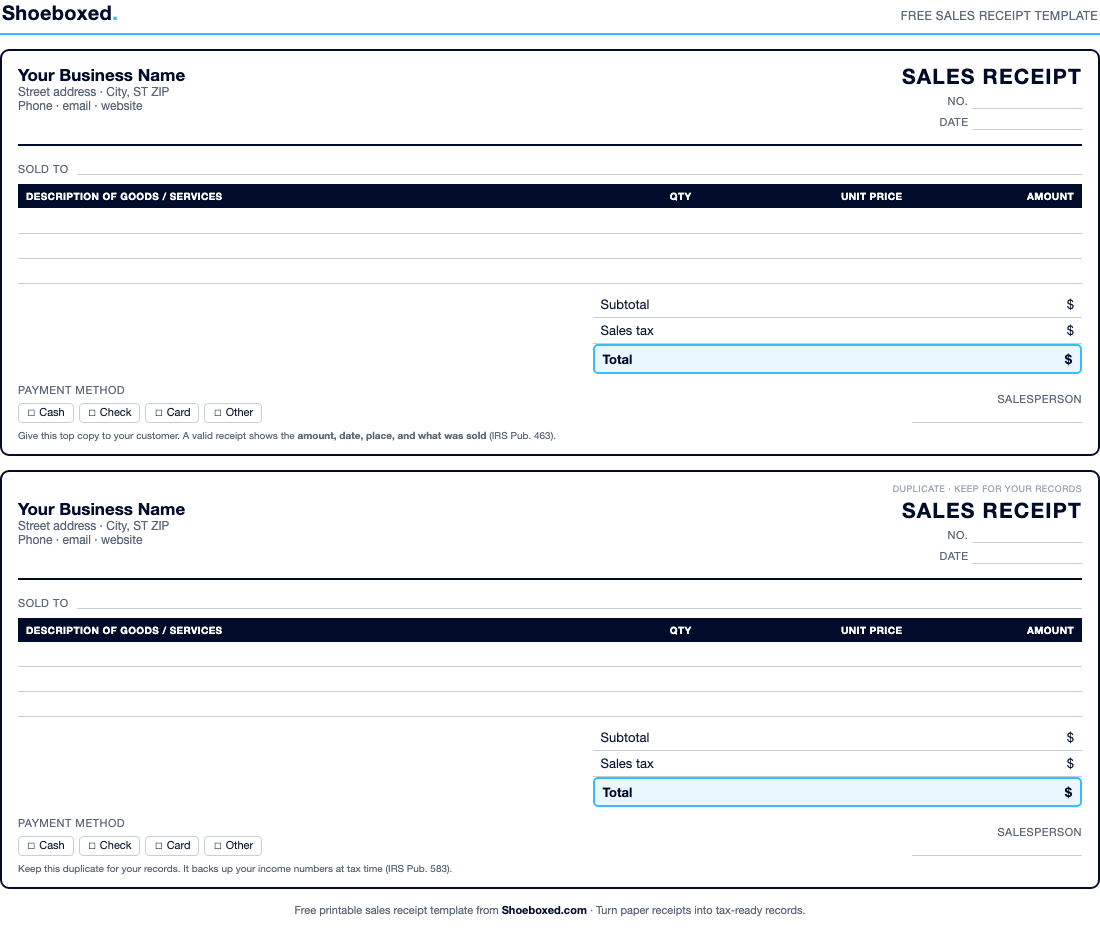 The free template prints two receipts per page: the top copy goes to your customer and the duplicate stays with you. Download the PDF.
The download asks for nothing: no account, no email address, no watermark. We built Shoeboxed to help small businesses keep clean records, and giving the template away is part of that work.
That duplicate copy backs up your income numbers at tax time. IRS Publication 583 lists receipt books and invoices among the records that show your gross receipts. Gross receipts means the income side of your tax return. Your customer's copy protects them, and the duplicate protects you. If you'd rather work from a bound book with carbon copies, our receipt book guide covers that system.
How to fill out a sales receipt, line by line
Three people end up using this receipt: your customer, you when you do the books, and the IRS. Each blank serves at least one of them.
| Field | What to write | Why it matters |
|---|---|---|
| Business name and address | Your business name, street address, and phone | The IRS calls this the "place" of the expense. Your customer uses it to know where to bring a return |
| Receipt number | The next number in your sequence | Keeps your records in order, so you can find one sale months later |
| Date | The day the money changed hands | The IRS reads this as one of its four facts. It also sets the tax year and backs up returns and warranties |
| Sold to | The customer's name, if they'll give it | Optional, but it settles a dispute fast when two people claim one purchase |
| Description, quantity, price | One line per item, in plain words | The IRS calls this the "essential character" of the expense. "Misc." proves nothing |
| Subtotal, sales tax, total | The math, with tax on its own line | The IRS calls this the "amount." Tax on its own line keeps your books clean if your state charges sales tax |
| Payment method | Check one box: cash, check, or card | Card and check payments match to a bank record later. For cash, this box is the only record of how you were paid |
| Salesperson | Who made the sale | Once you've hired help, this tells you who to ask when a question comes up |
| Every field on a sales receipt and what to write in it. |
The IRS sums up that whole table in one sentence.
"Documentary evidence will ordinarily be considered adequate if it shows the amount, date, place, and essential character of the expense."
IRS Publication 463, Recordkeeping
The IRS treats a handwritten receipt the same as a register slip, because both carry the same facts. Write those four things legibly, and your customer walks away with paper the IRS will accept. (Wondering when the IRS requires a receipt at all? Our guide to the IRS receipt requirements and the $75 rule covers when a log entry stands in for the paper.)
Sales receipt vs. invoice vs. transaction receipt
Three documents show up around every sale, and people file the wrong one as proof all the time. Our scanning team in Durham sees the mix-up firsthand: customer envelopes arrive with unpaid invoices filed in place of receipts. A misfiled invoice leaves you claiming a deduction with nothing to show the money ever left your account. When you're the buyer holding that slip instead of the seller, the same document is a purchase receipt.
| Document | When you get it | What it proves |
|---|---|---|
| Invoice | Before payment, asking for money | That someone owes money. Until someone marks it paid, it shows a request, not a payment |
| Sales receipt | At the moment of sale, after payment | What was sold, for how much, and that the customer paid in full |
| Transaction receipt | After any single payment goes through | That one specific payment cleared, with a transaction number you can quote in a dispute |
| The three documents around a sale. Only the receipts prove money moved. |
If the paper in your hand requests payment, it can't prove payment. A sales receipt covers the whole sale, including every item on it. A transaction receipt zeroes in on one payment, and it carries the number you'd quote to chase a refund. And a copy with the prices hidden is a gift receipt, which follows its own rules for returns and exchanges.
What 3.5 million receipts show: 1 in 5 has a fact we can't read
Since January 2024, customers have mailed, emailed, and snapped photos of 3.5 million receipts for us to scan. For each one, our software tries to read three basic facts off the paper: who sold it, the date, and the total. On about 1 in 5 receipts, we couldn't read at least one of the three.
| The basic | How often our software could read it |
|---|---|
| Who sold it (the vendor name) | 82.7% |
| The date | 83.6% |
| The total | 83.1% |
| All three on one receipt | 79.6% |
| What our software could read on 3.5 million receipts sent in since January 2024. On about 1 in 5, we couldn't read at least one of the three. |
Faded thermal ink, torn-off totals, and cropped photos explain a lot of what we see. And sometimes our software misses one. If you're the one keeping receipts, scan or snap each one the day you get it, instead of letting it ride in a glovebox until April.
If you're the one writing receipts, you control every line. Press hard, fill in the date, and describe the item in plain words. Do that and the slip you hand over stays legible for as long as anyone needs it.
How to get a sales receipt, and keep it where you can find it
Getting a sales receipt is easy: ask at the point of sale. If the slip is long gone, call the store. Most big retailers will reprint one if you give them the date and your card's last four digits. (Our lost receipt guide walks through the rescue options in order.)
Most owners lose the slip somewhere between the counter and tax season, and Shoeboxed exists for exactly this problem. Give every receipt one home the day you get it, whichever way is easiest:
- Snap a photo with the mobile app.
- Upload the file on the website, straight from your computer.
- Forward email receipts to your account's email-in address.
- Let our Gmail plugin pick receipts out of your inbox on its own.
- Drop the paper in a Magic Envelope, the postage-paid envelope we send you, and mail it back to us.
If most of your receipts are paper, the Magic Envelope is the lazy option that works. If most of them land in your inbox, turn on the Gmail plugin and forget about it.
Our team in Durham scans whatever arrives on paper, and our software reads out the vendor, date, and total. Those are the facts the IRS wants to see on a receipt. We store the receipt image itself, not just the numbers, and we keep everything for as long as you have an account. The IRS says to keep records for at least 3 years from the date you filed, and longer in special cases, like underreported income. A scanned copy holds up for whichever window applies to you.
Never lose a sales receipt again. Join over a million businesses that scan receipts, sort them into categories, and build IRS-ready expense reports with Shoeboxed. See how it works.
On the web, Shoeboxed starts at $9 a month with a 30-day money-back guarantee. Rather start from your phone? The mobile app comes with a 7-day free trial, no payment required up front:


Frequently asked questions about sales receipts
How do you write a sales receipt by hand?
Write your business name and address at the top, then the date, each item with its quantity and price, the sales tax if your state charges it, the total, and how the customer paid. Press hard enough for the duplicate copy if you're using a receipt book, and keep that copy for your records.
Can I make a sales receipt online for free?
Yes. Print our free sales receipt template and fill it in by hand, or recreate the same fields in any word processor. The paper doesn't need special software to be valid. It needs the amount, the date, the place, and what was sold.
Is a bill of sale the same as a sales receipt?
No. A bill of sale transfers ownership of something big, like a car or a trailer, and both sides usually sign it. A sales receipt proves payment for an everyday purchase. For a private car sale you'll want both: the bill of sale for the title transfer and a receipt for the money.
Does the IRS require a sales receipt for every expense?
Not for every expense. For travel, meals, and similar costs under $75, the IRS accepts a logged record in place of the paper. Our guide to the $75 receipt rule covers exactly when you need the receipt and when a log entry covers you.
Do gift receipts count as sales receipts?
They're a version of one. A gift receipt shows the same items and return barcode but hides the prices, so it works for returns and exchanges. If you bought the gift for business reasons, keep the priced copy too, because the hidden-price version can't back up a deduction.
About the author
I'm Doug. I bought Shoeboxed in late 2025 with an SBA loan and 5% down, so I run a small business and sweat the same tax bill you do. The receipt numbers in this article come straight from our own scanning operation in Durham, and the template is one we built ourselves. I write these guides because the surest way to grow Shoeboxed is to help people keep more of what they earn.
Sources
- IRS Publication 463 (documentary evidence: amount, date, place, essential character)
- IRS Publication 583 (records that show gross receipts, including receipt books and invoices)
- IRS: How long should I keep records?




 4.4 / 5 on