Gift Receipt: What It Is, How It Works, and When to Save One
A gift receipt is a copy of the receipt with the prices hidden. The recipient can return or exchange the gift without seeing what you paid. Here is how gift receipts work, how to get one at Amazon and Target, and the IRS $25 rule for business gifts.


Gift Receipt: What It Is, How It Works, and When to Save One
Imagine you're a realtor picking up a closing gift for your latest sale. Or maybe you're an executive coach buying a gift for a client who just landed the promotion they dreamed of. Did you know you can turn that gift into a tax deduction? Keep reading for the simple way to do that.
"Across 19,369 business-gift receipts scanned by Shoeboxed customers, the median receipt is $47, almost double the $25 the IRS lets you deduct per person."
Shoeboxed customer data, June 2026
First, the basics: a gift receipt is the copy of a receipt with the prices stripped out. Same items, same return barcode, no dollar amounts. The person opening your gift can return or exchange it without ever seeing what you paid.
A gift receipt starts life as a regular sales receipt before the store strips the prices off.
The quick answer:
- What it does: proves the purchase without showing the price.
- Who can return with it: the gift recipient, usually for an exchange or store credit, not cash.
- How to get one: check the gift option at online checkout (exact steps for Amazon and Target below), or ask the cashier before they ring you up in store.
- If the gift is for a client or customer: save your own copy of the receipt. The IRS lets a business deduct up to $25 per recipient per year, and the receipt is your proof.
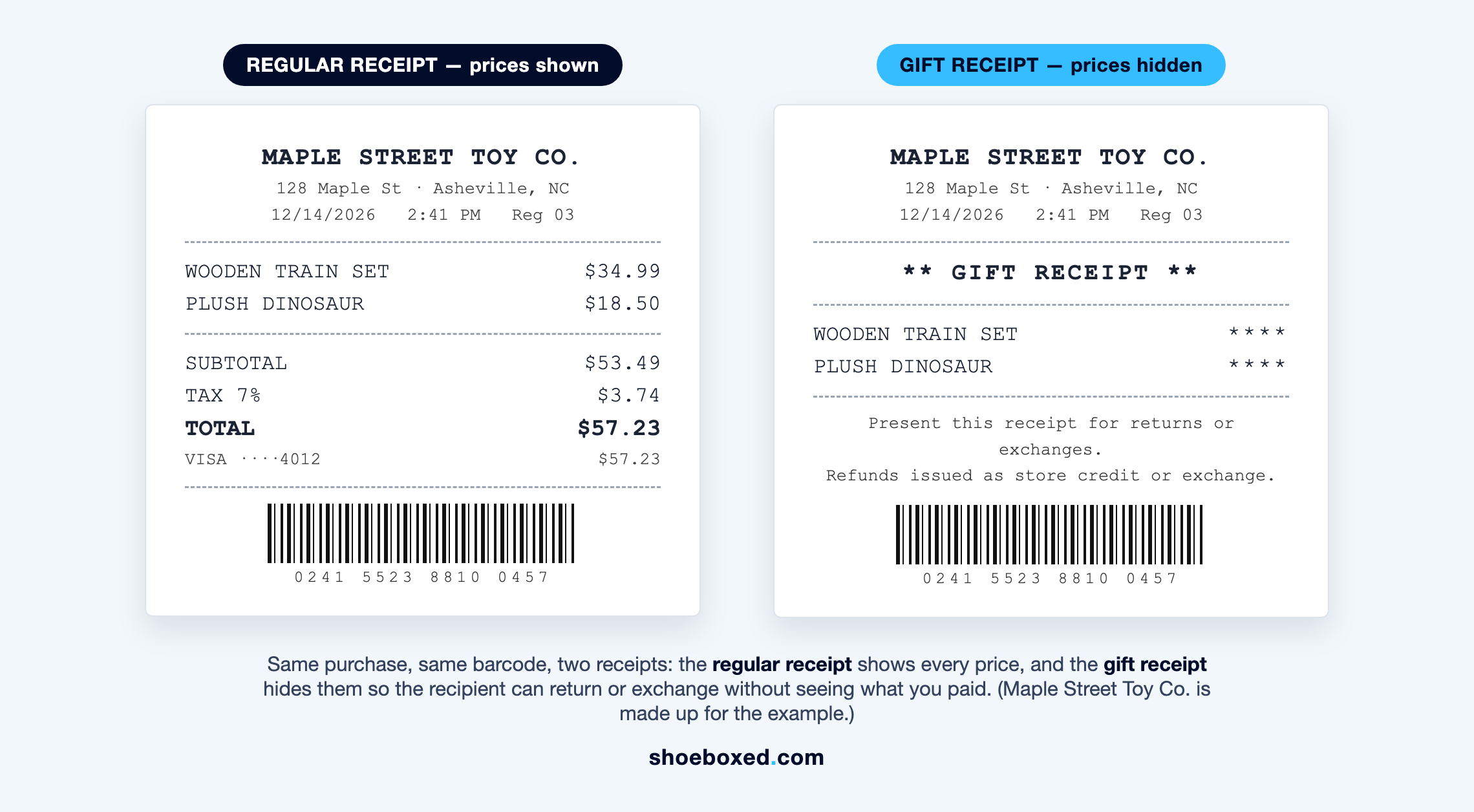 Same purchase, two receipts: the regular receipt shows every price, and the gift receipt hides them. (Maple Street Toy Co. is made up for the example.)
How a gift receipt is different from a regular receipt
A regular purchase receipt lists every item with its price, the tax, and the total. A gift receipt lists the same items and keeps the same transaction number and barcode, but strips out the dollar amounts.
The barcode is what makes the return work. When the recipient brings the gift back, the store scans it and pulls up the full transaction on their end, prices included. The recipient never sees what you paid. The store still knows what the item is worth, so the return goes through at the real price instead of a guess.
Big chains like Amazon and Target print gift receipts for free at checkout, online or in store, and we'll walk through both below. They sit alongside the other types of receipts a store can produce. Gift receipts exist for one social reason: nobody wants their mother-in-law to find out what the sweater cost.
What can you do with a gift receipt?
If you received the gift
You can exchange the item or return it for store credit. You won't get cash back, because the refund belongs to whoever paid. Stores send cash and card refunds back to the original payment method. Every store writes its own return policy, so check the back of the receipt or the store's return page before you head out.
If you gave the gift
You keep more options. Bring your original receipt and the card you paid with, and you can return the item for a full refund. It works the same as any other return.
Is it rude to ask for a gift receipt?
Asking the giver after the fact puts them on the spot, since it announces you want to return their gift.
If you're the one giving, tuck the gift receipt in the box up front. Do it for clothing, electronics, or anything that has to fit. It reads as thoughtful, not cheap, and it saves everyone the awkward conversation.
How to get a gift receipt on Amazon
Amazon gives you two ways to send a gift receipt: during checkout and after the order ships.
During checkout
- Check the " This order contains a gift" box before you buy.
- Proceed to checkout, and Amazon shows the " Choose gift options" page.
- Select " This item is a gift." Then check " Email the recipient a digital copy of their gift receipt after the gift is delivered."
- Enter the recipient's email and save the gift options.
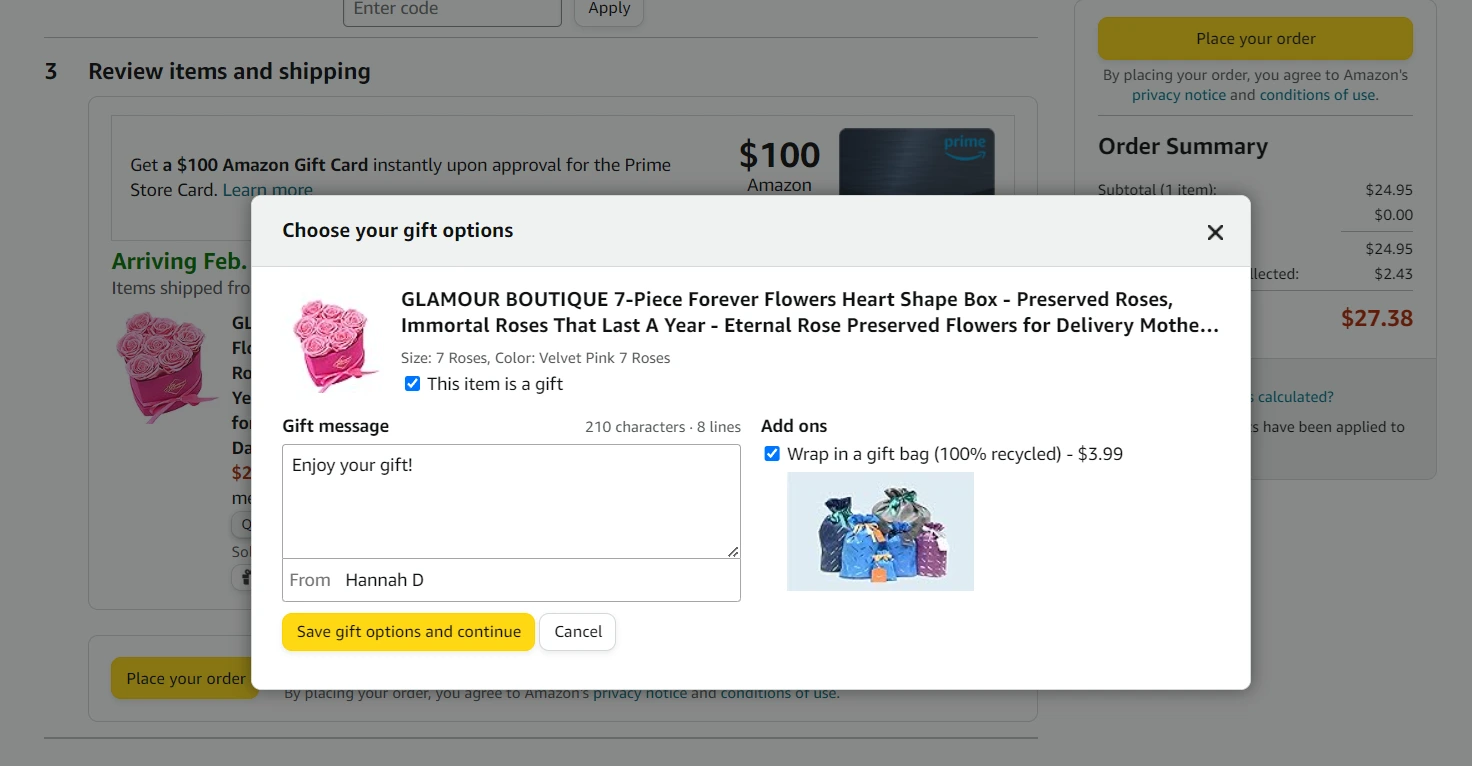 Amazon's "Choose your gift options" screen at checkout, from one of our own orders.
After checkout
- Sign in and open " Your Orders."
- Find the purchase and click " Share gift receipt."
- Copy the link and send it to the recipient by email or text.
Need the full version with prices for your own records? Our guide to getting any Amazon receipt walks through it in a few minutes.
How to get a gift receipt at Target
Target hands out paper gift receipts at any register if you ask, and the app and website can produce one after the purchase too.
In the Target app
- Open the app and tap the account tab.
- Tap " Purchase history" and choose the order.
- Tap " Return an item" (some versions of the app label it " Return options").
- Share the gift receipt from there.
On Target.com
- Sign in and open " Orders."
- Click " View orders" for the one you need.
- Click " Receipts and invoices," then choose " Print gift receipt."
The same purchase history covers regular receipts as well. Here is how to find any Target receipt, including in-store purchases tied to your card.
The $25 rule: when a gift receipt becomes a tax document
If you run a business, gift receipts pick up a second job. Client thank-yous, closing gifts, and holiday baskets for your best customers count as business gifts, and the IRS lets you deduct them, up to a hard ceiling. IRS Publication 463 states the limit in one sentence:
"You can deduct no more than $25 for business gifts you give directly or indirectly to each person during your tax year."
IRS, Publication 463, chapter 3
That $25 cap comes from Section 274(b) of the Internal Revenue Code (tax pros write it as IRC §274(b)), and Congress set it in 1962. Nobody has adjusted it for inflation since, which explains why it feels so low.
Our own numbers show how often businesses bump into that ceiling. Shoeboxed customers have scanned 19,369 receipts filed under business-gift categories, across 1,164 small businesses, and the median receipt comes to $47. Seven out of ten business-gift receipts in our system run over $25.
A $47 gift basket for a client is a normal thing to buy. The IRS just won't let you deduct more than $25 of it per person, no matter what you spent.
The $25 rule at a glance. A business can deduct up to $25 per recipient per year for gifts (IRC §274(b)), and the receipt showing the cost, date, and description of the gift is your proof.
A few more details from the same IRS publication worth knowing before you file:
- Incidental costs don 't eat your $25. Engraving, packaging, insuring, and mailing stay outside the limit, as long as they don't add substantial value to the gift itself.
- Cheap branded swag is exempt. A $4-or-less item with your business name permanently printed on it, handed out widely (pens, for example), doesn't count as a gift for the limit.
- Married couples share one limit. The tax code treats spouses as a single taxpayer here, even with separate businesses. The IRS's own example: a couple gives 3 gift baskets to a customer's executives and deducts $75 total.
- Your records need the cost, date, and description of the gift. That requirement comes straight from the publication's substantiation table, and a receipt captures all three in one slip of paper.
Now connect that to the receipt in your hand. When you buy a client gift, the gift receipt goes in the box for them. The regular receipt, the one with prices on it, goes in your tax file, because that itemized copy backs up your deduction if the IRS asks. Give away the gift receipt and keep the priced one.
Keep the receipts that save you money
Business gifts are easy to lose track of. They happen a few times a year, December most of all, when everything else is on fire and the receipt rides home in a shopping bag with the wrapping paper.
Our customers know this category matters, and they keep inventing it themselves. We pulled the numbers for this article and found over 1,400 spellings of gift categories, every one created by hand. Customers typed in "Client Gifts," "Business Gifts," "BUYER GIFTS," and a thousand other versions. People build those categories because they know the deduction is real. The receipts are the part that goes missing.
Shoeboxed closes that gap. Snap the receipt with our app before you leave the store, or forward the email receipt to your Shoeboxed inbox. If you'd rather skip the scanning, stuff the pile into a postage-paid Magic Envelope and mail it in. We pull the vendor, date, and total off each one and file it under a category, including a custom "Client Gifts" category if you want one. Then we keep it stored well past the IRS's standard three-year look-back window.
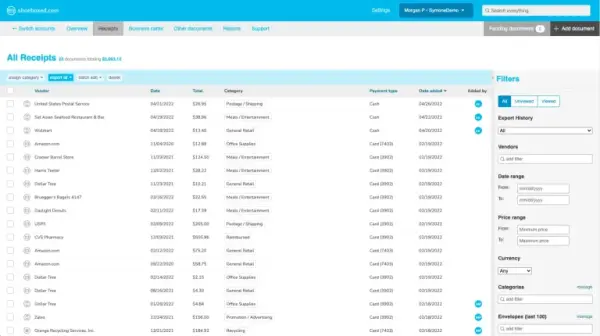 Receipts in the Shoeboxed dashboard: every scan gets a vendor, date, total, and category, searchable at tax time.
At tax time, you export an expense report with the receipt images attached and hand it to your accountant. The $25-per-recipient math becomes a five-minute conversation instead of a shoebox archaeology dig. And if you work from home, a bigger deduction may be waiting: our free home office deduction calculator estimates it from your address.
Never lose a receipt again. Join over a million businesses that scan receipts, sort them into tax categories, and build IRS-ready expense reports with Shoeboxed. See how it works.
Frequently asked questions about gift receipts
What does a gift receipt mean?
A gift receipt means the purchase came with a second copy of the receipt that hides the prices. It tells the recipient the item can be returned or exchanged, without telling them what it cost.
Can you see the price on a gift receipt?
No. The gift receipt hides the price from the person holding it. The store can still see the full transaction when they scan the barcode, which is how they process the return at the correct amount.
Can you get cash back with a gift receipt?
No. A gift receipt gets you an exchange or store credit for the item's value. Cash and card refunds go back to the original buyer with the original receipt.
Should you include a gift receipt with a gift?
Yes, especially for clothing, electronics, or anything that has to fit. It gives the recipient an easy way to swap the item, and it spares them from asking you for the receipt later.
Can a business deduct gifts to clients?
Yes, up to $25 per recipient per year under IRC §274(b). Keep the itemized receipt showing the cost, date, and description of the gift. Wrapping and shipping costs stay outside the $25 in most cases.
Final thoughts
A gift receipt does one small job well: it lets the person you care about return the sweater without learning what you paid for it. Ask for one at checkout, tuck it in the box, and you've covered the social side.
The business side takes one more step. If the gift went to a client, customer, or employee, the priced receipt in your pocket is worth real money, $25 per person at a time, on your Schedule C. That's the tax form sole proprietors file. Keep it somewhere that isn't a shopping bag, because that part is what we're good at.
About the author. I'm Doug. I bought Shoeboxed in late 2025 with an SBA loan after fifteen years of running other people's companies as CEO. I'd used Shoeboxed myself back in 2010 at a previous gig and called it magical even then. I use it daily now. Small business owners deserve every dollar they're legally entitled to keep, which is why I bought Shoeboxed and work hard to make it better.
Sources
- IRS, Publication 463, chapter 3 (Gifts): the $25 limit, incidental costs, the $4 exception, and the records you must keep.
- Cornell Law School Legal Information Institute, 26 U.S. Code §274(b): the statutory $25 ceiling on business-gift deductions.
- Shoeboxed internal data, June 2026: aggregated counts and totals from 19,369 receipts filed under business-gift categories across 1,164 customer accounts. No individual customer data is published.




 4.4 / 5 on