Types of Bookkeeping: How to Record Your Books and Who Should Do It
Every type of bookkeeping in plain English, plus who should keep your books: you, software, or a pro. Real costs and data from 57 million receipts.


Updated June 2026
The types of bookkeeping come down to two choices: how each sale and expense gets recorded (single or double entry, cash or accrual), and who does the recording (you, software, or someone you pay). For most small businesses, the cash method plus bookkeeping software covers the first choice, and the second one decides whether the books get done.
If you have not started at all, our step-by-step guide to bookkeeping shows a one-person business doing a month in an hour with a free spreadsheet.
For years I did my bookkeeping the worst way you can do it. I own a few small websites that I run through an LLC, and every spring I waited until the last week before the tax day to put my P&L; and balance sheet together. I'd scramble through a year of bank statements in one sitting and usually get something wrong. Then I'd pay my CPA extra to untangle the mess.
This is exactly what CPAs and bookkeepers tell you NOT to do. It usually means you miss out on tax savings, and it hands them a headache right when they're busiest and most stressed.
Then I bought Shoeboxed in late 2025, and keeping clean records became the thing my company does all day. So here's the answer I needed back when I was the one scrambling.
Every type of bookkeeping you'll read about answers one of two questions. First: how do you record each sale and expense? Second: who does the recording, you, software, or someone you pay? The first choice barely matters for a small business. The second one decides whether your books get done at all. Here's the whole map in 30 seconds, with real dollars on each option further down.
"Of 3,017 active Shoeboxed accounts that each scanned 100 or more receipts, only 108 ever recorded a dollar of income. The other 96% tracked their spending and nothing else."
Shoeboxed customer data, June 2026
The types of bookkeeping, in 30 seconds
The map has two halves, one for each question: how the money gets recorded, and who does the recording.
How transactions get recorded:
- Single-entry: each transaction gets written down once, like a checkbook. It works for simple cash businesses.
- Double-entry: every transaction gets written down twice, once on each side of the books, so mistakes show up on their own. Any software you'd buy does this for you in the background.
- Cash-basis: you count income when the money arrives and expenses when you pay them. If you file a Schedule C, the IRS lets you use it.
- Accrual-basis: you count income when you earn it and expenses when you owe them. The IRS forces it only on companies selling over $26 million a year, and on some businesses with inventory.
Who manages the books:
- You, by hand (manual): a paper ledger or a plain spreadsheet.
- You, with software (computerized or cloud): QuickBooks, Xero, or Wave.
- A part-time or freelance bookkeeper: a person you pay by the hour or by the month.
- An outsourced or virtual bookkeeping service: a company that keeps the books remotely.
- An in-house bookkeeper: an employee on your payroll, once there's enough work to keep one busy.
The verdict for most one-person businesses: count money when it comes in or goes out (the cash method), use bookkeeping software so the accounting math runs itself, and update your books every week. Which type you pick matters far less than whether the books get done. The rest of this article puts real numbers on each choice, drawn from the 57 million receipts our customers have sent us since 2007.
Single entry, double entry, cash, accrual: why the choice barely matters at your size
Single-entry bookkeeping means one line per transaction: the date, what it was, and whether money came in or went out. A checkbook register is single-entry, and so is a clean spreadsheet with one row per expense. Double-entry records the same transaction in two places, a debit and a credit, so the two sides always have to balance.
Accountants prefer double-entry because the two sides have to match, so a typo shows up as books that won't balance. You don't have to learn it, though. QuickBooks, Xero, and Wave run double-entry under the hood while showing you a plain list of transactions. You get the error-checking without ever learning the accounting terms.
Cash versus accrual is the other recording choice. IRS Publication 538 spells out the cash method:
"Under the cash method, you generally report income in the tax year you receive it, and deduct expenses in the tax year in which you pay the expenses."
In plain English: count the money when it moves.
You tell the IRS which one you use on line F of your Schedule C. Line F offers three checkboxes: Cash, Accrual, and Other. The IRS allows cash for any business selling under $26 million a year. Cash also matches how you already think about money, so that's the box a typical one-person service business checks.
One wrinkle: a business that sells products usually has to track its unsold stock (an inventory) and count those sales the accrual way. Below the same $26 million line, the IRS waives that too, so a small seller can stick with cash.
| Recording type | What it means | Who it fits | Do you have to choose it? |
|---|---|---|---|
| Single-entry | One line per transaction, like a checkbook | Solo businesses with simple money | No. A spreadsheet does this by default |
| Double-entry | Each transaction recorded as a debit and a credit | Anyone who uses bookkeeping software | No. The software runs it for you |
| Cash-basis | Count income when received, expenses when paid | Schedule C filers and other small operations | Yes. Check the cash box on Schedule C line F |
| Accrual-basis | Count income when earned, expenses when owed | Bigger companies and inventory-heavy businesses | Only if the IRS makes you (over $26M a year in sales) |
| The four recording types. For a small service business, the everyday combination is cash-basis records with software quietly running the double-entry. |
So if the recording method barely matters at your size, why do so many small-business books still fall apart? We see the answer every day in our own data, and it has nothing to do with debits.
What your books are missing: the half-a-ledger problem
While building our free accounting template, I pulled two years of receipts from 3,017 active Shoeboxed accounts. Each of those accounts had scanned at least 100 receipts. That's close to two million receipts from businesses that already track their spending carefully. Then I checked how many of those accounts had ever recorded a dollar of income.
Only 108 of the 3,017 ever had. The other 96% kept a careful record of what they spent and no record of what they earned.
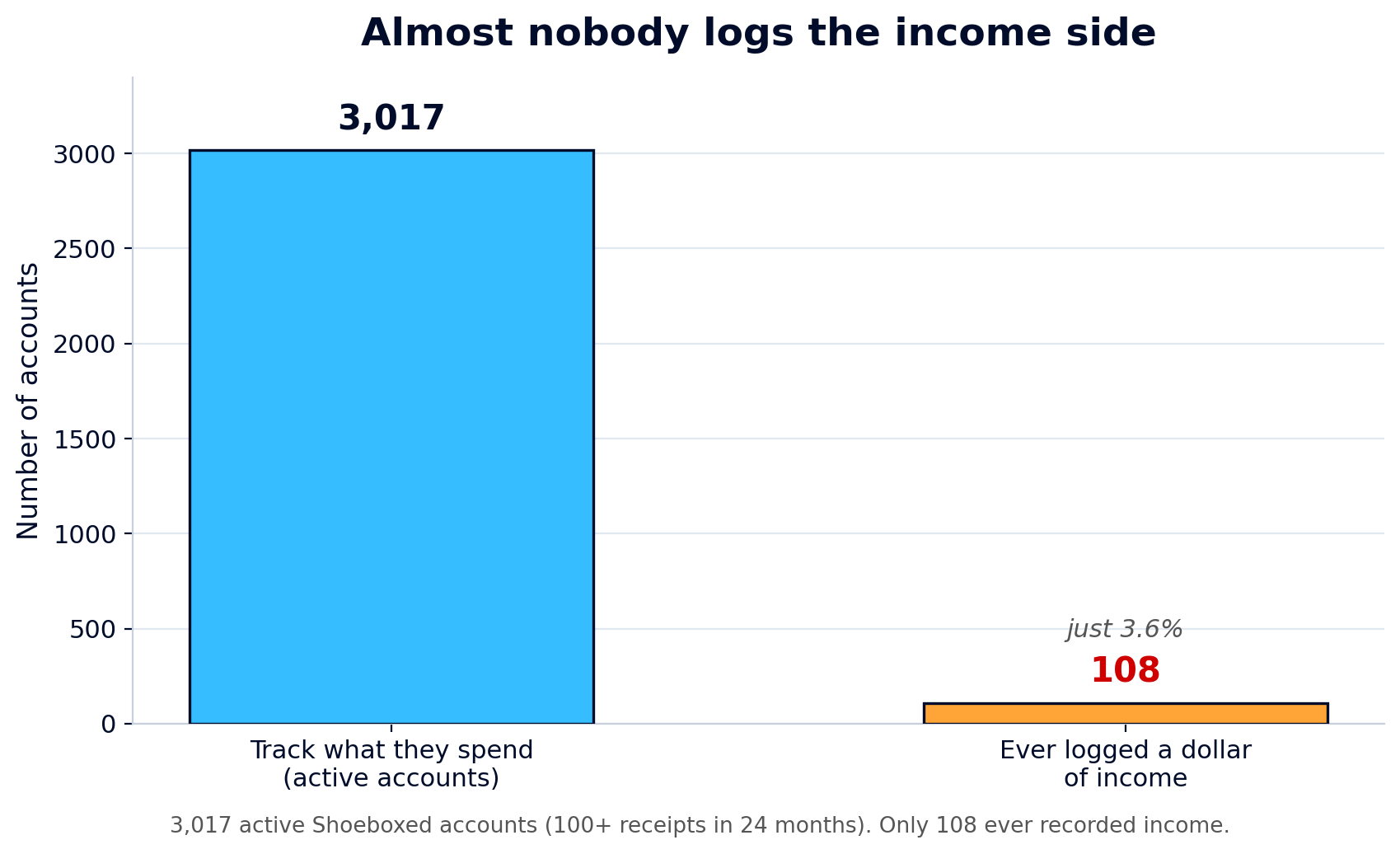 Of 3,017 active Shoeboxed accounts, only 108 ever logged a dollar of income. The other 96% kept half a ledger.
I call that half a ledger. Your profit is income minus expenses, and a spreadsheet that only saw the expenses can't tell you what you made. You end up guessing at your quarterly estimated taxes. Guessing is how you hand the IRS extra money all year, or how you get an April bill you didn't see coming. Remember, your tax return ends with one number on Schedule C line 31: your net profit. Half a ledger can't produce it.
The expense half is messier than it looks, too. Since 2007, our customers have invented 186,981 different category labels. Schedule C sorts all of that into roughly two dozen lines. Labels for food and meals alone account for 5,886 of them: Meals, Business Meals, Meals & Entertainment, versions with a year bolted on, versions with typos. Another 10,902 are the same label typed slightly differently, with an extra space, a stray comma, or different capital letters.
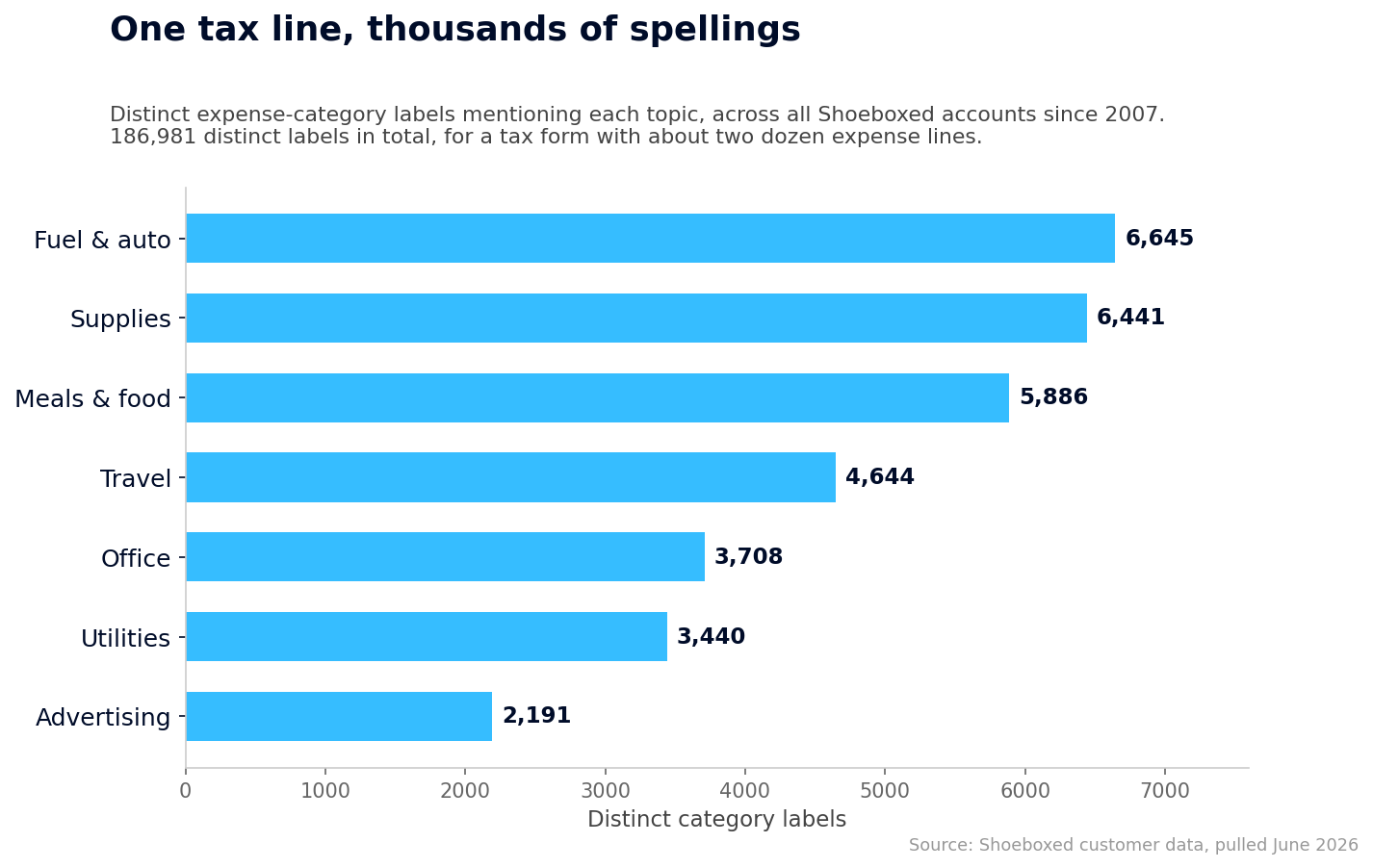 186,981 distinct category labels for a tax form with about two dozen lines. Meals and food alone exist in 5,886 spellings.
And the most common category of all is no category. Since January 2024, 38.1% of the 3.4 million receipts our customers sent in arrived with no category assigned. An expense with no category is a deduction nobody claims in April.
All three numbers come from the same problem, and it isn't the method. The recording got skipped, week after week, because recording is a chore. So spend less worry on single versus double entry and more on who keeps the books current. That choice comes with real price tags.
Who does the recording: you, software, or a person you pay
Now for the second question: who does the recording. You have five real options, the same five from the map, and each one costs money, evenings, or both.
Doing it yourself by hand costs nothing but time, and the time is what disappears first when business picks up. Software runs the double-entry and the math for you. But you still do the typing, and the typing is what gets skipped when a week gets busy. Skipped weeks are how a business ends up with the blank categories you saw a minute ago.
A bookkeeper isn't free, but it isn't mysterious either. The Bureau of Labor Statistics says the median (middle-of-the-pack) bookkeeper salary is $49,210 a year as of May 2024. That works out to $23.66 an hour at full-time hours.
From there, the hired paths split three ways. A part-time or freelance bookkeeper charges by the hour or a small monthly retainer. An outsourced or virtual bookkeeping service charges a monthly fee and keeps the books remotely. An in-house bookkeeper goes on your payroll, which starts to make sense once there's enough work to fill their week.
| Path | What it costs | What it costs you in time | Best when |
|---|---|---|---|
| DIY by hand (manual) | Free | The most. Every entry is yours | A tiny cash business with few transactions |
| DIY with software (cloud) | A monthly subscription | Less math, same typing | You'll keep a weekly habit going |
| Part-time or freelance bookkeeper | Hourly or a monthly retainer; rates vary by market | A monthly review on your end | The books outgrew your evenings |
| Outsourced or virtual service | A monthly fee; varies by market | A review now and then | You want the whole job done for you |
| In-house bookkeeper | $49,210 median salary (BLS, May 2024) | None. It's their job | Enough volume to fill an employee's week |
| The five who-does-it paths. The BLS salary figure anchors what bookkeeping labor costs; freelance and service pricing varies by market. |
You'll notice I didn't print freelance or service rates, and that's on purpose: they swing too much by market for a number you should trust. Use the salary math as a gut check instead. Bookkeeper labor runs about $24 an hour before a service adds overhead and profit. So when a service quotes you a monthly price, divide it by $24. That's roughly the most hours of real bookkeeping attention your money can buy each month.
When to hand it off, and what a bookkeeper does all day
People ask for a revenue number that means it's time to hand off the books, and there isn't one. Watch for the Sunday night you catch yourself dreading the typing instead. A simpler tripwire: if you've skipped two months in a row, the habit isn't coming back on its own. You skip a week, then another one, and by April you're holding half a ledger.
I stopped doing the books at night, and that was the year my bad Aprils ended. Until then, I paid my CPA extra every spring to untangle the mess I'd made, and the untangling cost more than the recording ever would have.
So what does a bookkeeper do all day? The job is plain, steady work, and none of it requires magic. They record the transactions you didn't and sort each one into the right category.
They match the books against the bank statement so the two agree, which bookkeepers call reconciling. Then they close out the month so you and your CPA can trust the numbers. If you want to do that work yourself, our monthly bookkeeping checklist lists every task, in order.
That recording-reconciling-closing loop has a name, and our plain-English guide to the accounting cycle walks all five steps.
And if your books are months behind right now, don't wait for the perfect system. Capture the paper today, so whoever does the catch-up has something real to work from. (Capturing is the part Shoeboxed does for you.)
Bookkeeping as a career: pay, certifications, and the no-degree truth
Run a business and just want the books handled? Skip to the next section. This part is for the people who want the job.
This last stretch is for the other reader: the person thinking about doing bookkeeping for pay. You don't need a degree, and the Bureau of Labor Statistics calls certification optional. In the BLS's words, certification "can help to demonstrate competency." It's helpful, not required.
The pay is real, and so is the pressure from software. The BLS puts the median at $49,210 a year as of May 2024, with the bottom tenth under $34,600 and the top tenth over $72,660. The same agency projects the role to shrink 6% by 2034 as software takes over the data entry. It still expects about 170,000 openings a year as people retire or move up. Software is taking the typing, while the openings stay open for people who can check its work.
Three certifications come up when you research this, and they're not interchangeable. Intuit runs the free one. Two industry groups run the paid ones: the American Institute of Professional Bookkeepers (AIPB), and the National Association of Certified Public Bookkeepers (NACPB).
| Credential | Who runs it | What it costs | What it asks of you |
|---|---|---|---|
| QuickBooks Online ProAdvisor | Intuit | Free, through a free QuickBooks Online Accountant account | Pass the certification exam; recertify annually |
| Certified Bookkeeper (CB) | AIPB | $1,495 for the online course, which includes registration, workbooks, and exam fees | A national exam plus 2 years full-time experience, or 3,000 part-time hours |
| Certified Public Bookkeeper (CPB) | NACPB | Sold per course on a monthly plan; no public all-in price | A three-part exam, courses, and one year of supervised experience; ends with job assistance |
| The three bookkeeping credentials people weigh, with costs from each organization's own site as of June 2026. |
Which one gets you hired? Start with the free one. Small companies run their books on QuickBooks, while bigger companies run bigger systems. The SBA counts 99.9% of US businesses as small, so QuickBooks skill covers where most of the jobs are.
The paid credentials earn their fee later, when you go freelance and need strangers to trust you. AIPB reports that 37% of its freelance Certified Bookkeepers say being certified helped them gain new clients. NACPB's program closes with job-placement help through its affiliated firm.
How long to keep the records: three years, not seven
One more rule, and it saves you shelf space. The "keep everything for seven years" advice gets repeated everywhere. The IRS itself says something shorter: keep records for three years from the date you filed, for most filers.
The window stretches in two situations. It runs six years if you leave more than 25% of your income off the return, and it never closes if you skip filing or file a fraudulent return. If your books are honest and you file on time, three years is all the IRS asks.
Keep the scan, not the paper. Thermal receipts fade toward blank inside a year or two, and the digital copy is the one you'll find if a letter ever shows up.
The easy way: let the receipts file themselves
Our own data shows what happens when the typing becomes a chore. People stop logging income, categories go blank, and the books quietly drift out of date. That's the reason Shoeboxed exists: we do the typing for you. Snap a photo of a receipt in the app, forward the email ones, or mail us the whole pile in a Magic Envelope.
Our team in Durham scans the paper, and our software pulls out the date, vendor, total, and category, building the expense log the IRS wants. Your bookkeeper can work right inside your account, and you can export everything whenever you like.
Shoeboxed starts at $9 a month, and web signup carries a 30-day money-back guarantee: try it for a month, and if it isn't for you, we refund the money. Start a Shoeboxed account → The mobile app comes with a 7-day free trial, no payment required up front:


If you want to go deeper, our monthly bookkeeping checklist lays out the weekly routine, and contractors get their own guide to bookkeeping for independent contractors. Our free Google Sheets accounting template maps every category to its Schedule C line. The income and expense worksheet starts simpler. The free home office calculator and mileage log template cover the two deductions that go missing from expense-only books.
Helping you keep more of your hard-earned money is the whole point.
Frequently asked questions
What are the 4 types of bookkeeping?
People usually mean the four recording types: single entry, double entry, cash basis, and accrual basis. The first pair describes how each transaction gets written down, and the second pair describes when income and expenses count. They're two separate choices, not four competing systems.
What are the three types of bookkeeping?
Lists of three usually name single entry, double entry, and computerized (or virtual) bookkeeping. That last one mixes a recording method with a way of managing the books. The cleaner split is two questions: how you record (single or double entry, cash or accrual) and who records it (you, software, or someone you pay).
What does a bookkeeping service do?
A bookkeeping service keeps your books up to date for a monthly fee. It records transactions, sorts each one into a category, matches the books against your bank statement, and closes each month. Along the way it keeps the records the IRS expects under Publication 583.
How much should I pay a bookkeeper per hour?
Start from what the work itself pays. The median bookkeeper salary of $49,210 works out to $23.66 an hour as an employee wage, and a freelancer charges more than that because they cover their own overhead and taxes. Rates swing by market, so compare any quote against that hourly wage, not against another company's quote.
Is it hard to learn bookkeeping?
No. The concepts fit in an article like this one, and Intuit's free ProAdvisor training covers the software. The hard part is doing the recording every single week, and that part stays hard whether or not you're certified.
Is AI replacing bookkeepers?
Software keeps taking the data entry, and the BLS projects 6% fewer bookkeeping-clerk jobs by 2034. The same projection counts about 170,000 openings a year as people retire or move up. The work that stays human is judgment: catching what the software mislabeled and explaining what the numbers mean.
About the author
I'm Doug. I bought Shoeboxed in late 2025 with an SBA loan and 5% down, so I run a small business and sweat the same tax bill you do. The April scramble at the top of this article is my own. I write these guides because the surest way to grow Shoeboxed is to help people keep more of what they earn.
Sources
- IRS Publication 538: Accounting Periods and Methods
- IRS Schedule C Instructions and Schedule C (Form 1040)
- IRS: How long should I keep records?
- IRS Publication 583: Starting a Business and Keeping Records
- BLS Occupational Outlook Handbook: Bookkeeping, Accounting, and Auditing Clerks
- AIPB Certification Program and AIPB CB Online Course
- NACPB Certified Public Bookkeeper License and NACPB CPB Program
- Intuit QuickBooks ProAdvisor Program
- SBA Office of Advocacy: Frequently Asked Questions About Small Business (2024)




 4.4 / 5 on