What Is a Purchase Receipt? (And How to Make One)
A purchase receipt is the proof you get when you buy something. Here's what's on one, how it differs from an invoice, and how to write one in five minutes.


Updated June 2026.
A purchase receipt is the proof you get when you buy something. It shows what you bought, the date, what you paid, and how you paid. The seller hands it to you. You keep it as proof the sale is done and the thing is now yours.
You're probably here for one of two reasons. Maybe someone handed you a receipt, and you want to know what it is and whether to keep it. Maybe you sell something, a customer asked for a receipt, and you need to write one. This guide covers both, and it sorts out the words that get tangled up with it: invoice, sales receipt, proof of purchase.
I'm Doug. I own Shoeboxed, and since 2007 we've scanned over 57 million receipts for more than 552,000 small businesses. The plain purchase receipt, the everyday slip from a store or a vendor, is the most common one in that pile. So I've seen what a good one looks like and what a useless one looks like.
What a purchase receipt is
A purchase receipt is the receipt from the buyer's side of the counter. You paid for something, and the seller gave you a slip that proves it. That's the whole idea.
The word "purchase" is the giveaway. It's the receipt for a purchase you made. If you sold the item instead, your copy of that same sale would be a sales receipt. One sale, two names, depending on which side of the counter you're on.
A purchase receipt can be a printed slip from a register, a handwritten page torn from a receipt book, or an email that lands after you pay online. The format doesn't matter. What matters is that it shows the sale happened and you paid.
Purchase receipt vs. invoice, sales receipt, and proof of purchase
These four terms get used like they mean the same thing. They don't. Here's the plain-English split.
| Term | Whose view | When it's made | What it says |
|---|---|---|---|
| Purchase receipt | The buyer's | After you pay | "You paid, and this is yours now." |
| Sales receipt | The seller's | After the customer pays | "Your customer paid you." The seller's copy of that same sale. |
| Invoice | The seller's | Before payment | "Here's what you owe." A bill, not proof you paid. |
| Proof of purchase | The buyer's | Any time after buying | The umbrella term. A purchase receipt is the most common kind. |
The one that trips people up most is the invoice. An invoice is a request for payment, so it comes first. A receipt is proof of payment, so it comes after.
So if you're holding a document that asks you to pay, it's an invoice. If you're holding one that says you already paid, it's a receipt. For the seller side of this, our guide to the sales receipt walks through writing one, and the independent contractor invoice template covers the invoice.
"Proof of purchase" is the loosest of the four. It just means any document that shows you bought something, which a purchase receipt does perfectly. A bank or card statement can also serve as proof of purchase in a pinch, though it shows less detail than the receipt itself.
What goes on a purchase receipt
A good purchase receipt answers five questions: who you bought from, what, when, how much, and how you paid. Here's what that looks like, line by line.
- The seller's name and contact. Who you bought from, at the top.
- A date and a receipt number. The date the sale happened, plus a number so you can find it later.
- The items, with quantity and price. Each thing you bought, how many, and what each cost.
- The totals. Subtotal, sales tax, and the final amount.
- How it was paid. Cash, card, check, or an app like Venmo or Square, plus the last four digits if it was a card.
Here's a filled-out example so you can see all of it on one slip.
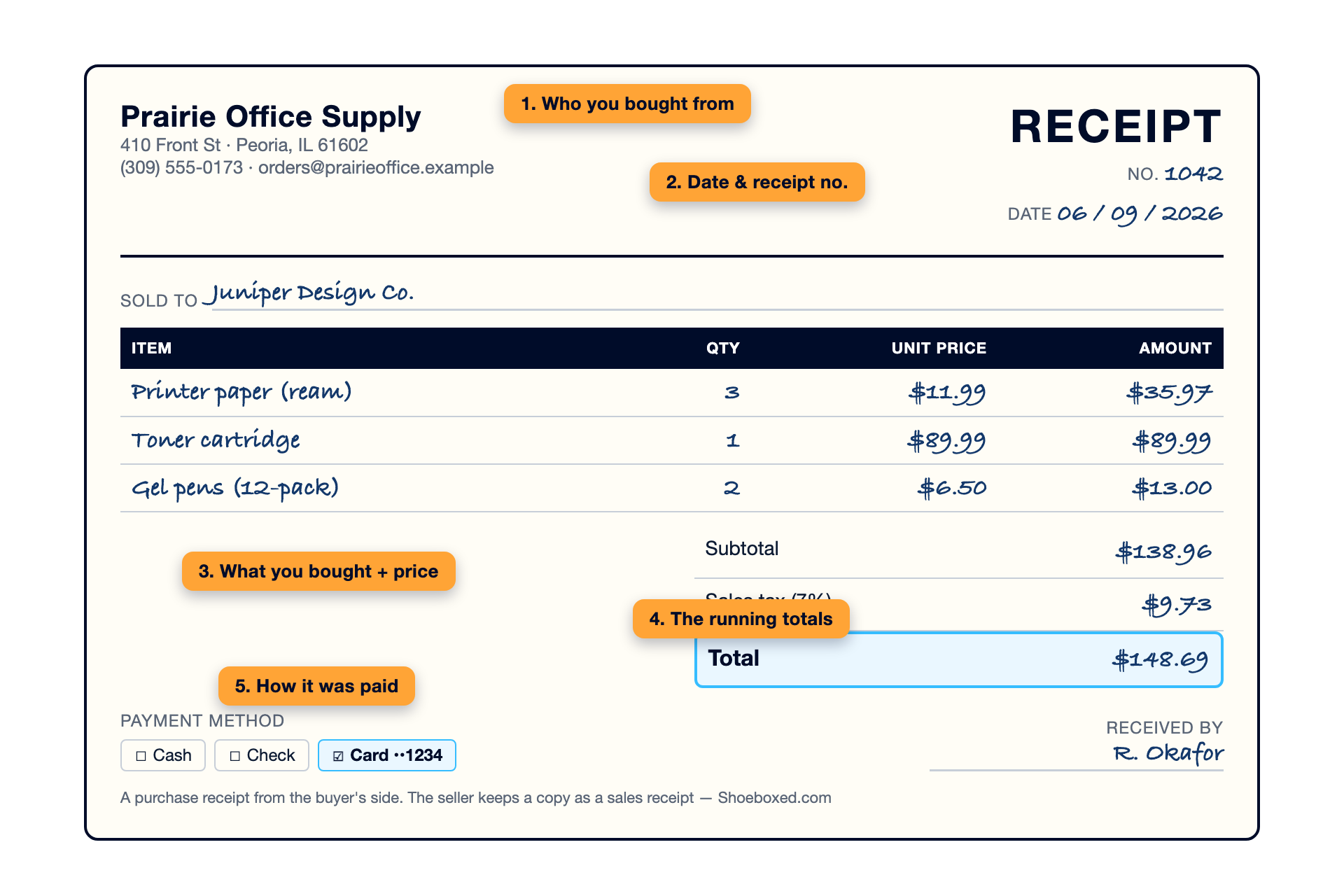
Those details aren't just good manners. They're the same things the IRS looks for when a purchase receipt has to double as tax proof. Publication 463 spells it out:
"Documentary evidence ordinarily will be considered adequate if it shows the amount, date, place, and essential character of the expense."
IRS, Publication 463
Amount, date, place, and what it was for. A normal purchase receipt shows all four, which is why a shoebox of plain store slips is worth keeping if you run a business. The fuller rules on when a receipt is required live in our guide to IRS receipt requirements.
How to make a purchase receipt
If you're the seller, making a purchase receipt for a customer takes about five minutes. Here's the whole thing in six steps.
- Put your business name and contact at the top.
- Add the date and a receipt number.
- List each item, the quantity, and the price.
- Add up the subtotal, the sales tax, and the total.
- Note how the customer paid.
- Hand them the original and keep a copy for your records.
You can do this two ways: by hand or on a computer.
By hand, with a receipt book
The simplest tool is a carbonless receipt book, the kind that runs about five dollars at any office store. You write the receipt once, and the page underneath copies it for you at the same time. You hand over the top sheet and keep the one beneath it.
No printer, no power, nothing to set up. Our guide to receipt books shows how the two-copy trick works.
On a computer, with a template
To type it instead, set up a one-page template: your business name at the top, then a row for each item with its quantity and price, and the totals at the bottom. Save a customer's details so you don't retype them next time. Print it, or email it as a PDF. An emailed receipt is a digital receipt, and it counts the same as a paper one.
Either way, the math is the part to get right. Double-check that the line items add up to the subtotal and that the tax and total are correct. A receipt with a math error is a headache to untangle later.
What to do with your purchase receipts once you have them
Making or getting the receipt is the easy part. The hard part is still having that exact slip two or three Aprils later, when your accountant asks about a number on your return.
If you run a business, your purchase receipts are your deductions. Every one you keep is a number you can back up. Lose it, and you're either guessing or leaving money on the table.
The catch is that store receipts print on thermal paper, and that ink fades to a blank slip in a year or two, faster in a hot car or glovebox. A faded receipt proves nothing. That's the job I bought Shoeboxed to do.
So the move is to get a copy saved before the ink gives up. Send a receipt to Shoeboxed. We keep the actual image, then our software pulls out the fields the IRS wants to see: the vendor, the date, and the total. You can get receipts to us five ways:
- Snap a photo in the app before the slip leaves your hand.
- Drop the paper in a prepaid Magic Envelope and mail it to us.
- Forward an emailed receipt to your Shoeboxed address.
- Let our Gmail plugin pick up emailed receipts on its own.
- Upload or drag and drop on the website.
Everything lands in one searchable account, sorted into categories, ready to become an expense report. We keep it all for as long as you have an account, and if you ever leave, you can download every bit of it. For the bigger picture, here's our guide to storing business receipts and a full map of the types of receipts you'll run into.
How long to keep them? The IRS can look back three years on a normal return, six years if you left out more than 25% of your income, and seven if you wrote off a bad debt or a worthless investment. My rule for most small businesses: keep everything seven years and stop thinking about it.
Never lose a purchase receipt again. Join the small businesses that scan their receipts, sort them into categories, and build IRS-ready expense reports with Shoeboxed. Pricing starts at $9 a month, and the web plan is risk-free with a 30-day money-back guarantee. See how it works.
Frequently asked questions
What is a purchase receipt?
A purchase receipt is the proof you get after you buy something. It shows what you bought, when, how much you paid, and how you paid. The seller hands it to you, and you keep it as proof the sale is done and the item is yours.
What is the difference between a purchase receipt and an invoice?
An invoice is a request for payment that comes before you pay. A purchase receipt is proof of payment that comes after. The invoice says what you owe, and the receipt says you paid it.
Is a purchase receipt the same as a sales receipt?
They cover the same sale from two sides of the counter. The buyer keeps a purchase receipt; the seller keeps a sales receipt. Same transaction, same details, two copies.
How do I make a purchase receipt?
Put your business name and contact at the top, add a date and a receipt number, list each item with quantity and price, total it up with tax, and note how the customer paid. Hand them the original and keep a copy. You can write it in a receipt book by hand or fill in a template on your computer.
Do I need to keep my purchase receipts?
Yes, if you run a business. A purchase receipt backs up an expense you deduct on your taxes. The IRS wants the amount, date, place, and what it was for, and a normal store receipt shows all four. Keep them at least three years.
Final thoughts
A purchase receipt is a small thing with one job: proving you bought what you bought. From the buyer's side it's a purchase receipt; from the seller's side it's a sales receipt; before you pay it's an invoice. Once you know which one you're holding, the rest is easy.
Making one takes five minutes. Keeping one until you need it is the real work, and that's the part we handle. Save your receipts, file them, and they'll outlast the ink.
About the author. I'm Doug, and I bought Shoeboxed in late 2025 with an SBA loan after fifteen years of running other people's companies as CEO. I'd used Shoeboxed myself back in 2010 at a previous job and called it magical even then, and I use it daily now.
Small business owners deserve every dollar they're entitled to keep, which is why I bought Shoeboxed and work to make it better.
Sources
- IRS, Publication 463, on what counts as adequate documentary evidence for a business expense.
- IRS, How long should I keep records, on the 3, 6, and 7 year windows.




 4.4 / 5 on