Owner-Operator Trucking Expense Spreadsheet: Free for 2026 (With Per-Diem Tracker)
Free owner-operator trucking expense spreadsheet for 2026 — Google Sheets, Excel, PDF, CSV. Built-in per-diem log auto-calculates the $80/day deduction most truckers miss.

Owner-Operator Trucking Expense Spreadsheet: Free for 2026 (With Per-Diem Tracker)
By Doug
Last updated: May 2026
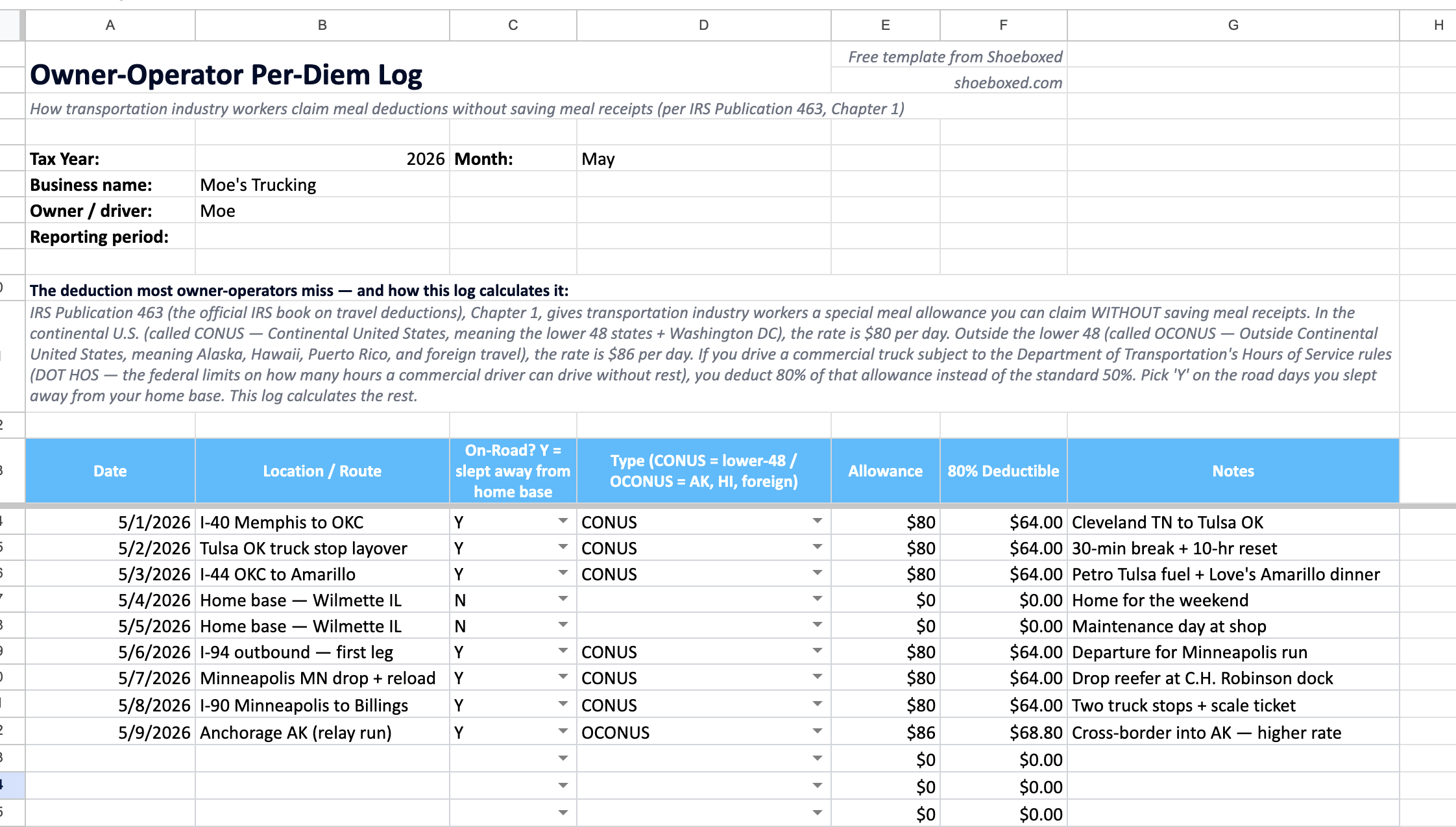
The Per-Diem Log tab open in Google Sheets. Nine sample road days showing how the $80/day CONUS allowance and the 80% DOT hours-of-service deduction work in practice. Two home-base rows show $0 — per-diem only applies when you sleep away from your tax home.
I went looking through ten years of trucker receipts and found something every owner-operator should know.
Across 8 owner-operator and trucking accounts on Shoeboxed since 2016 — 12,601 receipts total — fuel makes up 63.6% of every receipt logged. Maintenance, tolls, permits, insurance, lodging — all the obvious stuff. Meal entries make up just 4% of receipts. The per-diem deduction that the IRS gives transportation industry workers? Almost zero entries across the whole cohort over ten years.
Per IRS Publication 463, Chapter 1, transportation industry workers can claim $80 per day for meals inside the continental United States, with no receipts required. With the 80% rule for drivers under Department of Transportation hours-of-service limits (Pub 463 §2), that works out to $64 a day deductible. For a typical owner-operator on the road 280 days a year, that's $17,920 in Schedule C deduction. At a 24% federal bracket plus 15.3% self-employment tax — roughly $7,000 in tax you didn't have to pay.
A real owner-operator asked the same math on the TruckersReport forum recently: " As it was explained to me, a truck driver gets 80% of $80 per day written off, 271 days total for me. Do I have that correct?" He has it right. Most truckers have never seen the rule.
This spreadsheet is built around that gap.
TL;DR, the four steps:
- Copy the spreadsheet into your Drive (or grab the Excel, PDF, or CSV).
- Log every fuel receipt + every business receipt on the Daily Expenses tab.
- Flip to the Per-Diem Log tab every road day you sleep away from home base.
- Total at month-end. Keep records 3 years from filing date (IRS Pub 583).
Get the free Owner-Operator Trucking Expense Spreadsheet
All four formats share the same three-tab structure and the same dropdowns. Pick the one that fits how you work.
- Google Sheets (one-click copy). Hit the link, click Make a copy , your copy lands in your Drive. Auto-totals as you type. Share with your accountant in two clicks.
- Excel (.xlsx). Same three tabs, same dropdowns, same formulas. Opens in Excel 2010 and later.
- PDF. Print-ready, two pages (Daily Expenses on page 1, Per-Diem Log on page 2). Fill in by hand.
- CSV. Raw rows for QuickBooks, your bookkeeper's import, or your own spreadsheet.
The spreadsheet belongs to you the moment you click. We don't ask for your email, we don't run a trial in the background, we don't gate the download behind a signup. We built it because every other free trucker template we found ships with one big problem: no per-diem tracker. Off-the-shelf templates don't capture the single biggest deduction most owner-operators miss.
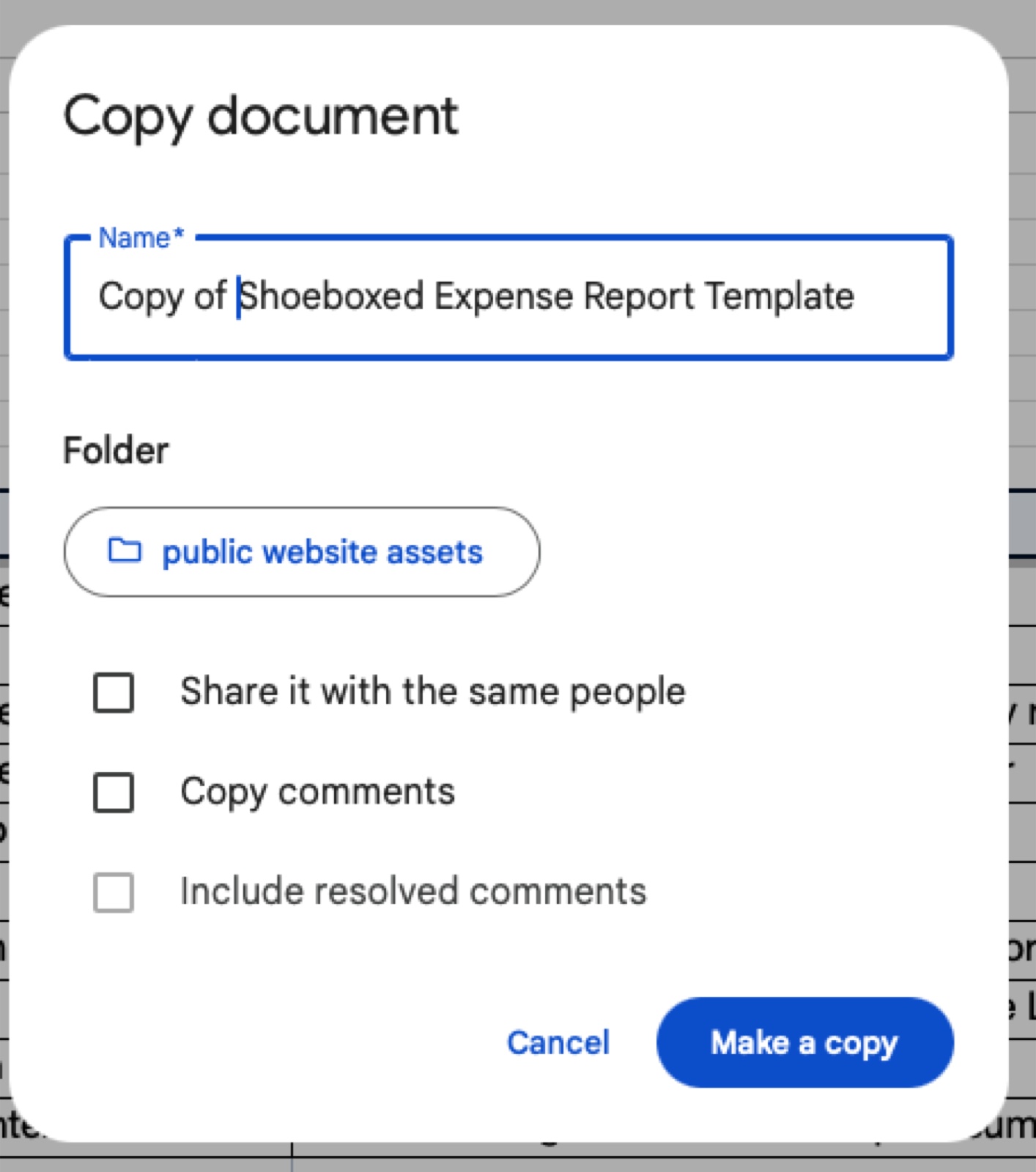 One click, one Make a copy, the spreadsheet lives in your Drive.
The per-diem gap most owner-operators don't know about
Here's the cohort number that surprised me when I went looking through our trucker data.
Across 8 owner-operator and small-fleet trucking accounts on Shoeboxed going back to March 2016, we logged 12,601 receipts across 10 years. 63.6% of those receipts are fuel. That's 8,019 individual fuel-stop receipts — six of the eight accounts log every fill at every Pilot, Flying J, Love's, and TA. Truckers photograph and file the fuel side religiously.
Meal entries make up just 4.0% of receipts across seven of the eight accounts. That's 507 meals over a decade of road life. If those drivers tracked actual receipts for every meal they ate on the road, you'd expect 30 to 50 entries per driver per year. Per-diem accounting would push that number toward 280 entries per year — one for every road day. Neither pattern shows up in the data.
The per-diem deduction is sitting there in IRS Publication 463, Chapter 1, and almost nobody is using it.
A real owner-operator on the TruckersReport forum just learned about it from a tax expert and asked the forum if he had it right:
" Now that I'm free to take per diem, it makes up for the self employment tax… a truck driver gets 80% of $80 per day written off, 271 days total for me. Do I have that correct?"
He has it right. The reply on the forum confused him further by mixing up the IRS special standard meal allowance with employer-provided per-diem-pay programs — they're different things. The IRS rule is the one he was asking about, and it's the one this spreadsheet is built to capture.
How the per-diem rule actually works
Two questions to answer. Do you qualify, and how do you calculate it.
Do you qualify? Per IRS Publication 463, Chapter 1, the special standard meal allowance applies to workers whose jobs " directly involve moving people or goods by airplane, barge, bus, ship, train, or truck." If you drive a commercial truck as an owner-operator and you regularly travel away from your tax home, you qualify. The tax home is the general area of your main place of business — usually your home base if you maintain one. Nomadic drivers without a fixed home address can disqualify themselves, so this matters most if you actually have a home you return to.
How much? Per Pub 463 §1:
" You can claim a standard meal allowance of $80 per day ($86 for travel outside the continental United States) in 2025."
CONUS = Continental United States, meaning the lower 48 states plus Washington DC. OCONUS = Alaska, Hawaii, Puerto Rico, and foreign travel. The $80/$86 rate is set annually by IRS Notice (typically published in September for the federal fiscal year starting October 1).
The 80% bonus. Per Pub 463 §2:
" If you are subject to the Department of Transportation's 'hours of service' limits, you can deduct 80% of your business-related meal expenses."
The federal rules at 49 CFR §395.3 set the DOT hours-of-service limits — 11 hours max driving per shift, 14-hour on-duty window, 10 consecutive hours off-duty, 60-70 hours per week. If you drive a Class 7 or Class 8 commercial truck in interstate commerce, you fall under those rules. You deduct 80% of the meal allowance instead of the standard 50% non-transportation rate.
The math. $80 × 80% = $64 a day deductible. For an owner-operator on the road 280 days a year (typical OTR mileage of 100K–120K business miles annually maps to 250–290 road days), that's $17,920 in Schedule C deduction , every year. At a 24% federal bracket plus 15.3% self-employment tax — about 39% combined — that's $6,989 in tax you didn 't have to pay.
The catch. You pick one method for the entire year. Either per-diem (this rate, no receipts, simpler) or actual meal receipts (every receipt, also 80% deductible, more paperwork). For almost every owner-operator I've talked to, per-diem wins. Per-diem is less hassle and usually a bigger deduction. The Per-Diem Log tab in this spreadsheet handles the per-diem method.
The 15 expense categories real owner-operators use
The Daily Expenses tab ships with 15 categories drawn from the cohort data and from looking at what owner-operators actually log:
- Fuel / Diesel — 63.6% of receipts in our cohort
- Maintenance & Repairs — engine, drivetrain, tires, fluids
- Truck Payment / Lease — tractor financing
- Trailer Payment / Lease
- Insurance — liability, physical damage, cargo, occupational accident
- Tolls & Weigh Stations — including PrePass and EZ-Pass replenishments
- Permits & Licenses — IFTA quarterly, HVUT Form 2290 ($550/year for trucks ≥75,000 lb), state apportioned registration, MC authority renewal
- ELD & Compliance Software — electronic logging, DQF, drug-and-alcohol consortium fees
- Lodging — hotel nights when you're not sleeping in the bunk
- Communication — CB, satellite, phone
- Office Supplies & Logbooks — paper supplies, printer ink, file storage
- Professional Fees — CPA, accountant, tax-preparation services
- Tools & Equipment — straps, chains, gloves, dashcam, GPS
- Truck Wash / Detail
- Other — for the edge case
Here's the number that worried me most when I went through the data. 19.6% of those 12,601 trucker receipts have no category attached at all. Almost 1 in 5. The drivers who filed them knew what each receipt was for at the time, but a year later at tax time, "what was this $124.32 at Travel Centers America on a Tuesday in March?" becomes a guess. Guesses don't survive an audit.
The fix runs through pre-defined dropdown categories, not free text. The 15 above are baked into the Category column as a Data Validation dropdown. You pick from the list. Your records stay readable.
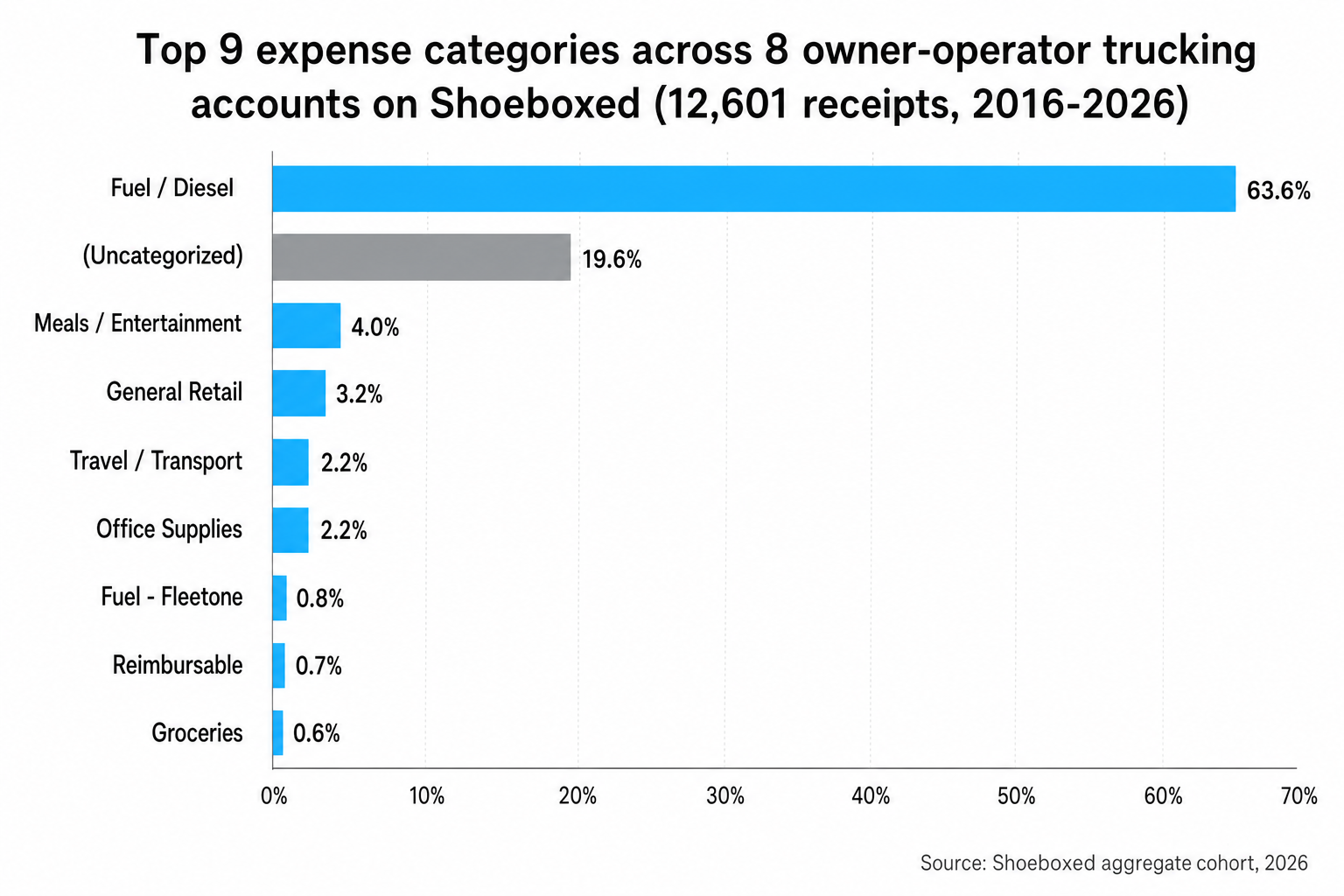 The cohort at a glance. Fuel dominates at 63.6% — owner-operators photograph and file every fill. The 19.6% Uncategorized bucket is the audit-defensibility gap most never close.
Why three tabs beat one ledger
Most trucker spreadsheets I've seen give you one tab. Log everything as it happens. Done.
The problem is that per-diem isn't a cost you paid. It's an IRS-granted daily allowance for road days you slept away from home base. It needs a different shape of tracking — date and on-road yes/no and auto-calculate, not date and vendor and dollar amount.
This spreadsheet uses three tabs:
- Tab 1 — Daily Expenses. Standard 6-column ledger for receipts. Date, vendor, amount, category, business purpose, notes. 15-category dropdown.
- Tab 2 — Per-Diem Log. 7-column tracker for road days. Date, location or route, on-road yes/no, type (CONUS or OCONUS), allowance, 80% deductible, notes. The allowance and 80% columns auto-calculate from the on-road flag.
- Tab 3 — EXCLUSIVE Coupon & Tax Secrets. Bonus tab with the home office calculator, per-diem calculator, and a 25%-off-for-three-months coupon to Shoeboxed.
At year-end, sum Tab 1 and Tab 2 totals. That's your Schedule C deduction picture for the year. Clean, simple, defensible if the IRS asks.
This is why we shipped this spreadsheet instead of another single-ledger template.
How to use the spreadsheet
Here's the workflow most of our trucker customers settle into.
Step 1: Copy the spreadsheet into your Drive
Click the Google Sheets link above. Google opens a Copy document prompt. Click Make a copy. Rename the file with the year that sorts: Trucker Expenses 2026, not Trucker Expenses. You'll thank yourself in three years.
Step 2: Set your tax year and home base
Fill the meta block at the top of Tab 1: tax year, business name, owner or driver name, reporting period. Same fields on Tab 2 so both tabs match.
Step 3: Log every business receipt as it happens
Daily Expenses tab. One row per receipt. Date, vendor, amount, category from the dropdown, business purpose, notes. Don't free-type categories — the dropdown protects you from the 19.6% no-category problem we see across the cohort.
The business purpose field is the one auditors care about. " Fuel for Atlanta-to-Chicago run, load #4429" beats " fuel." Two seconds of writing at the pump becomes the line that defends the deduction.
Step 4: Log every road day on the Per-Diem Log tab
End of every day where you slept away from home base, add a row on Tab 2. Date, location or route, on-road = Y, type = CONUS (or OCONUS if you ran into Alaska, Hawaii, or foreign territory). The allowance ($80 CONUS, $86 OCONUS) and the 80% deductible column ($64 or $68.80) calculate automatically.
If you came home and slept in your own bed, on-road = N for that date. Per-diem only applies when you're away from tax home.
Step 5: Save every source document
Fuel receipts in the truck folder. ELD logs become your per-diem proof (they show every hour you were on duty and where). The spreadsheet is the index; the source documents prove the entries.
Step 6: Share with your accountant monthly
Click Share in the top right, paste your accountant's email, set them to Viewer. They watch the records build all year and ask questions in March instead of April.
Most one-truck owner-operators run this loop in about 10 minutes a week.
The 4 things every entry needs (per the IRS)
IRS Publication 463 spells out what counts as adequate records for expenses:
" You should be able to prove the elements of an expense or use of property… Generally, you must have documentary evidence, such as receipts, canceled checks, or bills, to support your expenses."
For each expense entry on Tab 1, you need four fields:
- Date — when you paid
- Amount — what you paid, including sales tax
- Vendor — who you paid (the truck stop, the parts store, the mechanic)
- Business purpose — why this expense counts as business
For each per-diem entry on Tab 2:
- Date — the road day
- Location or route — where you slept away from home base (city or run)
- On-road flag — proof you were away from tax home
- Type — CONUS or OCONUS (drives the $80 vs $86 allowance)
The per-diem method actually requires less documentation than tracking every meal receipt. No meal receipts at all. Just the road-day log plus your ELD records as backup if the IRS ever asks.
For the official line on which expenses qualify in the first place, see Schedule C and its instructions.
Real money math: what per-diem alone is worth in 2026
Walk through the numbers with me.
Owner-operator on the road 280 days a year, CONUS only, subject to DOT hours-of-service rules. Per IRS Pub 463 §1, $80/day standard meal allowance. Per Pub 463 §2, 80% deductible because of the hours-of-service rule.
$80 × 280 = $22,400 gross meal allowance.
× 80% = $17,920 actual Schedule C deduction.
At a 24% federal bracket plus 15.3% self-employment tax (a typical effective rate for an owner-operator netting $80K to $150K), that's about a 39% combined marginal rate.
× 39% = $6,989 in combined tax savings every year. Most owner-operators in our data leave this on the table.
Per IRS Pub 463 itself: " Using the special rate for transportation workers eliminates the need for you to determine the standard meal allowance for every area where you stop for sleep or rest." In plain English: per-diem runs simpler than the alternative and usually delivers a bigger deduction.
Compare to actual meal receipts. The typical owner-operator I see in the data spends $25 to $45 a day on meals out — Maverik gas station hot dogs, Subway, the truck-stop diner. Call it $30 average. With the 80% deduction, that's $24 a day. Multiply by 280 = $6,720 deduction. Per-diem ($17,920) beats actual receipts ($6,720) by more than $11,000 of deduction. Plus per-diem requires zero meal receipts.
Plug your road days into the Per-Diem Log tab and the spreadsheet does the math.
The home office deduction most owner-operators don't realize they can claim
"My truck is my office. I don't have a home office."
That's what most owner-operators tell me. It sounds right, and it misses a rule almost nobody mentions. IRS Publication 587 has what it calls the " administrative or management activities" exception:
" Your home office will qualify as your principal place of business if you meet the following requirements. You use it exclusively and regularly for administrative or management activities of your trade or business. You have no other fixed location where you conduct substantial administrative or management activities of your trade or business."
Think about what you do when you're not driving. Reviewing ELD logs. Prepping IFTA quarterly. Sorting fuel receipts. Billing brokers. Talking to your insurance agent. Booking the next load. That's all administrative or management work, and you do it at a desk at home.
The truck cab is not a fixed location for administrative work under Pub 587. Vehicles are explicitly excluded from that test. If admin happens at home and only at home, your home office qualifies.
Two ways to calculate the deduction:
Simplified method (Pub 587): $5 per square foot of office space, capped at 300 square feet — so $1,500 maximum. 30 seconds of math, no receipts.
Actual method: office square footage divided by total home square footage gives your business-use percentage. Multiply that against your annual home costs — mortgage interest or rent, property taxes, utilities, insurance, maintenance. For most owner-operators with a real 150 to 200 sq ft home admin office and typical home costs, the actual method beats simplified by $1,500 to $3,000 a year.
Gathering all those home-cost numbers is a pain. Our free home office calculator walks through both methods and tells you which one to claim. About two minutes, no signup.
This deduction is sitting on the table for almost every owner-operator who runs the business out of a home base. Tab 3 of this spreadsheet has the calculator + explainer built in.
A quick note on the mileage rate (it doesn't apply to your rig)
Every "trucker mileage tips" article on the internet conflates the IRS standard mileage rate with heavy truck deductions. They're different rules.
Per IRS Publication 463 §4:
" For depreciation purposes, a car is any four-wheeled vehicle (including a truck or van) made primarily for use on public streets, roads, and highways. Its unloaded gross vehicle weight (for trucks and vans, gross vehicle weight) must not be more than 6,000 pounds."
Class 7 and Class 8 commercial trucks are over 6,000 lb GVWR. They're not "cars" for IRS purposes. The standard mileage rate (72.5 cents per business mile in 2026) doesn 't apply to your rig.
Your tractor uses the actual-expense method. Fuel, maintenance, depreciation or Section 179, insurance, tolls, registration — all on Schedule C Line 9 or via Form 4562.
Where the 72.5¢/mi rate does apply: if you have a personal car or pickup you also use for business errands — parts runs, admin meetings, the post office for the IRS check — that's a separate vehicle and the standard mileage rate applies to it. Track those miles separately. Our free mileage log template handles it. Or skip the log entirely: our automatic mileage tracker records those drives by GPS and texts you at the end of the day to ask which were business.
What 20 years of receipts taught us about owner-operators
Shoeboxed launched in 2007. We've been processing receipts for almost twenty years.
A lot of owner-operator receipts arrive on thermal paper. Fuel-stop receipts from Pilot, scale tickets from weigh stations, truck-stop diner tabs. Thermal paper fades. Your fuel receipt from October will be a blank slip by next April unless you photograph it or scan it within 6 to 12 months of paying.
The cohort pattern matches life on the road: most trucker customers mail receipts to us in batches every 1 to 2 months. They run hard for a few weeks, fill a Magic Envelope at the next layover, and drop it in the mail at the next truck stop with USPS. Pile-and-mail beats trying to log every receipt the minute you get it.
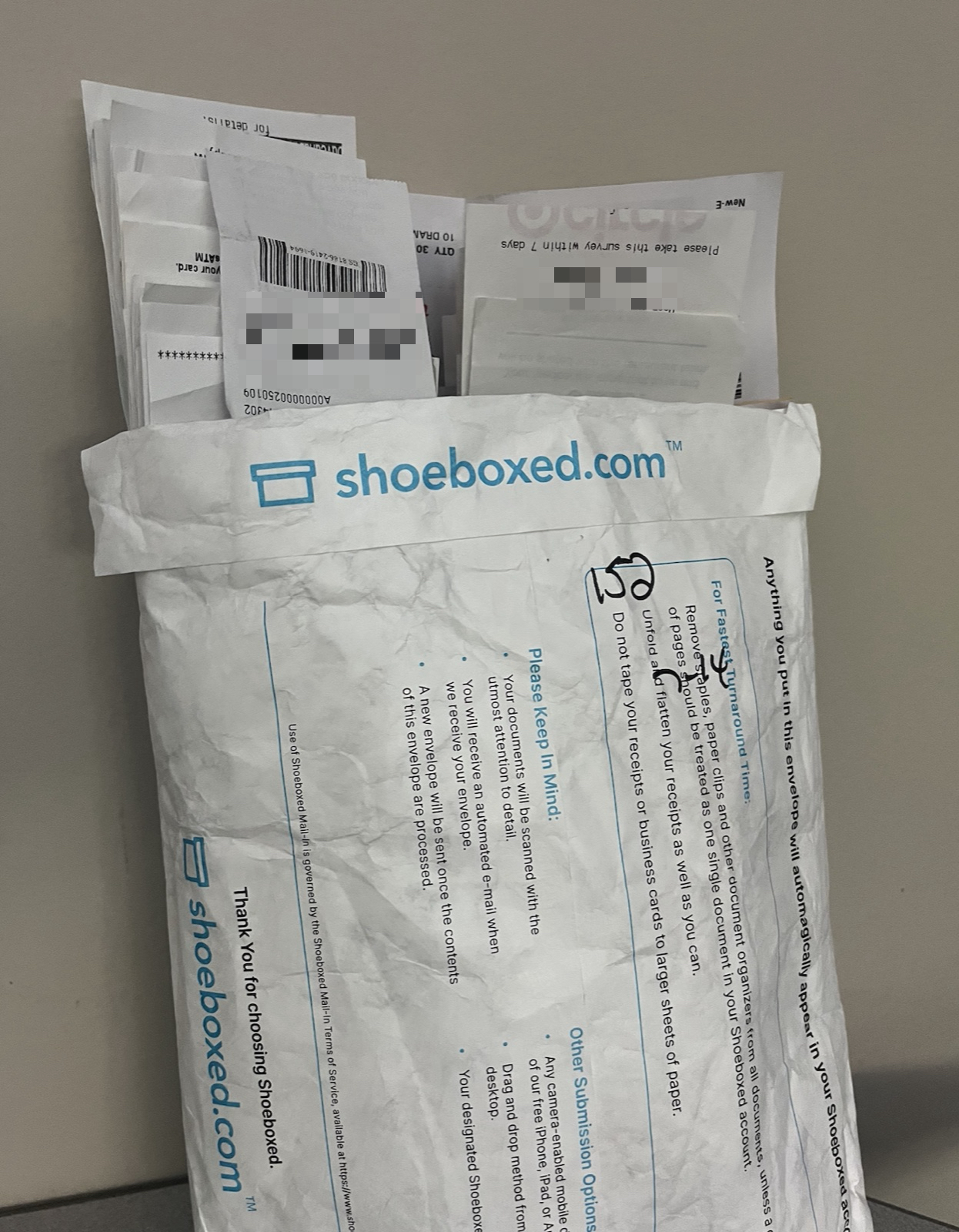 A Magic Envelope from a trucker 's run. This one held 152 receipts. The customer wrote the count on the outside.
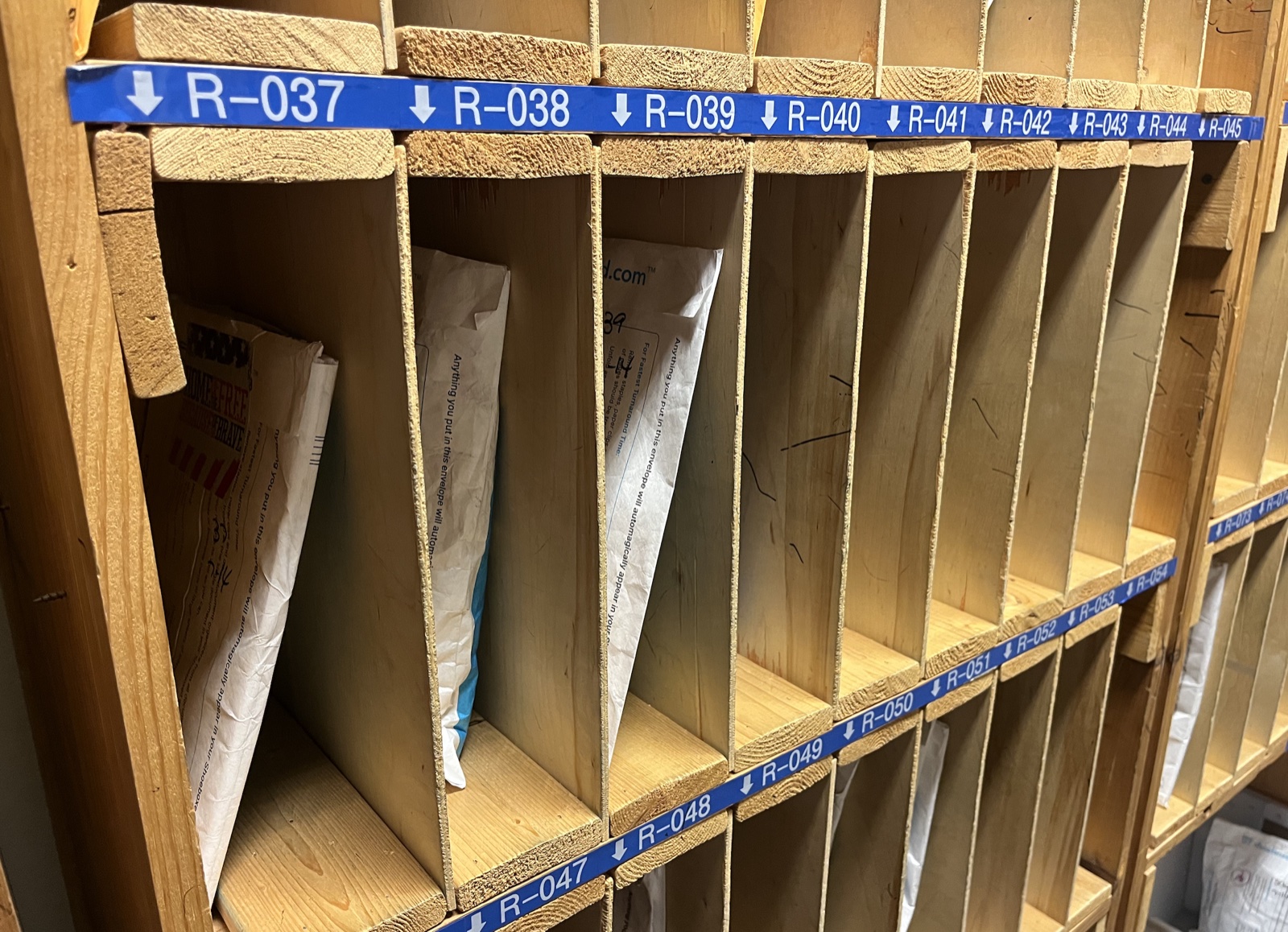 Each customer 's envelope goes into its own slot. We process them one at a time so receipts never get mixed across accounts.
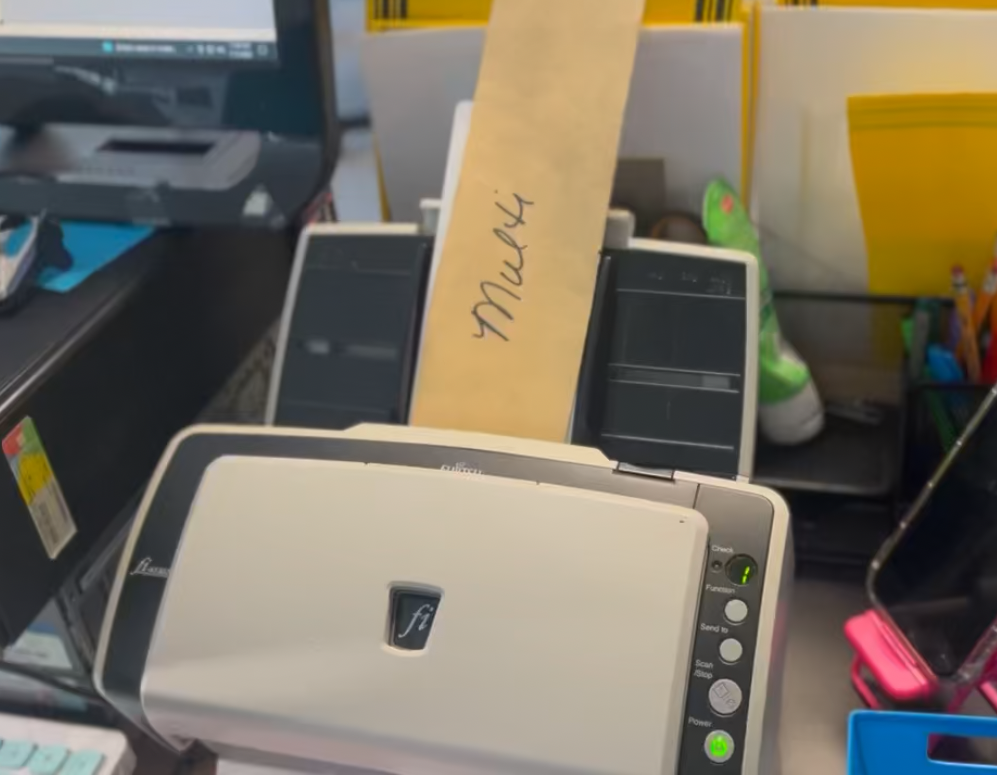 Receipts feed through the scanner one at a time. The envelope tag keeps every customer 's pile separate from start to finish.
The two-doors observation: fuel and maintenance receipts arrive on paper at the truck stop or the shop. ELD-software invoices, factoring statements, and broker payments arrive electronic. The Daily Expenses tab handles both inputs — type in the paper ones, paste in the digital ones.
Audit-proofing: 3 small habits that hold up under review
The IRS doesn't audit randomly. They flag returns where the records look thin. Three habits cover most of what holds up under review.
Habit 1: Photograph every fuel and toll receipt the day you get it
Thermal paper from truck stops, Pilot, Flying J, Love's, TA, weigh stations — all of it fades within 6 to 12 months. By tax time next year, half of last summer's receipts will be blank slips. Snap a photo the same day, before the ink walks off.
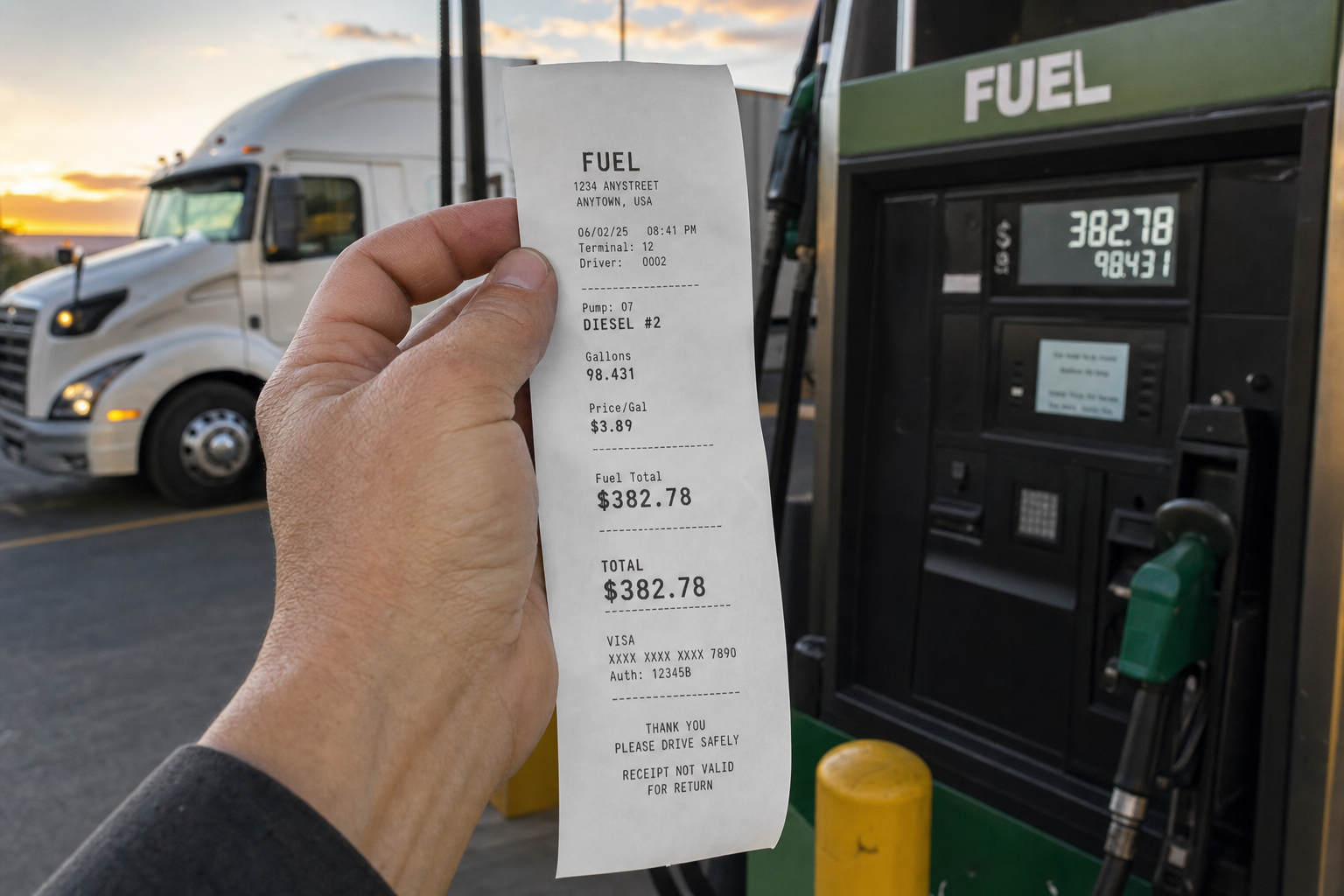 One fuel stop, one thermal receipt. Snap a photo at the pump before the ink fades. By next April it will read like a blank slip if you don 't.
Habit 2: Categorize the receipt the same day you photograph it
Remember the 19.6% no-category stat from our cohort? Almost 1 in 5 trucker receipts in the data has no category at all. Those are the entries that become "unknown" at tax time. Two seconds of category-selection at the pump beats two hours of forensics in April.
Habit 3: Log road days the day you sleep away from home base
Per-diem requires showing you were away from tax home. ELD logs back it up at the regulatory level, but a simple Per-Diem Log entry — date, route, on-road = Y — makes it bulletproof. Late-summer 2025 IRS audits in transportation industry returns have been catching per-diem claims without contemporaneous road-day logs. Same day or no claim.
If you run a home office, our free home office calculator can help with the other big deduction most owner-operators miss.
What expenses can an owner-operator deduct?
Per Schedule C and IRS Publications 463 and 535 (business expenses), the standard list for an owner-operator includes:
Fuel and DEF. Maintenance and repairs. Truck and trailer payments or lease. Insurance (liability, physical damage, cargo, occupational accident). Tolls and weigh-station fees. Permits and licenses (IFTA quarterly, HVUT Form 2290, state apportioned registration). ELD and compliance software. Lodging when not in the sleeper. Communication (CB, satellite, phone). Office supplies and logbooks. Professional fees (CPA, accountant). Tools and equipment. Truck wash and detail.
Plus the per-diem meal allowance (Pub 463 §1, the one most miss).
Plus the home office deduction if you qualify under Pub 587's admin-functions exception.
All 15 expense categories are baked into the dropdown on Tab 1 of this spreadsheet.
Can owner-operators claim the home office deduction?
Yes — and most don't realize they qualify.
Per IRS Pub 587, your home office qualifies as your principal place of business if you use it exclusively and regularly for administrative or management activities, and you have no other fixed location where you conduct substantial admin work. Vehicles are explicitly excluded from the "fixed location" test. The truck cab doesn't count.
If you do dispatch, IFTA prep, billing, ELD log review, and recordkeeping from a home desk — you qualify. Calculator and walkthrough in Tab 3 of this spreadsheet, or use our free home office calculator (two minutes, no signup).
Is there a free owner-operator expense spreadsheet?
Yes. The one above. All four formats — Google Sheets, Excel, PDF, CSV — are free. We don't ask for your email. No background trial. No signup.
We built it because every free trucker template we found shipped without a per-diem tracker. The single biggest deduction most owner-operators miss isn't on the spreadsheet you'd be using. So we made one that has it.
If you don't want to type at all
 Our Durham headquarters. We 've processed receipts since 2007.
I'll be straight with you. Typing every fuel and toll receipt into a spreadsheet is the slowest way to do this. Some people like the control. Most owner-operators skip the typing when they can.
Here's what we built at Shoeboxed for the second camp:
- Magic Envelope. Stuff a month of fuel receipts, scale tickets, and maintenance invoices in the postage-paid envelope. Drop it at any truck stop. Our team in Durham scans and categorizes each one into your account. Think of it as a bookkeeper sitting in your mailbox.
- Mobile app. Snap a photo of any receipt — fuel pump, scale ticket, broker invoice. Our team reads vendor, amount, date, and category and writes it to your account in seconds. You never type a number.
- Both sides of the ledger. Shoeboxed handles fuel receipts and broker payments, factoring statements, and ELD-software invoices. Send the digital ones via email forwarding. They land in your account categorized.
- Per-Diem auto-tracking. If you log road days through the app, the Per-Diem Log tab populates for you.
- Real US support. When you have a question, you reach a real US support team in our same Durham office.
A recent App Store review puts it better than I can:
" Not only is this app super easy to use, but REAL people answer your questions quickly and efficiently. Client for life!"
MN SBO, App Store review, May 2026
I bought Shoeboxed in late 2025 with an SBA loan after fifteen years of running other people's companies as CEO. I'd used Shoeboxed myself back in 2010 at a previous gig and called it magical even then. I use it daily now. Owner-operators deserve every dollar they're legally entitled to keep, which is why I bought Shoeboxed and work hard to make it better. More on why I bought it.
If the spreadsheet is enough, keep the spreadsheet. If you ever want to stop typing:
- Free home office calculator. No signup. If you run an admin office at home, please use it. Most owner-operators leave four figures on the table every spring.
- Try the Shoeboxed app. Seven-day free trial on iPhone and Android.
Either way, the spreadsheet above belongs to you. The bonus tab inside it has an exclusive coupon for readers who grab the template — it's not on the rest of the site.
Wrap
The spreadsheet comes in four formats — Google Sheets, Excel, PDF, and CSV. Three tabs in one file: Daily Expenses, Per-Diem Log, and a bonus tab with the home office calculator and a coupon for Shoeboxed. Fifteen trucker-shaped expense categories come from real owner-operator records since 2016, and the Per-Diem Log auto-calculates the $80-a-day deduction the IRS gives transportation industry workers under Pub 463 §1.
Grab whichever format fits how you work. It's yours the moment you click. We'll be here either way, almost twenty years in.
For per-diem rules and the GSA standard meal allowance method, see our travel expense report template.
For a full profit and loss view, with mileage and the home office flowing right onto your Schedule C, see our small business accounting template.
If you elect S-corp status on your trucking business, the Augusta Rule lets your S-corp rent your home up to 14 days a year and you pay zero personal tax on the rental income.
Hauling for a farm or ranch operation? See the farm expense spreadsheet for the Schedule F categories that cover livestock, feed, and equipment.




 4.4 / 5 on