Alliance Virtual Offices Review: A Virtual Office, Not a Virtual Mailbox
Honest Alliance Virtual Offices review from the former Earth Class Mail CEO who wholesaled Alliance addresses. Pricing, 6-month contract, Trustpilot, and who should sign up.


This is an honest review of Alliance Virtual Offices. I'll walk you through what Alliance is, what it costs, what real customers say about it on Trustpilot, and who it's the right fit for.
Short answer up front: Alliance Virtual Offices offers virtual offices, which you can think of as a virtual mailbox with a bunch more features. Both products give your business a street address. The difference is what sits behind that address. A virtual mailbox is just an address attached to a scanning shop, usually $10 to $30 a month. A virtual office is a real office building with a smiling receptionist at the front desk, meeting rooms you can book, and your mail handled by people who work there full time. Alliance offers the second kind, through a network of 1,400 business centers around the world, starting at $48 a month.
Doug here. I'm writing this because I ran Earth Class Mail about ten years ago, one of the original virtual address and postal mail scanning companies. We used Alliance as a wholesale provider of addresses. They would receive mail for us securely at their addresses, and forward it to our mail processing centers. That means I worked with Alliance as a partner, know what a quality company they are, and can vouch for how they do things.
It's been awhile since I worked with them as a partner, but read the review below for an up-to-date look at their virtual office/address products, how they stack up against virtual address competitors, how their virtual offices work, and what type of businesses should use them.
Alliance Virtual Offices in 5 bullets
- Alliance is a virtual office , which is a virtual mailbox plus a real office building. You get the street address and mail scanning a virtual mailbox gives you, plus a staffed reception desk, meeting rooms you can book, and a real lobby you can take clients to. The five mailbox brands we've reviewed (PhysicalAddress.com, Earth Class Mail, PostScan, iPostal1, Anytime Mailbox) stop at the address and scanning. Alliance keeps going.
- The price runs $48 to $79 a month, depending on the city. New York is $48, Miami $49, Chicago and Las Vegas $50, Los Angeles $60, San Francisco $79. The two tiers are called Platinum and Platinum Plus. Plus gets you 16 hours of meeting room time per month.
- The contract runs six months minimum. It renews on its own unless you cancel in writing 30 days before the term ends. Almost half the one-star Trustpilot reviews are about this. If you're not sure you'll stay six months, sign up somewhere else.
- The recent Trustpilot reviews split 64 percent five-star and 26 percent one-star. Almost no one lands in the middle. The five-star pile talks about easy notary appointments and named support reps. The one-star pile is mostly people who tried to cancel inside the six-month window and couldn't.
- If you want a real business-center address with a receptionist and meeting rooms you'll use, Alliance is the right answer at this price. If you just want a street address and mail scanned to your phone, look at PhysicalAddress.com or Earth Class Mail instead.
When I ran Earth Class Mail, we partnered with Alliance
Here's how the relationship worked. Earth Class Mail had its own customers and its own brand, but we needed real street addresses in cities all over the country. We worked with Alliance to use their addresses. When mail arrived at an Alliance building, the receptionist took it in and sorted it, and shipped it to our scanning facility. We scanned it, posted it to the customer's account, and forwarded the physical pieces if they asked. From the customer's side, it looked like one company. Behind the scenes, Alliance ran the building and we ran the customer relationship. We also operated our own addresses.
We picked Alliance over the other wholesale providers for their professionalism, their great operations, and because their addresses were real business centers with real receptionists. The other options lacked great security and operations, like the mailbox stores and that other virtual address providers use.
The piece that mattered most for ECM was reliable mail handoff. ECM scanned everything in one central facility. Alliance had to get the day's mail out the door from their many addresses and into our pipeline without losing anything. That's not a small operation. Alliance ran it well. The receptionists at each location knew their job. Shipping was steady. When something went wrong, an account team picked up the phone.
I'm not telling you this because Alliance is paying me. They're not. Shoeboxed has no current commercial relationship with Alliance. I'm telling you because I worked with them as a paying partner for years, and I can vouch for how they run their business. Most online reviews come from someone who rented one office from Alliance for a year. This one comes from the person who used to buy from them in bulk.
What Alliance Virtual Offices actually is
Alliance is a network of 1,400 business centers it works with around the world. Behind those addresses sit about 4,000 meeting rooms.
A business center is basically a small office building you can rent space in by the hour or by the month. Regus is the biggest name in this business. A staffed reception desk in the lobby takes your mail and sorts it into your cubby. On a regular schedule, the business-center staff ships your mail to Alliance's central scanning facility, where it gets opened, scanned, and posted to your account. Some buildings have full coworking floors with private offices and desks. Others are smaller, with just the reception desk and a couple of conference rooms. Either way, it's real commercial space with real staff running it.
 Illustrative photo, not an actual Alliance facility or employee. A typical business-center lobby, the kind of address Alliance contracts with.
Alliance sells four products under one roof:
- Virtual Office is the address itself. Mail receipt, sorting, scanning, and forwarding are included.
- Live Receptionist is a paid add-on. A real person answers your business phone in your business name.
- Virtual Phone is a separate business number with a cloud phone system.
- Meeting Rooms & Office Space lets you book conference rooms and private offices by the hour.
The two main virtual-office tiers are Platinum and Platinum Plus. Both get you the address, mail handling, mail forwarding, lobby reception, and hourly access to the meeting rooms. Platinum Plus adds 16 hours of meeting room or private-office time per month. Alliance markets that as saving 75 percent on meeting room rental. Whether the math works for you depends on whether you'll use the rooms.
One thing worth saying plainly: Alliance doesn't own or run the business centers. Alliance contracts with the business centers that operate the buildings. The business center's own staff handles the mail intake and the reception desk. Alliance arranges the contracts, the shipping of the mail, the central scanning, and the customer-facing platform. The model is closer to a hotel-booking platform than a hotel chain. Alliance is curating and integrating a network of business centers, not running them.
That's still a meaningful step up from the partner-licensed mailbox brands, because business centers are professional service operations with full-time staff and real offices. The mailbox brands contract with independent mail stores, where the operator is usually a one-person UPS-Store-style shop. The class of partner is different, even though both models depend on partner locations.
How the mail actually moves
Mail arrives at one of Alliance's 1,400 business centers. The receptionist receives it and sorts it. On a regular schedule, the business-center staff ships your mail to Alliance's central scanning facility, where Alliance employees open, scan, and post the contents to your online dashboard. From there you can have the physical pieces forwarded to your home or shredded.
 Illustrative photo, not an actual Alliance facility or employee. Business-center staff package sorted tenant mail for shipment to Alliance's central scanning facility on a regular schedule.
Routing all the mail through one central scanning facility is how Alliance keeps quality and mail security the same across 1,400 buildings. Same equipment, same trained people, same standards every time. That's exactly the model we ran at Earth Class Mail, and it's the reason Alliance can put a real business-center address in 1,400 cities instead of 8 or 50.
It's also a more secure way to handle your mail. The partner-licensed mailbox brands work the opposite way. Each independent mail-store owner opens and scans your mail at their counter, on their phone camera or other device, with whoever happens to be working that shift. That could be a UPS-Store-style clerk. It could be the front-desk employee at an assisted-living facility that contracted in for a side revenue stream. You don't know who, and you don't have any control over it. Alliance keeps that out of your business — the business center receives and sorts your mail, but the only people who open and scan it are Alliance employees at one secure facility.
The trade-off is timing. Your mail doesn't get scanned the minute it arrives. It gets scanned after the business center ships the batch to the central facility and Alliance's staff processes it. For most LLC owners, that doesn't matter. Business mail isn't usually ultra-time-sensitive.
The Trustpilot story tells two piles
I pulled 50 organic reviews off Alliance's Trustpilot page. The split landed at 64 percent five-star and 26 percent one-star. Almost no one lands in the middle. Customers either rent an office and stay for years, or they cancel angry on the way out. The angry pile has a specific reason it's angry (these customers likely aren't a fit for a virtual office, they're likely better off with just a virtual address).
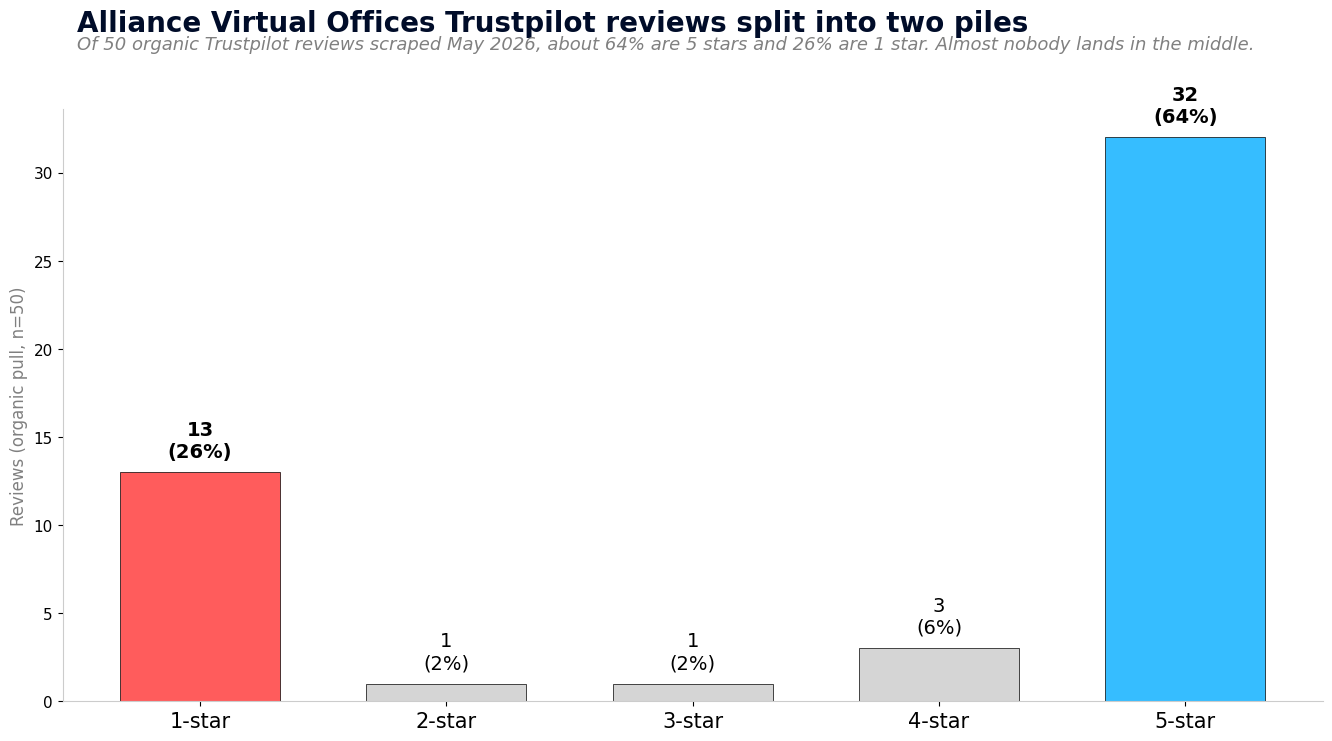 Alliance Virtual Offices' organic Trustpilot reviews (n=50): two piles, almost nothing in the middle.
Six of the 13 one-star reviews name the same thing: the six-month minimum, the 30-day cancellation notice, or the automatic renewal at the end of the term. Customers signed up assuming they could leave when they wanted. They didn't read the contract. They found the rule the moment they tried to cancel. Worth quoting two reviewers directly.
One reviewer who cancelled at four months wrote:
"No one I have spoken to or tried to leave a message for has contacted me back concerning my mail not being forwarded to me as per my agreement. After not getting anywhere I cancelled my office after 4 months of terrible service but was told there is a 6 month minimum on my rental. So their lack of service has cost me money. Please read the fine print in your contract before you sign. Sales team is responsive but after you sign you will get nowhere with any concerns. BEWARE."
Another reviewer described the renewal mechanic plainly:
"If you sign a six month contract, your contract does not end at the six months. It will automatically renew and they want a 30 day cancellation so if you don't cancel the month before the end of your six months you will still be charged for the following month."
That's the contract. It sits in the fine print on signup. Customers who read it sign with their eyes open. Most of them end up in the five-star pile after a couple of years on the service. Customers who don't read it sign expecting month-to-month flexibility. They end up in the one-star pile inside six months. The Trustpilot data is mostly about that gap, not about a quality problem with the product itself.
Alliance works best for established businesses that know they're goingto stay a while. Setting up a virtual address for your business is a commitment, an Alliance works well for those businesses who aren't going anywhere.
What customers love (and what trips them up)
Across the 32 five-star reviews, two themes show up over and over. The notary appointment for the USPS Form 1583 (the form that lets Alliance receive your mail) is described as painless. And named individual support reps get called out by name as the reason people stay. Two examples:
"Alliance was easy to set up and the customer service was awesome. I really loved how easy the notary was."
"Mr. Max, his mannerism, professionalism, poise and knowledge of my situation out ways the frustration I had. I am very happy that he was able to rectify the situation under 15 minutes time frame."
Alliance reviewers talk about people. Reception staff at the building. Account reps on the phone. The notary handling the 1583 paperwork. That's what you get when a real service business runs every location with its own staff. The partner-licensed mailbox brands get reviewed differently. Their reviews are mostly about the address being convenient or the price being cheap, because there are no employees in the picture to write about.
The trip-ups in the data are consistent too. A long-term customer reviewer (nearly two years on Alliance, $50 a month in downtown Fort Lauderdale, mostly positive about the service) named two friction points.
First, the website doesn't show enough detail about each individual location. She drove to her assigned address only to find all the parking around it was paid street parking.
Second, Alliance's own Virtual Phone tier at $30 a month wasn't strong enough for the price. She swapped to Freedom Voice at $10 a month for the same job.
Both complaints land. The location pages on AllianceVirtualOffices.com are thin. Parking, building hours, the exact suite, whether you can walk in for occasional work — none of it is documented super well. Call the support line before you sign if any of that matters to you, or just search up the address online to see the location and surroundings. The Virtual Phone tier is what it is: a $30 commodity phone service competing against $10 specialist phone services. Skip it unless you want everything on one bill.
The one-star pile names a third trip-up worth surfacing. Several reviewers complained that the included meeting room hours in their plan didn't cover their actual usage. They paid extra for a room they thought was free. Platinum includes zero meeting room hours. Platinum Plus includes 16 hours. If you'll use the rooms more than that, you pay hourly. Be sure to check before you book a room.
What you actually pay (and the 6-month-contract footnote)
The headline price varies by city. Here's the entry-tier Platinum pricing straight from alliancevirtualoffices.com:
- New York: from $48 a month
- Miami: from $49 a month
- Las Vegas: from $50 a month
- Chicago: from $50 a month
- Los Angeles: from $60 a month
- San Francisco: from $79 a month
That's the address itself with mail receipt, sorting, forwarding, and lobby reception. Platinum Plus runs higher and includes 16 hours of meeting room or private-office time per month. Alliance doesn't publish the exact uplift across all cities. Call them for the number at the location you want.
A real Alliance month for a small-business owner using a Chicago address looks like this. Platinum at $50 a month covers the address-and-mail bundle. No surprise add-ons if you stick to that. There's a one-time setup fee that can drop sharply during promo windows (one reviewer paid $8 by signing up on the 8th of the month). Skip the Virtual Phone tier at $30 a month and use a $10 alternative if you need a separate business number. Skip the Live Receptionist unless your call volume justifies it. You land at $50 a month on the recurring side, with meeting rooms available hourly when you actually need one.
Here's the part that costs people the most money on signup. It's worth saying twice.
Alliance contracts run six months minimum. They renew automatically at the end of six months unless you give 30 days written notice before the next term starts. If you sign on January 1, your minimum ends June 30. To leave on July 1, you have to cancel in writing before May 31. Otherwise you're locked in for another six months. That's the rule in plain English. It's the single biggest reason people leave a one-star review on Alliance's Trustpilot page. Worth knowing on day one, not month seven.
The six-month commitment isn't unreasonable for the product. A business address is a long-term commitment by nature. Once it lands on your LLC filing, your bank, and your vendors, you don't want to move it. Six months is a floor, not a ceiling. The complaint isn't really about the six months. It's about Alliance's sales process not making the term obvious enough on signup. Read the contract. Twice if you have to. If you're not committing for at least a year, pick a different product.
Alliance vs the virtual-mailbox cluster
The right comparison isn't who's cheapest. It's whether you need a business-center address with a receptionist and meeting rooms, or whether you need a mail-handling address that lives on your LLC filing and gets scanned to your phone. Alliance answers the first question. The five mailbox brands answer the second.
| Brand | Operating model | Headline price | What it's for |
|---|---|---|---|
| Alliance Virtual Offices | 1,400+ contracted business centers, on-site reception, central scanning | $48 to $79 / mo (6-month minimum) | Real business-center address with meeting room access and reception staff |
| PhysicalAddress.com | ~8 company-run locations | From $7.98 / mo | Consistent mailbox-only address, cheapest in the consistent-experience tier |
| Earth Class Mail | 50+ company-run locations | From $19 / mo | Premium consistent mailbox-only address, more locations than PA |
| PostScan Mail | Hybrid: company-run hubs plus hundreds of partner storefronts | From $10 / mo | Mailbox-only, but experience depends on whether your nearest address is a hub or a storefront |
| iPostal1 | 4,250+ partner-licensed storefronts | From $9.99 / mo | Mailbox-only, every location independently operated |
| Anytime Mailbox | 2,000+ partner-licensed storefronts | From $9.99 / mo | Mailbox-only, every location independently operated |
Alliance sits in its own row because it's selling a different product. The mailbox brands give you a street address and a scanning service. Alliance gives you a street address, a scanning service, a building you can walk into, a receptionist who knows you, and meeting rooms you can book for client meetings. That's why the price runs three to five times what the mailbox brands charge.
For home-office LLC owners who want a privacy address and never set foot in the building, Alliance is overkill. PhysicalAddress.com handles that job at a quarter of the price.
Alliance fits a narrower buyer. The kind who meets clients in person now and then. Who wants a real lobby and a receptionist if a client walks in. Who needs a conference room a few times a year without paying coworking rates. For that buyer, Alliance is the right tier and the price is fair. The mailbox brands can't deliver that experience because they don't run buildings.
Who Alliance is for, who should look at a mailbox instead
Two kinds of buyers will read this review and reach two different answers. That's the right outcome. One of you wants a real business-center address with a receptionist and a conference room you can book once a quarter. The other one of you wants a street address and your mail scanned to your phone for the lowest price that works. Both are legitimate. Alliance is built for the first one.
Sign up for Alliance Virtual Offices if all three are true:
- You want a business-center address with reception and meeting room access, not just a mailbox.
- You'll use the meeting rooms at least a few times a year, or you'll pay for one of Alliance's add-ons that justifies the upgrade.
- You're committing for at least a year. If you can't say yes with confidence, the six-month minimum and 30-day cancellation rule will end up in your Trustpilot review.
Look at PhysicalAddress.com or Earth Class Mail instead if:
- You just need a mail-scanning address for your LLC, your bank, and your vendors.
- You don't need meeting rooms or a building you can walk into.
- You want month-to-month flexibility, or you're not sure how long you'll be at this address.
Not sure whether your state's Secretary of State accepts business-center addresses? That's a CMRA-wide topic that applies to every brand in the table above. We covered it in our virtual address for LLC article. It walks through state-specific rules, the CMRA-vs-USPS distinction, and how a virtual address differs from a registered agent. Read that before you pick any brand.
Frequently asked questions
Is Alliance Virtual Offices legit?
Yes. Alliance contracts with 1,400 business centers around the world to provide their addresses, mail intake, and meeting room access. The business centers themselves are real commercial operations with full-time staff. Alliance arranges the network, the courier pipeline, the central scanning, and the customer dashboard. The homepage carries both the BBB seal and a ConsumerAffairs rating. Alliance has been in the virtual office business for a long time. The negative reviews online are mostly about the six-month contract terms, not about the product itself.
How much does Alliance Virtual Offices cost?
The Platinum tier runs $48 to $79 a month, depending on the city. The contract runs six months minimum and renews automatically unless you give 30 days written notice. Platinum Plus runs higher (the exact uplift varies by city, so call them) and includes 16 hours of meeting room or private-office time per month. There's a one-time setup fee that's often discounted during promo windows.
What 's the difference between Platinum and Platinum Plus?
Platinum gets you the address and mail handling. Meeting room access is hourly. Platinum Plus adds 16 hours of meeting room or private-office time per month. Alliance markets that as saving 75 percent on meeting room rental. The right tier depends on whether you'll use the rooms enough to justify the upgrade.
What 's the difference between Alliance and a virtual mailbox?
A virtual office is a virtual mailbox plus a real office building. A virtual mailbox gets you a street address and scanned mail, usually $10 to $30 a month. Alliance gives you all of that plus a staffed reception desk, meeting rooms you can book, and a real lobby a client can walk into. Most people who Google "virtual mailbox" actually want a virtual mailbox. Some want the extra office around it. The virtual address for LLC guide has the full side-by-side.
How do I see my Alliance mail once I sign up?
Alliance gives every customer an online dashboard. Scanned mail shows up there as PDFs. You log in with the credentials Alliance sends after signup. From the dashboard you can request forwarding, request a shred, or download the scans. The mail is received at your business-center location and routed to Alliance's central scanning facility before it lands in the dashboard.
Is the six-month contract a dealbreaker?
Only if you're not sure you'll stay six months. Once a business address lands on your LLC filing, your bank account, and your vendor invoices, you don't want to move it. Six months is a floor, not a ceiling, on how long that address will be yours.
Sources
- alliancevirtualoffices.com. Alliance Virtual Offices official homepage and Virtual Office product page, retrieved 2026-05-26.
- trustpilot.com/review/alliancevirtualoffices.com. Trustpilot Alliance Virtual Offices public review page, 50-review organic sample retrieved 2026-05-26.
- themarketingmompreneur.com/alliance-virtual-offices-review. Independent customer review, retrieved 2026-05-26.




 4.4 / 5 on