How Chris from TravelSports.com Saves About $1,400 a Year on Taxes With Shoeboxed
I have known Chris Pauly since our boys were in preschool together. We coached Little League house-league baseball side by side for five-plus seasons, our kids grew up together, and they are both college freshmen now. So when I tell you Chris is the real deal, that is not marketing talk. It is a friend vouching for a friend.

Chris runs TravelSports.com, the site travel-sports parents use to find tournaments, clubs, and leagues for their kids. If your weekends revolve around a hockey rink or a fastpitch diamond, you have probably landed on one of his pages. He built it to take a little of the chaos out of the travel-sports life, and over the years it grew into a real business that thousands of parents lean on every season. He and I even teamed up on a guide to the best summer jobs for travel-sports kids.
Here is why I wanted to tell you about how Chris uses Shoeboxed, and how much it saves him on his taxes. His business is a lot like the one you might run: a small LLC, operated from home, by someone who spends real time in the car. And two simple things put about $1,400 of real cash back in his pocket every year, on a Shoeboxed plan that costs $9 a month. Let me show you the math, because the numbers are the whole point.
Chris was missing two big tax deductions
Chris is a one-person operation with a handful of contractors, the way many small-business owners are. He writes the content, runs the site, talks to partners, and handles the books, all from a spare room in his house. He drives about 40 miles a week to meet with his developer, and to rinks, fields, and meetings.
Two of the biggest write-offs available to someone in his shoes are also two of the most valuable, and both were sitting right there waiting for him to claim:
- The home office deduction. Run your business from a spare room and a slice of your housing costs becomes a legitimate write-off. More than 30 million of the 35 million people who file a Schedule C never claim it (our read of IRS Statistics of Income data), so there is real money waiting for the ones who do.
- Mileage. Every business mile you drive puts money back in your pocket. Log the miles and the deduction is yours.
"Honestly, I'm a sports guy, not a numbers guy. I wondered if I could be saving more on my taxes, but I was too busy to dig in to our crazy tax code to find out. Finding out I could save more than $1,000 on my taxes by deducting mileage and my home office made my day."
—Chris Pauly, TravelSports.com
When I first walked Chris through the mileage and home office deductions, he lit up. He had not been tracking his miles at all, so the 40 miles a week he drives to rinks and meetings was money he had been throwing away every year. The home office deduction he had heard of, but he steered clear of it. He had heard it was an audit red flag, and he did not want to pile a bunch of extra hours onto his tax guy. I walked him through how home office deduction is completely legitimate, and it is not an audit trigger when it is done correctly with real records. More than 30 million of the 35 million Schedule C filers never claim it, a lot of them out of that same fear, and they leave real money behind. Shoeboxed handle the recordkeeping and makes it easy. His tax guy gets a clean report, and just plugs numbers into the tax forms.
On top of the deductions there were the receipts. Software subscriptions, travel, the gear and odds and ends that come with running a content business. Proof of all of it was scattered across his inbox, his glovebox, and a junk drawer somewhere.
How Shoeboxed does the work for him
Shoeboxed is built for exactly this. Chris snaps a photo of a receipt, or forwards the email version, and we store the actual receipt image and pull out the details the IRS cares about: the vendor, the date, and the amount. When his accountant has a question, the proof is right there instead of lost in a drawer.
For the driving, he uses the mileage tracker in the Shoeboxed app. It logs his trips automatically, so the miles live in one place instead of on the back of an envelope. At tax time those miles turn into a real deduction instead of a guess.
The home office deduction is the one people leave on the table most, and it is really about keeping receipts all year. A slice of almost every home bill counts: mortgage interest, property taxes, electric, heat, water, homeowners insurance, even lawn care and repairs. You deduct the business-use share of all of it. The catch is keeping the receipts and statements as they come in, or you are reconstructing the whole thing from memory in April. Chris forwards or snaps each one into Shoeboxed the day it shows up and tags it with a “home office” category. At tax time, getting all the data to his accountant is as simple as running a report and sending it off.
"Now I just take a picture of the receipt and forget about it. The mileage part is the one I never would have tracked on my own. I'm driving to rinks and to meet my developer regularly, and it all logs itself."
—Chris Pauly, TravelSports.com
What the home office deduction is worth
The easiest way to understand the home office deduction is to put it on a house you already recognize. The “Home Alone” house at 671 Lincoln Ave in Winnetka is a few towns over from Chris and I. We typed its address into our home office calculator, and here is what comes back:

| Home expense (yearly) | Estimate | Deductible at 2.4% |
|---|---|---|
| Mortgage interest | $276,210 | $6,521 |
| Property taxes | $49,770 | $1,175 |
| Home insurance | $9,952 | $235 |
| Utilities (electric) | $4,422 | $104 |
| Utilities (heat) | $3,253 | $77 |
| Water, sewer, trash | $1,500 | $35 |
| Lawn care & landscaping | $3,500 | $83 |
| Internet & phone | $900 | $21 |
| Repairs & maintenance | $9,330 | $220 |
| Total deduction | $8,471 |
A 120-square-foot office is about 2.4% of that 5,083-square-foot house, so you get to deduct 2.4% of nearly every home cost. At a 24% tax bracket, that $8,471 deduction is $2,033 back. (Those are our calculator's estimates from public property records, not anyone's actual bills.)
I won't show the exact breakdown for Chris's house, but the math follows the same path. His home office works out to about $4,400 in deductions a year.
See your own home office deduction →
What his business miles are worth
Then there is the driving. Chris logs about 40 miles a week for the business, to his developer, to rinks and fields, and to meetings. Every one of those miles is deductible at the 2026 IRS rate:
| Miles per week | ~40 |
| Weeks per year | ~50 |
| Total business miles | ~2,000 |
| 2026 IRS business rate | $0.725 / mile |
| Mileage deduction | ~$1,450 |
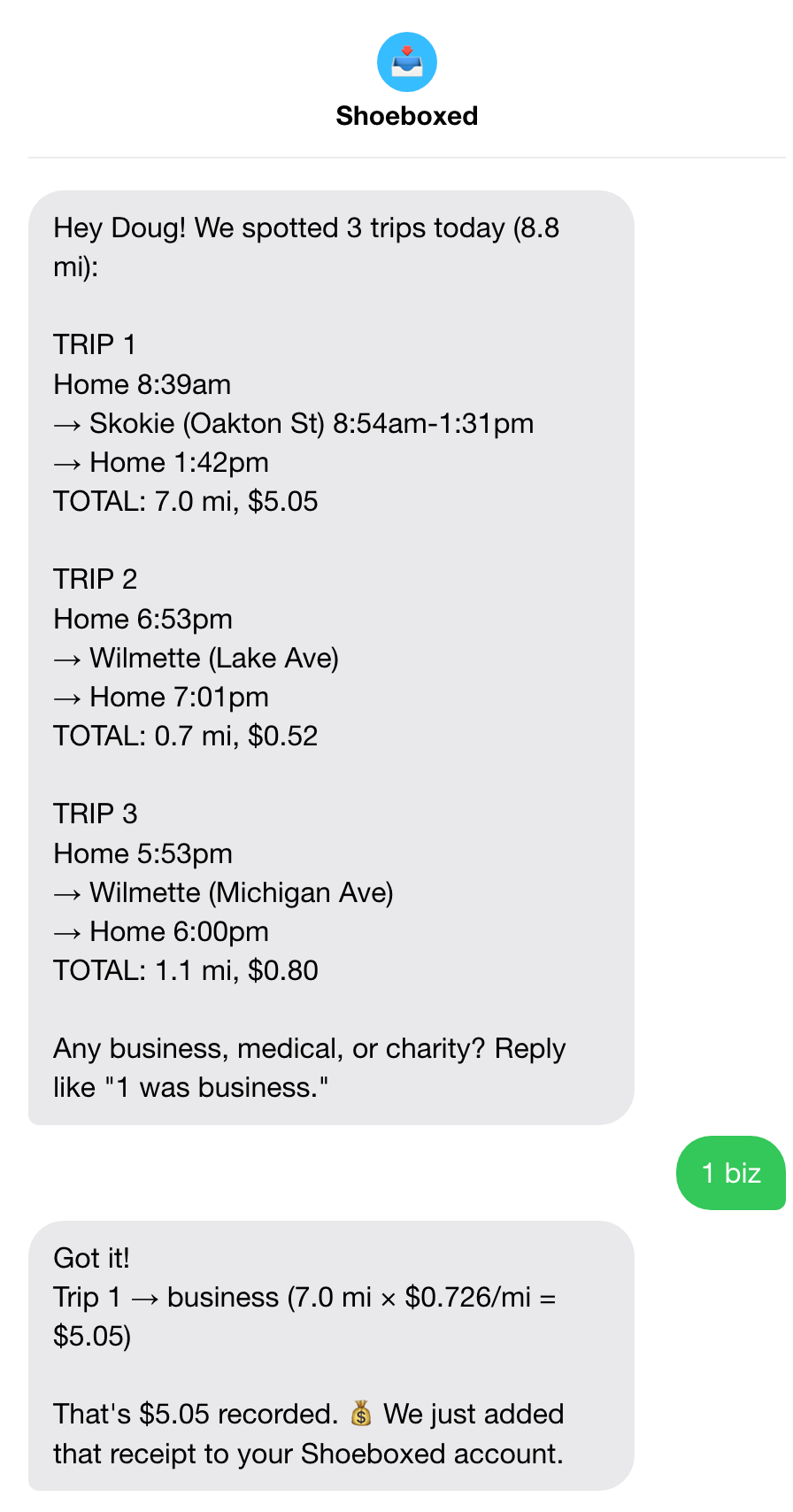
A deduction like that is the kind of thing almost nobody tracks by hand, and that is exactly the part Shoeboxed takes over. The app runs quietly in the background and logs every drive by GPS. At the end of each day it texts Chris a plain summary of his trips, and he just taps the ones that were for business. Those miles are now logged, with the date, the route, and the IRS dollar amount, ready for tax time. Here is what that daily text looks like:
What Chris saves every year
Put the two together and here is what Chris keeps:
| Deduction | Cash kept (24% bracket) | |
|---|---|---|
| Home office | ~$4,400 | ~$1,060 |
| Mileage | ~$1,450 | ~$350 |
| Total | ~$5,860 | ~$1,400 |
So for $108 a year, the cost of the $9-a-month Starter plan, Chris keeps about $1,400. The bigger win is harder to put a number on: he is not losing weekends to a shoebox of paper, and he is not lying awake wondering whether he could survive an audit.
"For nine bucks a month I'm keeping money I used to just hand over, and I'm not scared of an audit anymore. That's a no-brainer."
—Chris Pauly, TravelSports.com
What this means for your business
Chris built TravelSports.com to take a little chaos out of life for travel-sports parents. Shoeboxed does the same thing for the business behind it. The receipts get captured, the miles get logged, the home office deduction gets claimed, and Chris gets to spend his time on the part he actually loves.
If you run a small business out of your home and spend real time in the car, his story is worth a look. The money is already yours. The only trick is keeping track of it, and that part costs about nine bucks a month.
Or download the app and start tracking today:



Clear away piles of paper receipts by mailing them directly to our processing facility for free with the postage-paid Magic Envelope™. We’ll do the work of scanning your receipts and turning them into organized and actionable digital data.
Try Shoeboxed Today



 4.4 / 5 on
Capterra, G2 Crowd
and a review score 4.5/5 on
Techradar Pro
4.4 / 5 on
Capterra, G2 Crowd
and a review score 4.5/5 on
Techradar Pro
Turn business receipts into data & deductibles
Join over 1 million businesses scanning receipts, creating expense reports, and reclaiming multiple hours every week—with Shoeboxed.
Try Shoeboxed Risk-Free