
 Copy link


Updated June 2026.
Imagine you’re a realtor driving to showings all week, or a home health aide going house to house. Every one of those business miles is worth 72.5 cents off your taxable income in 2026. Did you know those miles slip away at tax time if you don’t write them down? Keep reading and I’ll show you the rates, who can use them, and how to turn your miles into real money back.
I’m Doug. I own Shoeboxed, and we’ve helped small businesses track expenses since 2007. Mileage is one of the biggest deductions our customers leave on the table, and the data shows exactly why.
"About 40% of active Shoeboxed accounts (5,056 of 12,695) log auto, fuel, or vehicle receipts. They clearly drive for work, but a gas receipt is not a mileage log."
Not sure the fuel receipts in your glovebox are worth anything? Here's whether your gas receipts count for taxes and why a mileage log usually beats them.
Shoeboxed customer data, June 2026
The 2026 IRS standard mileage rates
Here are the standard mileage rates for 2026, with the two prior years so you can file back taxes correctly.
| Purpose | 2026 rate | 2025 rate | 2024 rate | 2026 change |
|---|---|---|---|---|
| Business | 72.5¢ | 70¢ | 67¢ | +2.5¢ |
| Medical / military moving | 20.5¢ | 21¢ | 21¢ | -0.5¢ |
| Charitable | 14¢ | 14¢ | 14¢ | no change |
Use each year's rate for that year's taxes: 2024 rates on a 2024 return, 2026 rates on a 2026 return. Rates come straight from the IRS 2026 announcement.
That 2.5-cent bump for business miles is the IRS catching up to the cost of gas, repairs, and insurance. It also means every mile you write down is worth a little more this year.
One new wrinkle for 2026: the moving-mileage rate, long limited to active-duty Armed Forces, now also covers certain members of the intelligence community. For everyone else, moving miles are not deductible.
Who can use the standard mileage rate
If you're an employee
Since the 2018 tax law, most W-2 employees can’t deduct unreimbursed mileage on a federal return. The fix is reimbursement: ask your employer to pay you for business miles, and many use the IRS rate as the benchmark. A reimbursement at 72.5 cents a mile is tax-free to you, so the rate still matters even if you never file a Schedule C (the tax form self-employed people use to report business profit).
If you're self-employed
This is where the rate pays off. If you file a Schedule C (sole proprietors, single-member LLCs, 1099 contractors), every business mile is a deduction at 72.5 cents. Drive 12,000 business miles in 2026 and that’s an $8,700 deduction (12,000 × $0.725). At a 22% tax rate, that’s about $1,900 back in your pocket from miles you were already driving.
If you own a business with a vehicle
You choose between the standard rate and actual expenses (more on that next). A car or light truck under 6,000 pounds can use either. Heavier trucks and fleets of five or more vehicles used at the same time must use actual expenses, not the cents-per-mile rate.
Standard rate vs. actual expenses
You get one of two methods. Pick the one that gives the bigger deduction.
| Standard mileage rate | Actual expenses |
|---|---|
| Multiply business miles × 72.5¢. One number, one log. | Add up gas, repairs, insurance, depreciation, registration, then multiply by your business-use percentage. |
| Best for higher-mileage, fuel-efficient cars. Simple to track. | Best for expensive vehicles or low miles. More paperwork, more receipts. |
One rule trips people up: if you want to use the standard rate for a car you own, you must choose it the first year you use the car for business. Pick actual expenses that first year and you’re locked out of the standard rate for that vehicle for good. Either way, you need a mileage log, and if you go the actual-expense route, a simple expense spreadsheet keeps the gas, repair, and insurance receipts in one place.
How to turn miles into a deduction (and why a gas receipt isn't enough)
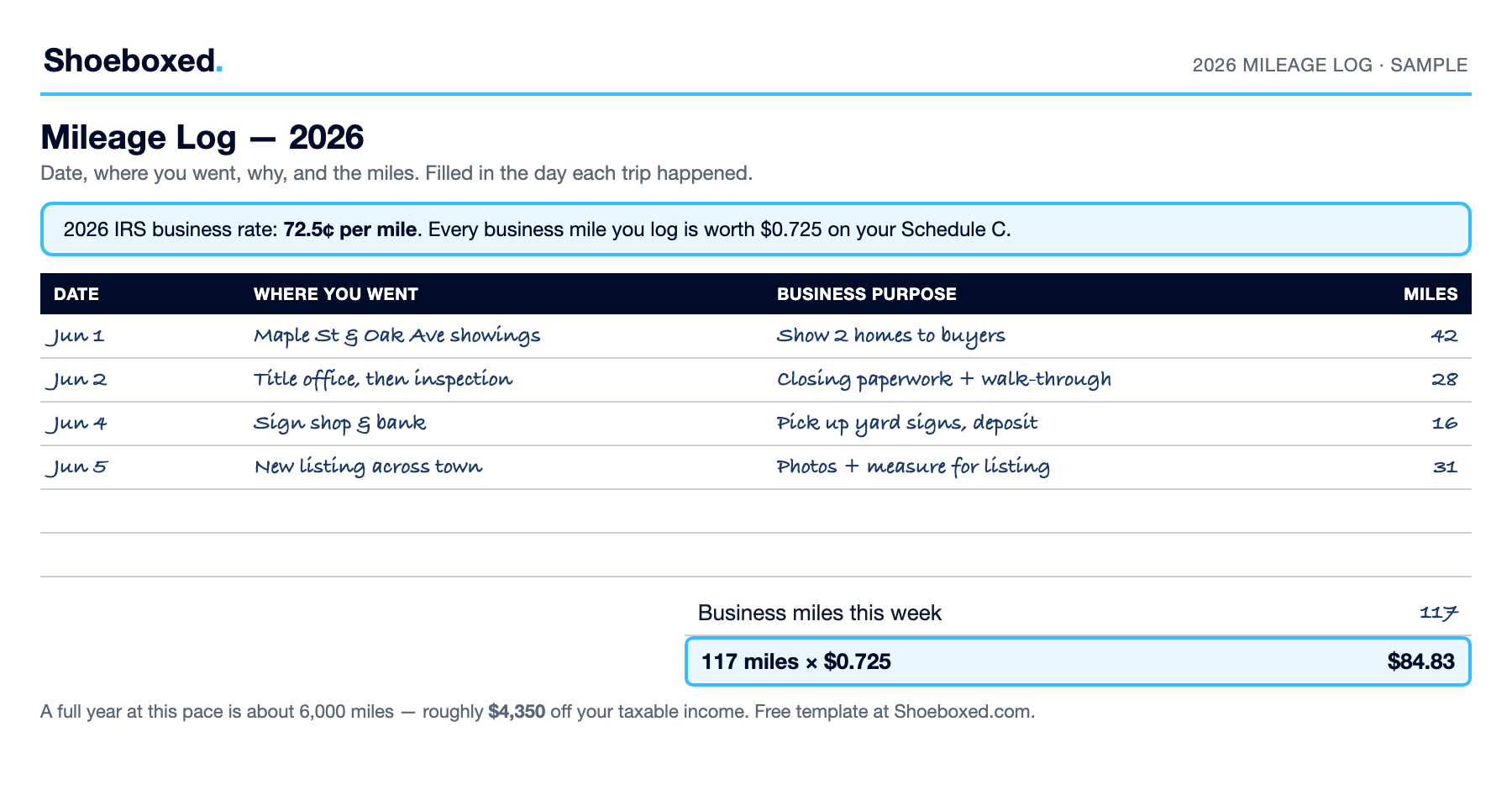
A huge share of small businesses drive for work. We see it in our own data, where about 4 in 10 active accounts log fuel and auto receipts. But the standard mileage method doesn’t run on gas receipts. It runs on a mileage log, where each trip shows four things:
- The date you drove
- Where you went
- The business reason for the trip
- The miles
That gap is where the money leaks out. You can have a shoebox full of gas receipts and still lose the mileage deduction, because the IRS wants the miles, not the fill-ups. A log that shows the date, destination, business purpose, and miles for each trip is what holds up.
How you lose the deduction: you scribble one number at tax time with no trip-by-trip record behind it. A log you rebuild from memory in April is the first thing an audit picks apart. Write each trip down the day you drive it. Our free mileage log template gives you a place to do exactly that, on paper, in Excel, or in Google Sheets.
Real examples of the 2026 deduction
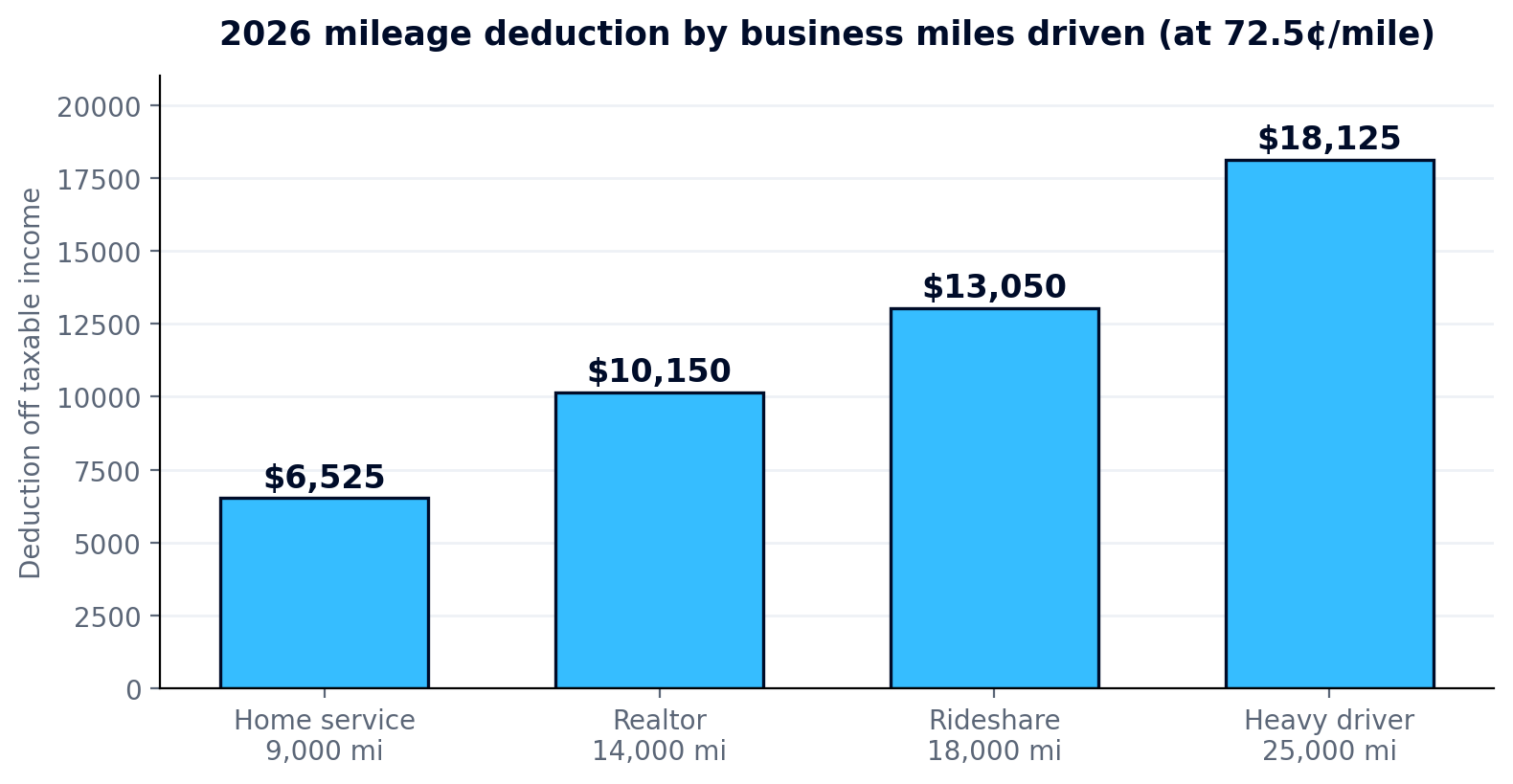
A deduction lowers your taxable income, so the cash you keep depends on your tax bracket. The dollars-back numbers below use a common 22% bracket; your real number depends on yours.
The rideshare driver
A part-time rideshare and delivery driver puts 18,000 business miles on the car in a year. At 72.5 cents, that’s a $13,050 deduction, or about $2,870 back at a 22% bracket. Gig drivers usually win with the standard rate, since the miles are high and the car is ordinary. (Our Uber driver expenses spreadsheet walks through the rest of a gig driver’s write-offs.)
The realtor
A real estate agent drives 14,000 miles to showings, inspections, and closings. That’s $10,150 off the taxable profit at the 2026 rate, about $2,230 back at 22%. Realtors are the classic case where the miles dwarf the gas receipts.
The home service business
A house cleaner or handyman driving 9,000 business miles between jobs gets a $6,525 deduction, around $1,435 back at 22%. Even a “small” amount of driving adds up to real money once you log a full year.
Common mileage mistakes that cost real money
- Counting your commute. Driving from home to a regular workplace is personal, not business. Trips between job sites, to clients, and to the bank are the deductible ones.
- Keeping gas receipts instead of a log. Receipts back up the actual-expense method, but the standard rate needs your miles logged trip by trip.
- Reconstructing the log in April. A contemporaneous log (written as you go) holds up; a guess does not.
- Mixing methods mid-stream on the same car. Choose your method the first year and follow the switching rules after that.
- Forgetting the small trips. The post office run, the supply pickup, and the drive to the client lunch all count, and they add up.
Let Shoeboxed track the miles for you
Logging every trip by hand is the part people quit. That’s why the Shoeboxed app tracks your business miles automatically with GPS, then builds an IRS-ready mileage log with the date, route, and miles for each drive. That means no more scribbling odometer readings in the car.
And because we’ve scanned receipts since 2007, the same account holds the rest of your tax records: snap a photo, forward an email, or mail us a Magic Envelope, and we store the image and pull out the vendor, date, and total. Your miles and your receipts end up in one place, ready at tax time.
IRS mileage rate FAQ
What is the 2026 IRS mileage rate?
72.5 cents per mile for business, 20.5 cents for medical and military moving, and 14 cents for charity.
How do I calculate my mileage deduction?
Multiply your business miles by the rate. 10,000 business miles in 2026 is 10,000 × $0.725 = $7,250.
Can I deduct mileage as a W-2 employee?
Not on a federal return for most employees since 2018. Ask your employer to reimburse you instead; reimbursement at the IRS rate is tax-free.
Do I need a mileage log?
Yes. Both methods require records, and the standard rate specifically needs a trip-by-trip log of date, destination, purpose, and miles. Write it down as you drive.
Can I switch between the standard rate and actual expenses?
You must use the standard rate the first year if you want the option later. After that, switching has limits, especially once you’ve claimed depreciation. When in doubt, ask your tax preparer.
About the author. I’m Doug. I bought Shoeboxed in late 2025 with an SBA loan after fifteen years of running other people’s companies as CEO. I’d used Shoeboxed myself back in 2010 at a previous gig and called it magical even then. I use it daily now. Small business owners deserve every dollar they’re legally entitled to keep, which is why I bought Shoeboxed and work hard to make it better.
Sources
- IRS: 2026 standard mileage rate announcement
- IRS: 2024 standard mileage rates (IR-2023-239)
- IRS: Standard mileage rates
- Shoeboxed customer data: 5,056 of 12,695 active accounts log vehicle receipts (June 2026)




 4.4 / 5 on