T2125 Form 2026: Plain-English Guide for Self-Employed Canadians
T2125 is the Canadian self-employment tax form. Read this plain-English walk-through of the home office, mileage, and 9 parts. 2026 CRA numbers, for sole proprietors.


T2125: A Plain-English Guide for Self-Employed Canadians (Including the Home Office Bit)
A Canadian guy emailed me earlier this spring. He'd been chatting with us about our home office deduction calculator, and his reply landed in my inbox a few hours later:
" I'm in Canada. The home office deduction doesn't apply to me. I'm the CEO and primary shareholder."
He was right. And that's exactly why I'm writing this.
If you're self-employed in Canada, T2125 is the form that decides your tax bill. It covers the home office, the mileage, and the receipts in your kitchen drawer.
This is the plain-English version. Numbers in 2026 dollars.
Let's start by figuring out if T2125 is even your form.
Is T2125 your form? The 30-second fork in the road
There are three buckets. Pick yours.
| If you are… | Your form is… | Read this article? |
|---|---|---|
| Unincorporated sole proprietor or partnership of 5 or fewer | T2125 (attached to your T1) | Yes. Keep going. |
| An employee with a T4, working from home | T2200 + T777 | Mostly no, but the mileage section below still applies if you drive your own car for work. Stay for that part. |
| Incorporated (you formed a CCPC and pay yourself a T4 from your own company) | T2 corporate return + T2200 from your own corp | No. Different paperwork. We'll write a separate guide for the Chris's of the world. |
" Unincorporated" in plain English: you operate the business under your own name, or under a business name that doesn't have "Inc." or "Ltd." or "Corporation" attached. As far as the CRA is concerned, you and the business are the same legal person. Your business income flows directly onto your personal tax return.
If you're not sure which bucket you're in, look at last year's tax return. Did you attach a T2125? If yes, this article is for you.
The third bucket catches a lot of people. In Canada, it's pretty common for a one-person business to incorporate early to grab the small business tax rate. The minute you do that, T2125 stops being your form. Don't fill one out by accident.
So what is a T2125?
Form T2125 is the Statement of Business or Professional Activities. It's where you add up your self-employment income, subtract your business expenses, and land on a net number that drops onto line 13500 (business) or 13700 (professional) of your personal T1 return.
It's not a separate filing. It rides along with your regular tax return.
If you have two businesses, you file two T2125s. One form per business. One business per form.
The link to the actual T2125 PDF lives on canada.ca. Pull it up if you want to look at it as we go.
What are the 9 parts of T2125?
The form has nine parts, and most sole proprietors only fill out four or five of them.
Part 1: Identification. Your name, SIN, business name, address, and a six-digit industry code from the CRA's NAICS list.
Part 2: Internet business activities. Skip unless a website earns you income.
Part 3: Income. What you sold, the GST/HST you collected, and (if you sell physical stuff) inventory math.
Part 4: Expenses. The big one. Advertising, supplies, insurance, professional fees, motor vehicle expenses, capital cost allowance. Each category gets its own line.
Part 5: Net income. Income minus expenses. Either positive (good) or a loss.
Part 6: Other deductibles. Mostly partnership-specific.
Part 7: Business-use-of-home expenses. The home office calculation. We're going to spend the most time here.
Part 8: Other partner details. Partnership-only.
Part 9: Equity. Debts, money in, money out.
Most sole proprietors only fill out Parts 1, 3, 4, 5, and (if applicable) 7. Parts 2, 6, 8, and 9 are usually blank. Don't psych yourself out about the form looking long.
How does the home office deduction work? (T2125 Part 7)
I pulled three years of receipts for one of our West Coast realtor customers. 439 receipts adding up to $104,672 CAD in business expenses. She tracked every dinner with a client, every listing photo shoot, every dollar of advertising. She's an organized small-business operator.
You know what I didn't see in those 439 receipts?
Not a single dollar for hydro (our Canadian friends tell us this is what they call electricity), natural gas, home insurance, mortgage interest, property tax, or condo strata fees.
Her home office is invisible in our system. And she's not unusual. About a third of her receipts (155 of 439) are uncategorized. Tracking is hard, and home-office tracking is the part most people skip first.
Here's how to not be her.
Do you qualify for a home office deduction?
You can claim home-office expenses if you meet one of these two tests:
- Your home is your principal place of business. Most of your work happens there.
- You use the space only for the business AND you use it regularly and continuously to meet clients, customers, or patients.
It's one or the other, not both. Most realtors, freelancers, consultants, and tradespeople running paperwork from home will pass the first test.
How do you calculate your home office percentage?
Divide your workspace area by the total finished area of your home. That gives you your business percentage. Then multiply by your eligible home expenses for the year.
Worked example. Say your home office is 12 m² in a 100 m² home. That's 12% business use. Your home expenses for the year (heat, hydro, water, home insurance, property tax, mortgage interest, maintenance, snow removal, garbage) total $14,400. Your home office deduction is $14,400 × 12% = $1,728.
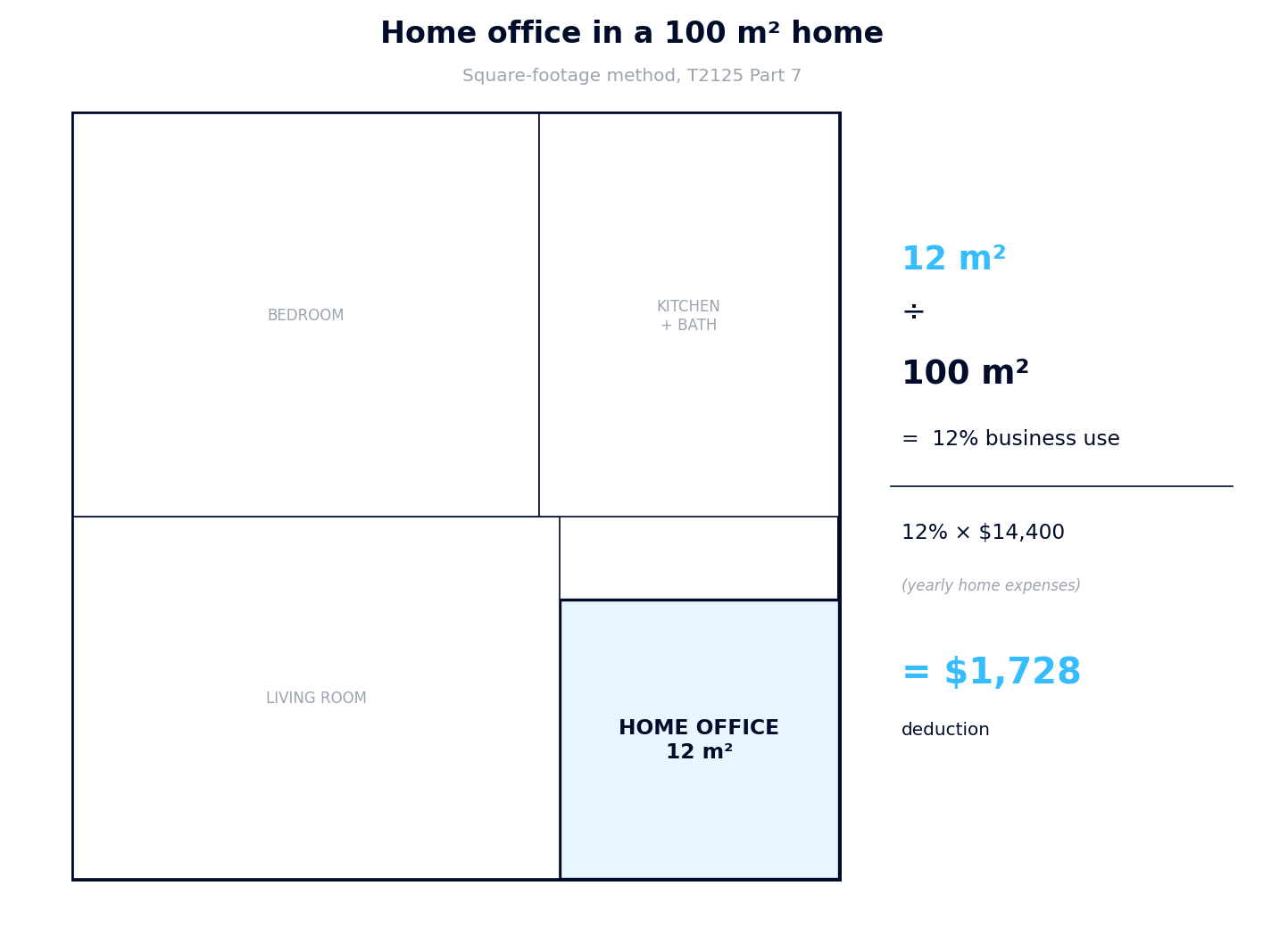
Bigger house, bigger expenses, bigger deduction. The math is the same.
What if your office is the kitchen table?
Then the math gets one extra step. If your workspace doubles as a personal space, you also multiply by hours-of-use.
Worked example. Same 12 m² area, but it's the dining room and you only use it for work 40 hours a week. 40 ÷ 168 hours in a week = 23.8%. So your business percentage is 12% × 23.8% = 2.86%. On $14,400 of home expenses, that works out to $412.
That's less than the dedicated room would get, but it's still real money for tracking something you were doing anyway.
What home expenses can you deduct?
The CRA lets you claim a proportional share of:
- Heat, hydro, water
- Home insurance (not life or disability insurance)
- Cleaning supplies and basic maintenance
- Property taxes
- Mortgage interest (not the principal portion of your payments)
- Rent, if you rent
- Snow removal and garbage
Shameless plug: Shoeboxed makes tracking these a breeze!
The CRA's official business-use-of-home page is the full reference. The deeper authority is Income Tax Folio S4-F2-C2 if you want to read the rules in full.
What if your home office expenses are bigger than your income?
Your home-office deduction can't push your business into a loss. So you only deduct what your income can absorb. The rest carries forward to next year.
Worked example. $5,000 of self-employment income. $4,500 of other business expenses. That leaves $500 of net income before home office. Your home office expenses calculate to $2,000. You can only deduct $500 this year. The remaining $1,500 carries forward to next year and offsets income then.
That carry-forward is real and useful. Track it.
Should you claim CCA on your home? (Probably not)
You can technically claim capital cost allowance (depreciation) on the business portion of your home. Most accountants will tell you not to. Here's why: it triggers capital-gains rules when you eventually sell, and that bill is often more painful than the deduction was worth.
If you're considering it, ask your accountant first. Don't DIY this one.
How is Shoeboxed going to help with this?
For our US customers, we use Smarty (an address-data API) to pull property info. Smarty doesn't cover Canada. When I went looking for a Canadian equivalent, Houski had data on 17 million Canadian properties , the deepest coverage I could find. So that's what we're building the Canadian calculator on.
Give us your Canadian address. We'll look up your home, pull the interior square metres, and walk you through this Part 7 math automatically. It ships soon. Drop your email at the bottom of the page to be first in line.
How do you claim mileage on T2125?
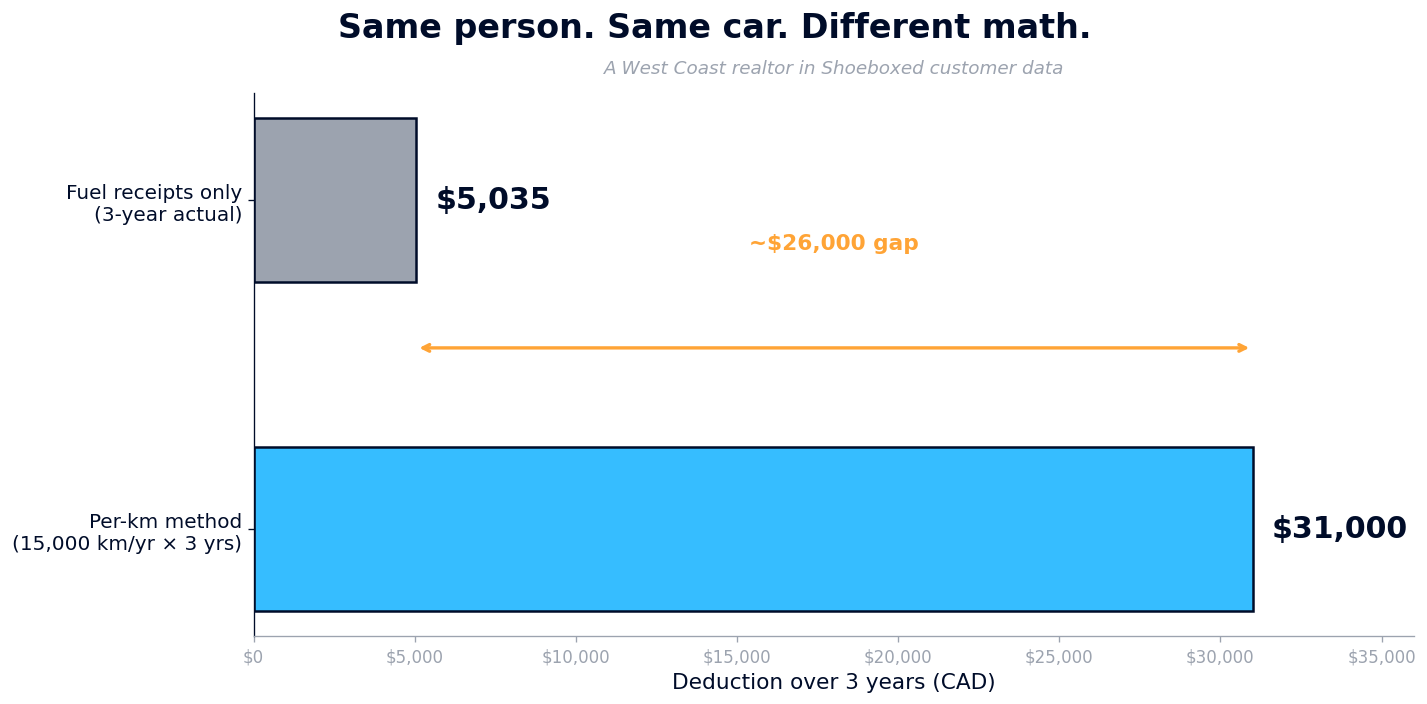
Let's take that same West Coast realtor. Over those three years she tracked $5,035 in fuel, parking, and auto receipts.
That sounds like solid tracking, and it is.
But here's the math she's competing with. A realtor doing 15,000 business kilometres a year (a normal year for someone showing properties across a metro area) claims about $10,350 with the CRA per-km method. Over three years, that's roughly $31,000.
Same person. Same car. Different math.
I don't actually know her exact kilometres. The 15,000 is a benchmark, not her data. But the gap between "track fuel only" and "track every km" is real for almost every self-employed Canadian who drives.
What are the 2026 CRA per-km rates?
| Province or Territory | First 5,000 km | Each km after |
|---|---|---|
| Provinces | $0.73 | $0.67 |
| Territories | $0.77 | $0.71 |
That's up one cent from 2025. Sources: CRA prescribed per-kilometre rates and the Department of Finance 2026 announcement.
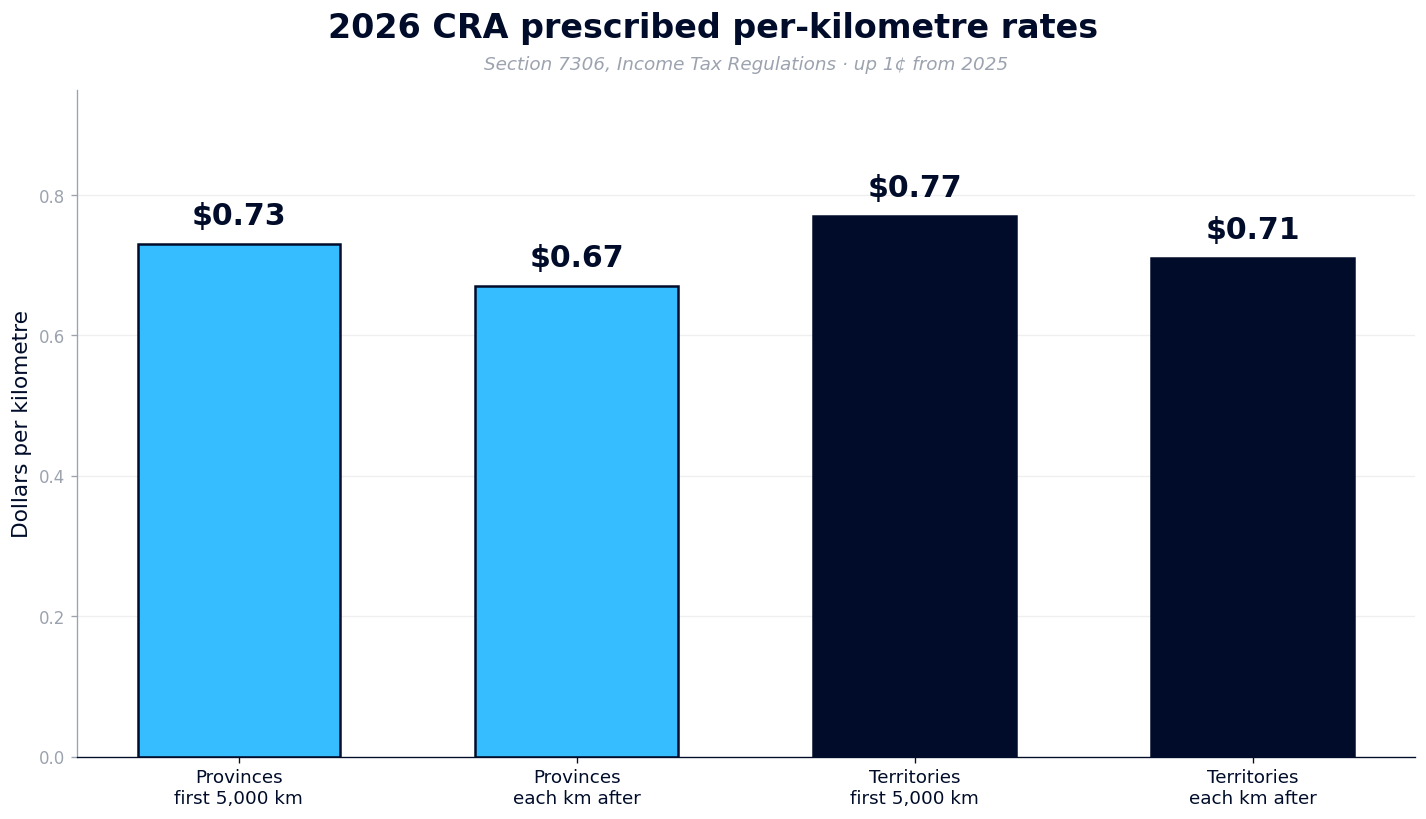
Worked example. 12,000 business km in a province: 5,000 × $0.73 + 7,000 × $0.67 = $8,340 deduction.
What about claiming actual vehicle costs?
Strictly speaking, on Part 4 you claim actual vehicle costs (gas, insurance, maintenance, lease payments, depreciation) multiplied by your business-use percentage. The per-km rate above is the practical sanity check most people use to know whether their actual-costs claim is reasonable.
Why does your mileage logbook matter so much?
Your logbook needs four things on it: the date, where you went, why, and how many kilometres. You write that down for every business trip, all year. The CRA can ask to see it, and motor vehicle expenses fail audits more often because of missing logbooks than because of bad math.
Without a logbook, your deduction is at risk no matter how clean your fuel receipts are.
How does Shoeboxed's Mileage Tracking Work?
Some apps try to auto-classify your trips with AI by reading your calendar and learning your patterns. Cool idea, but the CRA doesn't grade on a curve. A wrong AI guess becomes a wrong logbook becomes a failed audit.
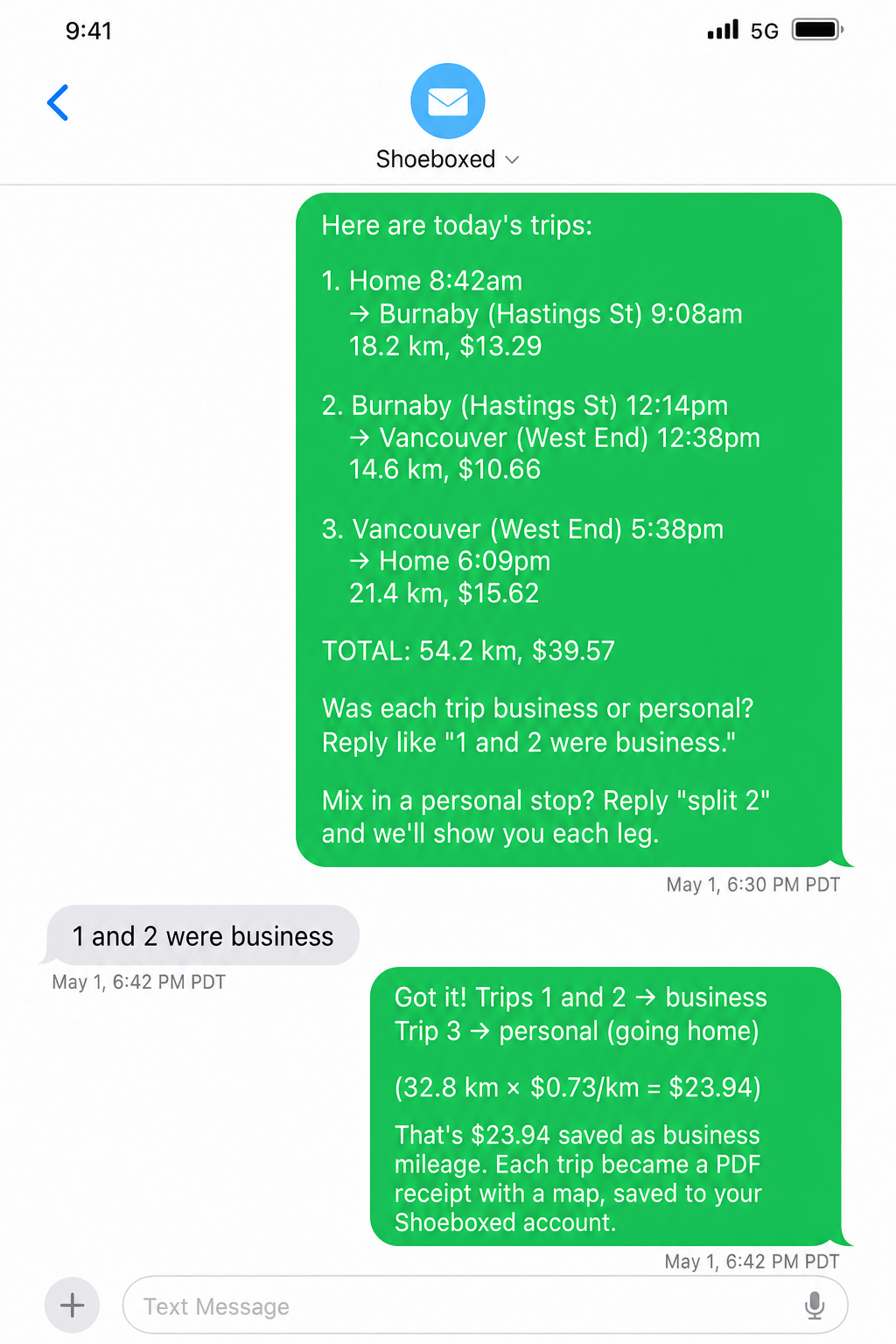
So we don't guess. We log your trips by GPS, and once a day we send you one text with all your trips listed and numbered. You reply with which ones were business, by trip number, in plain language. If a trip mixed in a personal stop, reply "split 1" and we'll show you each leg.
You get a 100%-accurate logbook because you wrote it. We just made it dead simple to write.
(One place we DO use AI: reading your reply. We use it to parse "trips 1 and 3 were business" into a proper logbook entry. The AI's job is reading your text, not guessing your life.)
What if you're a T4 employee who drives for work?
If you're a T4 employee with a signed T2200 from your boss, you claim motor vehicle expenses on Form T777, line 22900 of your T1. Same logbook. Same calculation. Just a different form.
You also get this whole mileage section.
How does Shoeboxed help Canadians today?
What works for Canadian customers today?
Receipt scanning. Snap a photo in our mobile app, or stuff a month of receipts in our prepaid Magic Envelope and drop it in the mail. We scan and categorize.
Mileage tracker. Turn on GPS tracking. Once a day we text you all your trips, numbered. You reply with which were business. Each one becomes a PDF receipt with a map, saved forever.
In that West Coast realtor's account alone, we processed $4,260 in GST/HST on receipts over three years. If you're registered for GST/HST (and at $30,000+ revenue you're required to be), that's recoverable as input tax credits.
What's coming next for Canadians?
We're launching a free home-office deduction calculator. Give us your Canadian address and we pull your home's interior square metres from Houski's data on 17 million Canadian properties. We walk you through the Part 7 math. We hand you a number you can plug into your T2125, plus a paper trail you can keep.
What we don't do
We don't file your taxes. We don't replace your accountant. We don't auto-classify your trips with AI (we ask you, by SMS).
We're the boring back office that makes the spreadsheet work. Your accountant or filing software does the actual return.
Frequently asked questions
What is a T2125 in Canada?
T2125 is the Statement of Business or Professional Activities. It's the CRA tax form where self-employed Canadians (sole proprietors and partnerships of 5 or fewer) report their business income and expenses. The result attaches to your T1 personal return on line 13500 or 13700.
What is the difference between a T4 and a T2125?
A T4 is what your employer sends you (and the CRA) to report wages they paid you. A T2125 is what you fill out to report self-employment income and expenses. You can have both in the same year, and many side-hustlers do.
Who needs to file a T2125 form?
Anyone with self-employment income: sole props, freelancers, side-hustlers, partners in a small partnership. Even unregistered side gigs.
You do NOT file a T2125 if you incorporated (you file a T2 corporate return) or if you only have employee income (just a T4).
When is T2125 due?
June 15 to file, April 30 to pay any tax owed. The CRA charges interest on unpaid tax starting May 1, even if you don't file until June 15.
Do I need to file T2125 if my business lost money?
Yes. A loss can offset other income (with limits) and starts the carry-forward clock. Skipping a loss year looks suspicious to CRA reviewers when revenue shows up the next year.
The bottom line
T2125 isn't scary once you know which parts apply to you.
The home office calculation is just division. The mileage section is a logbook and a per-km rate. The hardest part is keeping the receipts together for a year, and that's exactly what we built Shoeboxed for.
If you want to be first in line for our free Canadian home-office calculator, drop your email below. We'll let you know the moment it ships.
Doug




 4.4 / 5 on