
 Copy link


You don’t have to call Apple or wait in line to find a lost receipt. Apple emails a receipt for every purchase, and your full purchase history sits in your Apple ID account. You can pull any receipt from your computer, your phone, or your inbox in under two minutes.
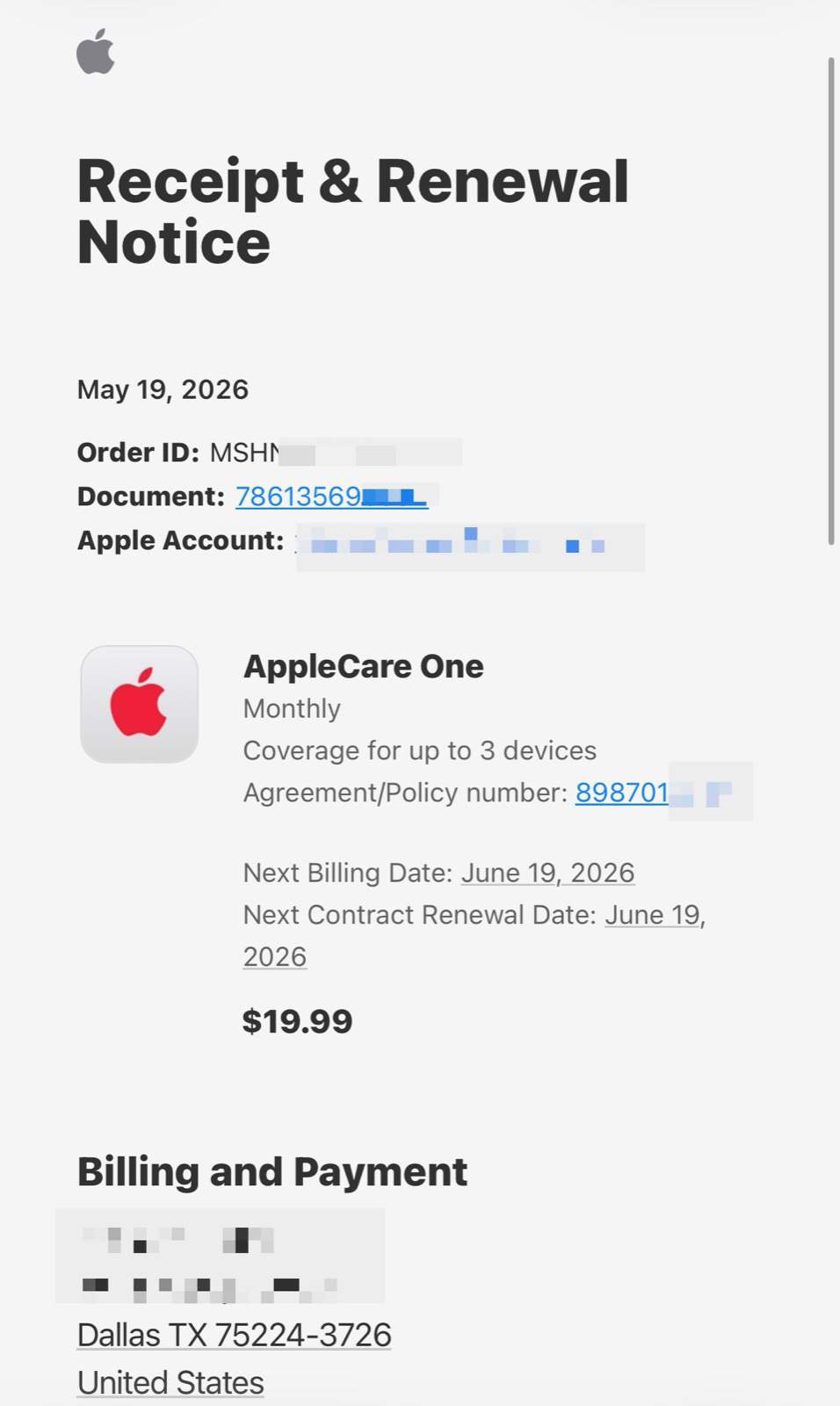
Below is the walk-through. After that, what to do with your Apple receipts if you run a small business.
How can you access your Apple purchase history?
If you need to find your Apple receipts, the best place to start is by accessing the purchase history section.
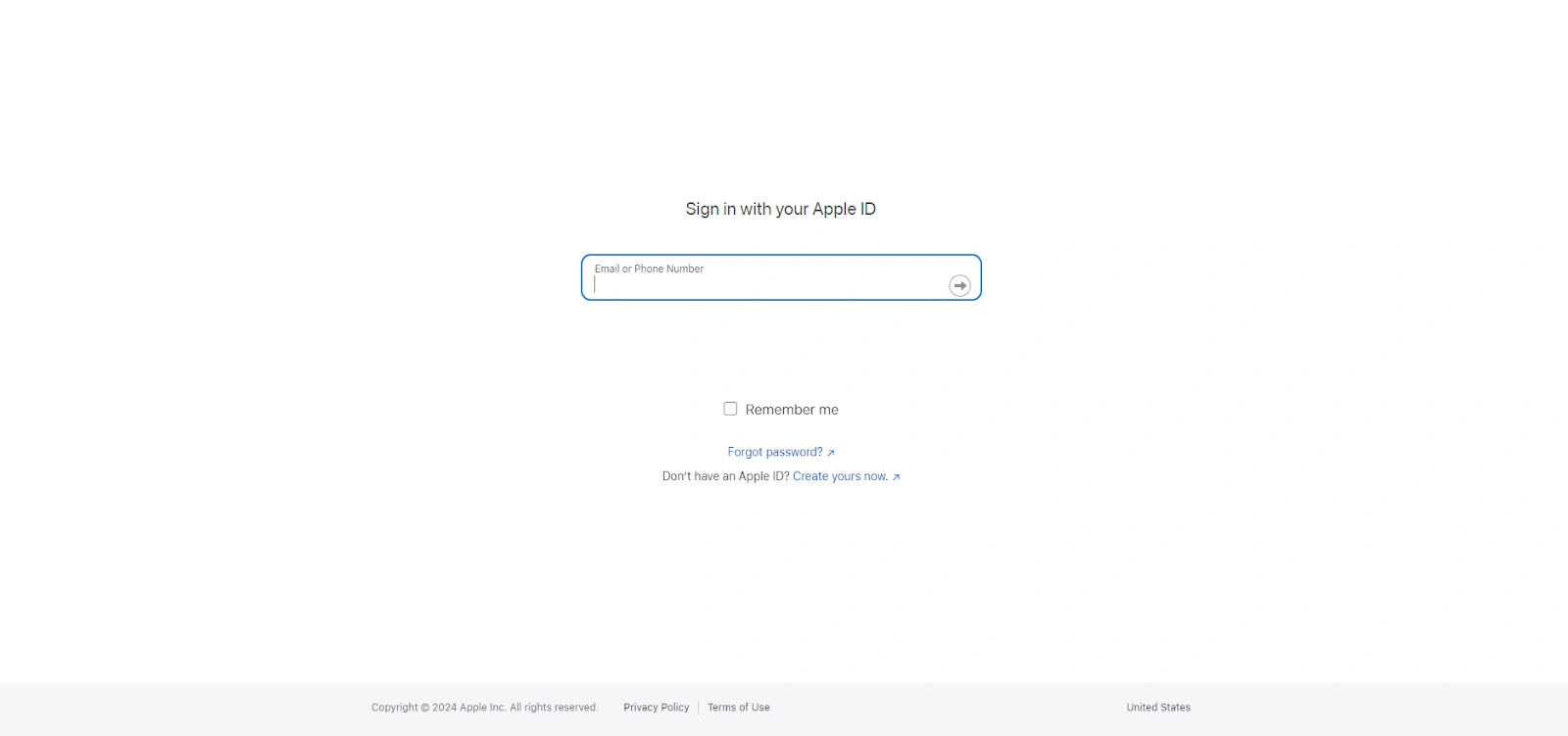
Here’s how:
1. Sign in with your Apple ID: Go to reportaproblem.apple.com and sign in with your Apple ID and password. This site will show you all your recent purchases.
2. Check purchase history in settings: You can also check your purchase history on your device through the Settings app or Account Settings. This method is useful for older purchases.
3. What to do if you can’t find your item: If you can’t find the item you’re looking for or if you find unexpected charges, Apple provides resources to help resolve these issues. Check your purchase history for in-app purchases and subscriptions from the App Store.
4. Using your Apple ID across devices: Remember, your Apple ID allows you to access your purchase history across all your devices.
How can you find an Apple receipt on your devices?
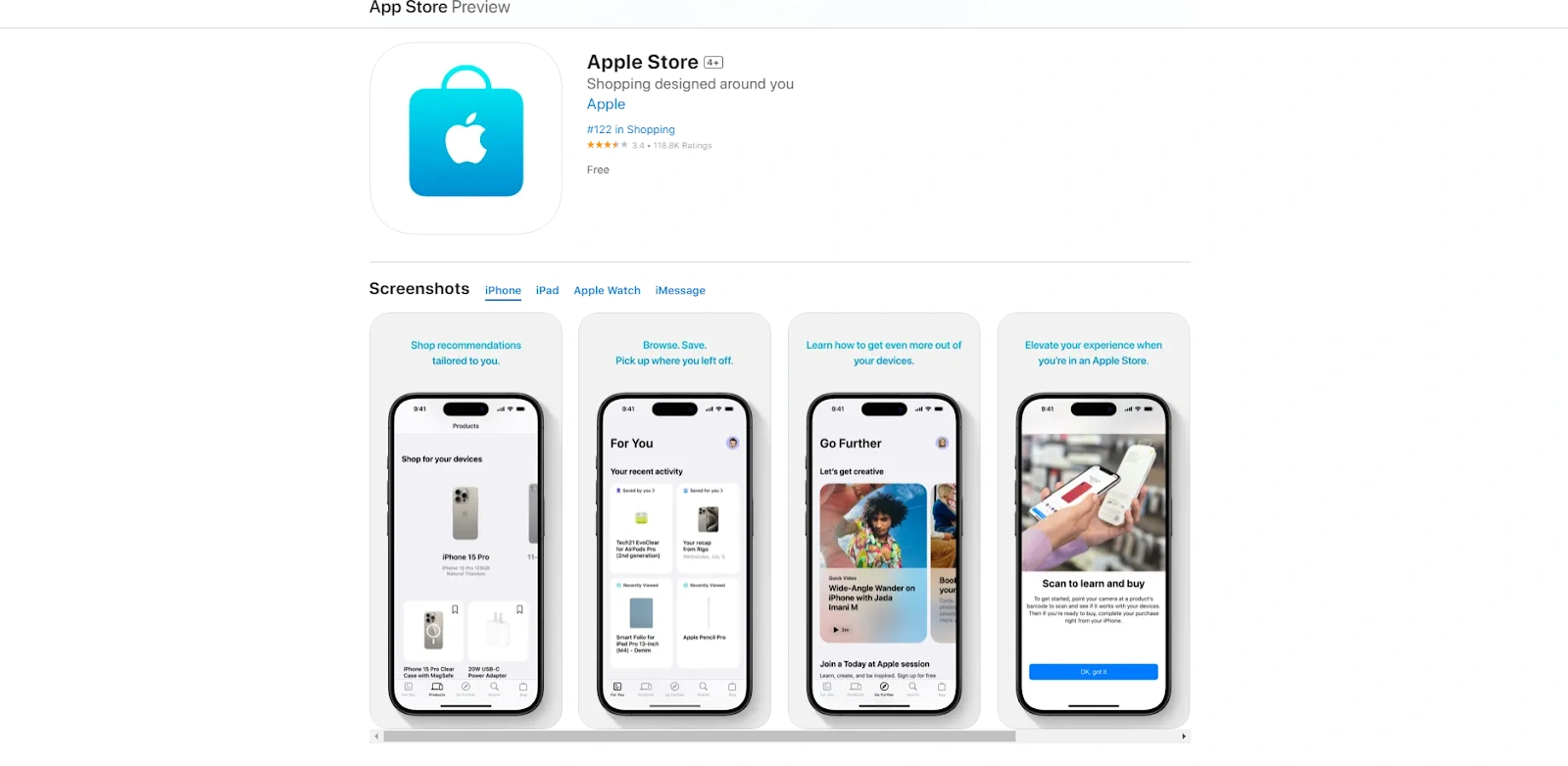
To find an Apple receipt on your devices, start by accessing the App Store app.
1. Open the App Store app: On your device, open the App Store app and tap the Sign-In button or your photo at the top of the screen.
2. Tap purchase history: You might be asked to sign in with your Apple ID again. Your purchase history will appear.
3. Filter your purchases: Tap “Last 90 days” to filter and a list of your recent purchases appears.
How can you view app store receipts via email?
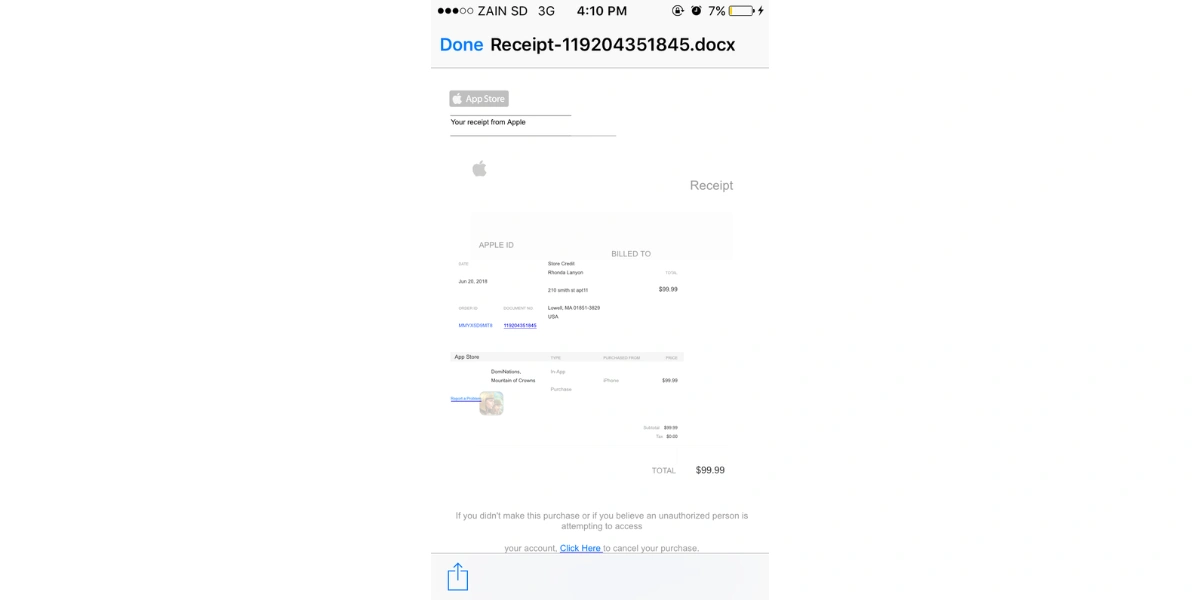
To view an Apple receipt, search your email.
Here’s how:
1. Apple email receipts: Apple sends an email receipt for every App Store purchase. If you don’t see one, check your Junk or Spam folders.
2. Search your email: Use the search function to locate the receipt. Emails are sent to the address associated with your Apple ID.
3. Resend receipt: Using the App Store app, you can also resend a receipt to your email address.
Tips and variations
Here are some tips for viewing an Apple receipt:
- Use Gmail Receipt Sync: Connect it once and every Apple confirmation email gets filed to your Shoeboxed account automatically. No forwarding, no folder digging.
- View receipts in the Music app or iTunes: You can also view your Apple receipts in the Music app or iTunes on a desktop.
- Order listing page: Go to the Order Listing page in your browser to view your Apple Store hardware orders (separate from App Store purchases).
- Auto-renewable subscriptions: View your subscription receipts in the App Store app under your account.
If you’re running a small business, the IRS expects you to save your receipts
Most people land here needing one receipt: a counter return, a client reimbursement, or a charge they don’t recognize.
But if you run a small business, get paid via 1099, or file a Schedule C, the IRS has a rule about every business-related receipt: keep it for at least three years after you file the return that includes it.
That’s from IRS Publication 583. Three years is the default, though some situations stretch to six. The IRS doesn’t care that you bought from Apple; they care that you can prove the expense was real, what it was for, and that it was for business.
Say you bought a $2,500 MacBook Pro from Apple last spring to replace the laptop you use for client work. You deducted the full $2,500 as Section 179 equipment. In 2027 or 2028, if the IRS asks, you need to pull up that Apple receipt to prove the purchase happened, what it cost, and what you bought. “Let me log into Apple and find it” works most of the time. It stops working the day you can’t find the email, you’ve switched Apple IDs, or the receipt is buried in 3 years of confirmations.
The problem isn’t one receipt today. It’s every receipt you might need three years from now.
Shoeboxed is the easy way to never lose another receipt
Snap a paper receipt with the Shoeboxed app, or mail us a shoebox of them and we scan them for you. If your receipts arrive by email, our Gmail Receipt Sync tool watches your inbox and pulls the receipt emails out automatically. We read each one for the store, the date, the total, and the expense category, then file it in your Shoeboxed account. Search by vendor or export the whole pile to your accountant at tax time. No more digging through Apple’s order history.
Since 2007, we’ve processed more than 440,000 Apple receipts. Most belong to small-business owners and 1099 contractors buying laptops, iPads, monitors, and the accessories that go with them. That’s the kind of equipment that’s fully deductible the year you buy it. After more than 440,000 of them, we know what most people miss.
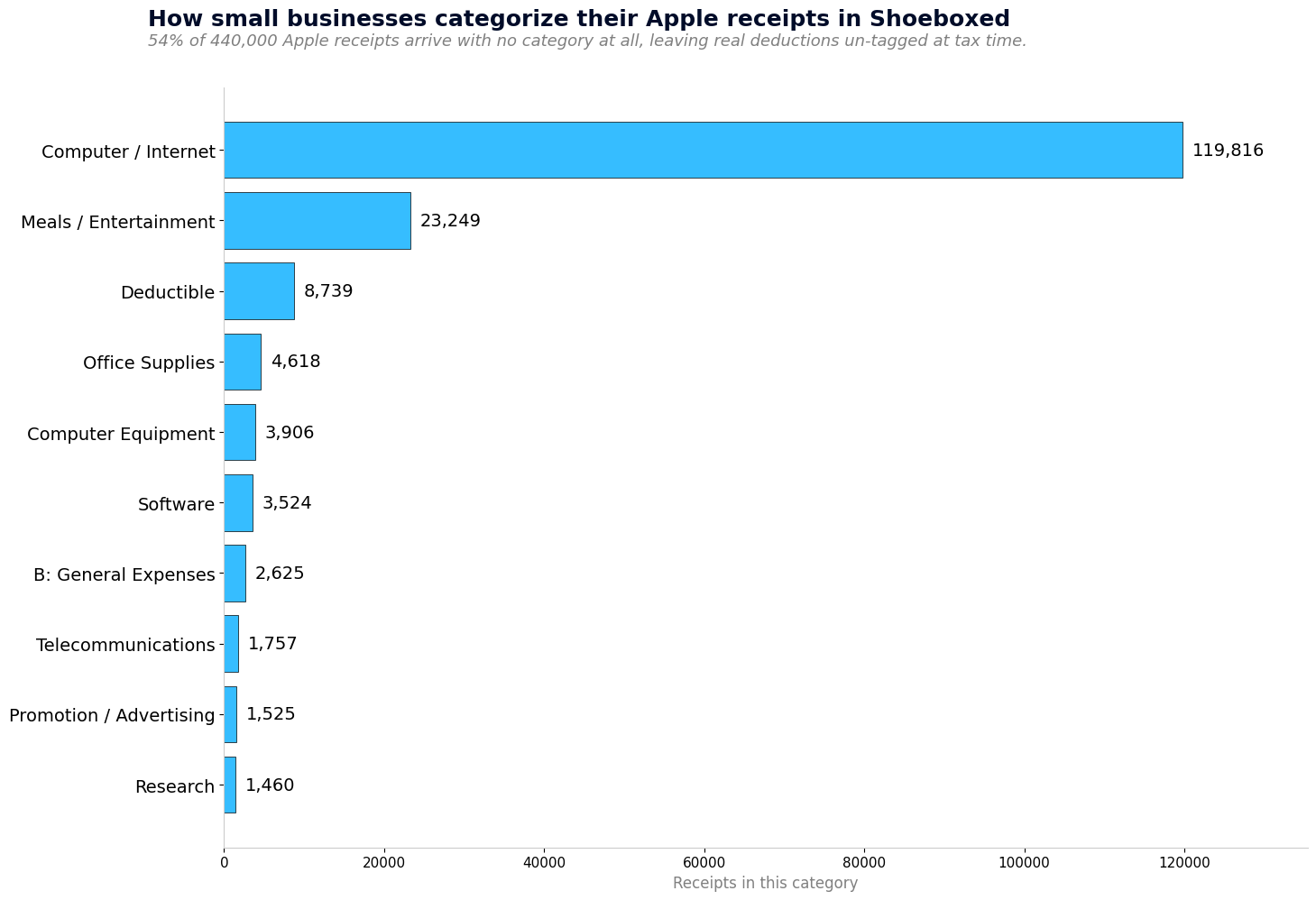
More than half of the more than 440,000 Apple receipts we’ve processed arrive with no category at all, which means the deduction never gets claimed at tax time. The receipts that do get tagged skew toward Computer/Internet, Computer Equipment, and Software, which is exactly what you’d expect from a brand whose biggest line items are MacBooks, iPads, and the accessories that go with them. Every one of those is a deduction worth tagging properly.
Two tax deductions you’re probably missing on your Apple runs
Two more deductions sit next to every Apple run, and most small-business owners miss them: the drive there (mileage), and the home office where the supplies end up.
Home office
If you work from home even part of the week, a slice of your rent or mortgage, utilities, internet, and home insurance is deductible. Anytime you buy a MacBook, iPad, Studio Display, Magic Keyboard, or AirPods at Apple for that home office, those receipts are separate deductions on top of the home office deduction itself.
You may have heard claiming a home office is an audit red flag. That hasn’t been true for years. The IRS simplified the rule in 2013 with a method that pays $5 per square foot up to 300 square feet (Pub 587), no receipts required. Take the deduction. And the chair you bought at Apple for that home office is a separate line on Schedule C, not part of the home office deduction. Two deductions, not one.
If you’ve never run the math, take two minutes with our free home office deduction calculator. It pulls your home’s square footage from your address and estimates your annual savings. No signup, no email required. Just the number.
Mileage
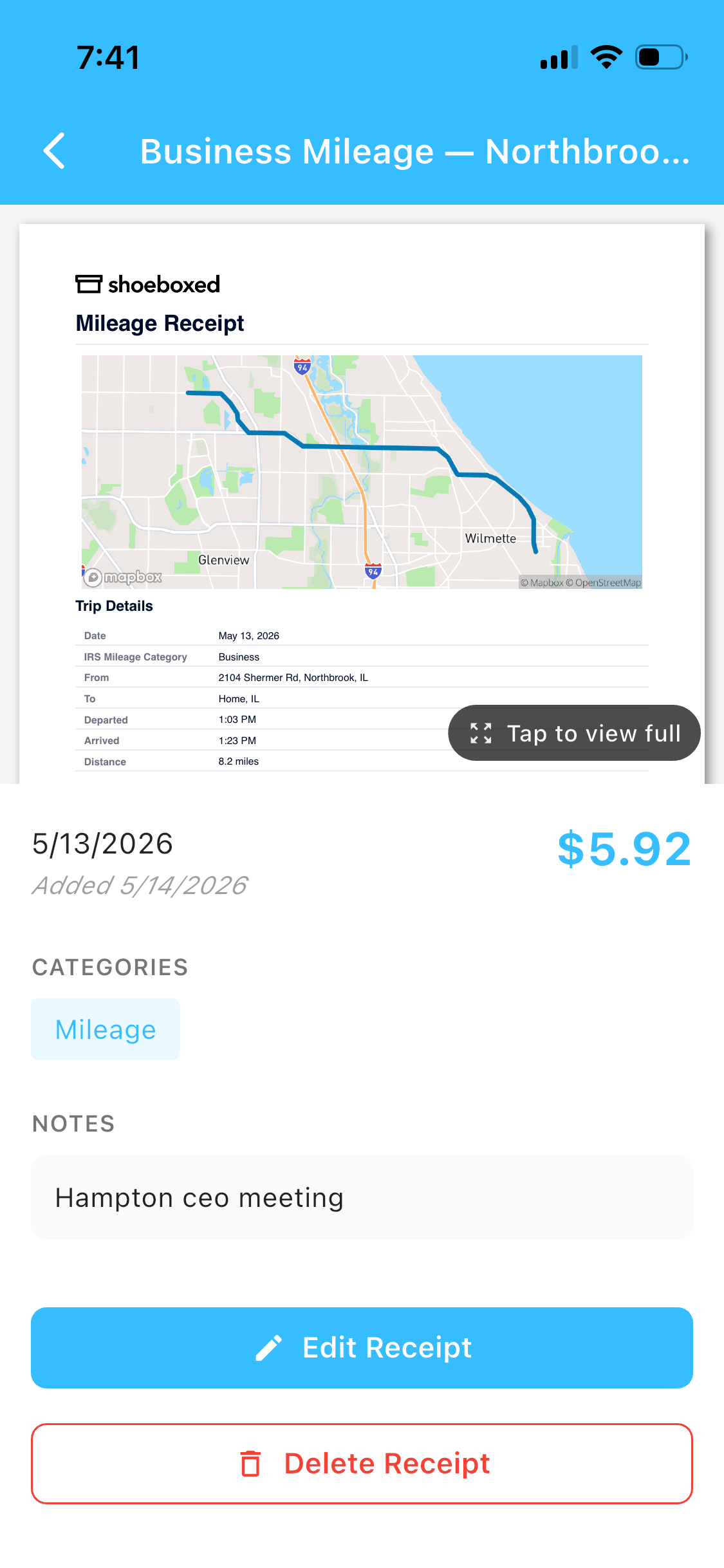
If you drove to a Apple to grab a new MacBook for client work, an iPad for site visits, or a Studio Display for the home office, that’s deductible business mileage. If you drove to a UPS Store to drop off a Apple mail-order return, that’s also deductible.
The IRS lets you deduct those drives at the 2026 standard business mileage rate of $0.725 per mile.
If you drove to a charity to drop off donated items you bought at Apple, that drive is also deductible as charity mileage. The charity mileage rate is 14¢ per mile under IRS Publication 526. It’s a different rate than business mileage, but it counts.
The Shoeboxed app uses your phone’s location to keep a quiet record of every drive in the background. At the end of each day, it texts you the list. Reply which trips were business, medical, or charity, and we save a tax-ready mileage log inside your Shoeboxed account: date, miles, IRS rate, total. When tax time comes, the document your accountant needs is already done.
Section 179 equipment
If you bought a laptop, iPad, or other equipment at Apple for business use, you can usually deduct the full purchase price in the year you bought it under Section 179. The IRS limit is high enough that most small-business equipment qualifies in full. The receipt is the only thing standing between you and that deduction at tax time.
All your options for saving receipts, honestly
Shoeboxed isn’t the only way to do this. Here’s the honest comparison.
- Shoeboxed app. Snap a pic to log a receipt. The app also tracks your drives via GPS automatically. At the end of each day we text you the trip list, you reply which ones were business, medical, or charity, and we file the mileage receipt. You get both deductions in one app, plus a tax-ready export when you need it. This is the one I’d recommend to a friend. Full disclosure: I bought the company in 2025; I was a customer for years before that.
- Shoeboxed Magic Envelope. Mail us your shoebox of paper receipts; we scan, categorize, digitize. This is the original Shoeboxed service, built for people who still get paper receipts and want them digitized without doing it themselves.
- Email-to-Shoeboxed. Apple emails a receipt for every purchase. Forward those confirmation emails to your unique Shoeboxed address, or set up Gmail Receipt Sync to grab them automatically and never think about it again.
- Paper folder or accordion file. It works, but thermal receipts fade in a year or two, paper gets lost, and good luck searching the pile when your accountant asks for a specific receipt from March 2024.
- Google Drive or Dropbox. Better than paper alone, worse than a tool built for receipts: no OCR, no categorization, no tax-ready export. You’re using a photo gallery as a filing cabinet.
- Photos on your phone. Fast and free, with the same trade-offs as Google Drive: your camera roll becomes a mess, and good luck finding the right receipt three years later.
A system you use beats a perfect one you don’t. If you’re a paper-folder person and you’ll stick to it, the paper folder is fine. Most people don’t stick with it. The Magic Envelope was invented for them.
Frequently asked questions
Can I find Apple receipts from years ago?
Yes. Apple keeps your full purchase history under your Apple ID. Go to reportaproblem.apple.com, sign in, and you can scroll back through every App Store, iTunes, and Apple Store purchase tied to that Apple ID. If you’ve switched Apple IDs over the years, you’ll need to sign in to each one to see its history.
How long do I need to keep my Apple receipts?
If you deducted the purchase as a business expense, the IRS expects you to be able to show the receipt for at least three years after you filed the return (Pub 583). Some situations stretch to six years. For a Section 179 equipment deduction on a laptop or iPad, you want that receipt in your back pocket.
How do I get a receipt for an in-store Apple Store purchase?
Apple emails the receipt to the address on file at checkout. If you can’t find the email, sign in to reportaproblem.apple.com and look up the order there. In-store purchases show up the same way as online purchases under your Apple ID.
Does Apple Pay show up as “Apple” on my Shoeboxed receipts?
Sometimes. When you use Apple Pay at a third-party merchant, the transaction normally records under the merchant’s name. But certain Apple-issued statements (Apple Card transactions, App Store auto-renewals, iCloud subscriptions) record as “Apple.” That’s why “Meals / Entertainment” shows up in the Apple categories chart above. Those are Apple Card transactions at restaurants that customers categorized.
Save the next one
The bigger win is saving the next receipt the moment you get it, so you never have to hunt again. The IRS expects small-business owners and 1099 contractors to keep these for three years. Saving them as they arrive beats hunting for them three years later.
Try Shoeboxed
Pick your platform. Both mobile apps come with a 7-day free trial. The web signup is a 30-day risk-free trial. If it doesn’t save you time, money, or both, you get your money back.


Or sign up online.
About the author. I’m Doug. I bought Shoeboxed in late 2025 with an SBA loan after fifteen years of running other people’s companies as CEO. I’d used Shoeboxed myself back in 2010 at a previous gig and called it magical even then. I use it daily now. Small business owners deserve every dollar they’re legally entitled to keep, which is why I bought Shoeboxed and work hard to make it better.




 4.4 / 5 on